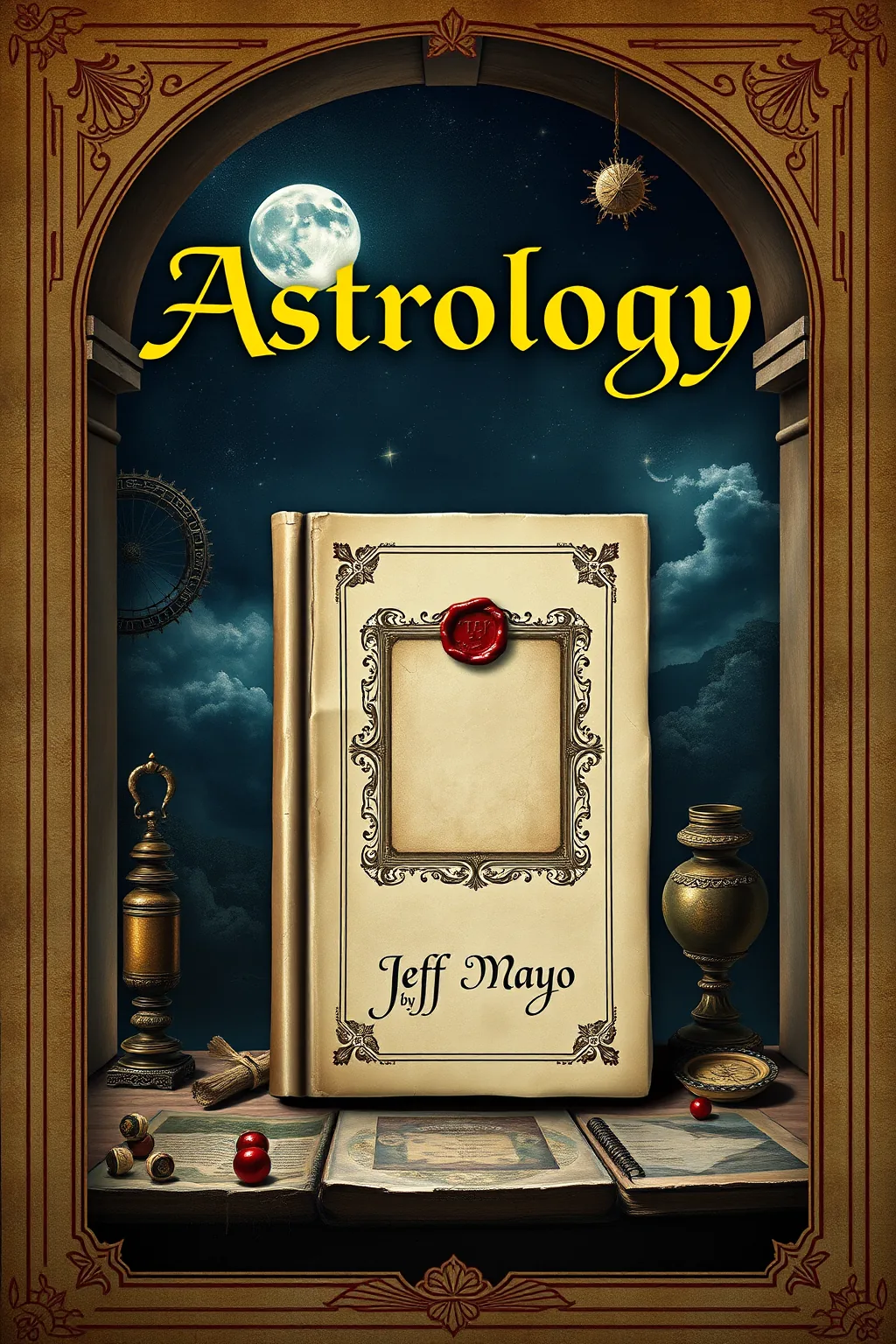
Astrology
 79
79

Astrology
Jeff Mayo’s *Astrology* presents a structured approach to a subject frequently mired in vagueness. The clarity with which the author dissects the planets, signs, and houses is commendable, particularly in the section detailing the dignities and debilities of planets, a concept often glossed over in contemporary astrological literature. This focus on traditional mechanics offers a robust framework for beginners and intermediate students alike. However, the text occasionally suffers from a dry, academic tone that may not fully capture the animating spirit of astrological practice for some. While the explanations of complex aspects are precise, the interpretative leaps required to synthesize these into a cohesive personality portrait are left largely to the reader. Despite this, the book remains a valuable reference for its systematic presentation of core astrological tenets, especially its detailed treatment of planetary rulerships.
📝 Description
79
Jeff Mayo's Astrology, published in 1992, moves beyond sun-sign basics to detail planetary placements and house systems.
First released in 1992, Jeff Mayo's Astrology offers a detailed examination of celestial interpretation. It goes beyond simple solar interpretations to explain the nuances of planetary positions, house divisions, and aspect patterns. The book breaks down the construction of a natal chart, giving readers the means to interpret an individual's cosmic map. This work is intended for serious students of esoteric subjects who want a firm grasp of astrological principles. It suits those who have moved past introductory ideas and seek a more technical and in-depth approach to chart reading. Individuals interested in the historical evolution of astrological thought will also find it valuable.
The book meticulously covers the symbolic meanings of the zodiac signs, the seven classical planets, and the twelve houses. It clarifies the importance of astrological aspects, the angular relationships between planets, and how these aspects influence and combine planetary energies. Readers will study various methods for calculating charts and the role of house rulership in understanding the dynamics of a birth chart.
Emerging in the early 1990s, a period that saw renewed interest in Western esotericism, Mayo's Astrology arrived as astrology itself experienced a shift. This era moved from generalized New Age views toward a more disciplined study of traditional astrological methods. Mayo's book aimed to present a clear, structured system for a practice often obscured by mystery. Its release coincided with increasing academic attention given to occult traditions.
💡 Why Read This Book?
• Gain a systematic understanding of planetary dignities and debilities, a core concept in traditional astrology, as detailed in the book's exploration of planetary condition. • Learn to interpret the complex interplay of astrological aspects, moving beyond simple conjunctions and oppositions to understand their nuanced effects on a natal chart. • Grasp the fundamental principles of house rulership, a critical technique for understanding how different areas of life are interconnected within an astrological framework.
⭐ Reader Reviews
Honest opinions from readers who have explored this book.
❓ Frequently Asked Questions
When was Jeff Mayo's Astrology first published?
Jeff Mayo's *Astrology* was first published in 1992, a period of renewed interest in structured esoteric studies.
What are the primary components of astrological interpretation covered in this book?
The book covers the twelve zodiac signs, the seven classical planets, the twelve houses, and the various astrological aspects, explaining their individual and combined meanings.
Does this book focus on modern psychological astrology or traditional techniques?
While not exclusively traditional, the book emphasizes a structured, systematic approach that draws heavily on foundational astrological principles and techniques.
Is Jeff Mayo's Astrology suitable for complete beginners?
It is suitable for beginners who desire a thorough, technical grounding, but it progresses beyond superficial sun-sign astrology to more complex interpretative methods.
What is a key concept discussed regarding planetary influence?
The book delves into planetary dignities and debilities, which assess a planet's strength and inherent nature based on its sign placement, a crucial element for accurate interpretation.
How does the book approach the interpretation of astrological aspects?
It systematically explains the symbolic meaning of different angular relationships between planets, such as conjunctions, squares, and trines, detailing how they modify planetary expression.
🔮 Key Themes & Symbolism
Planetary Dignities and Debilities
This work meticulously details the ancient concept of planetary dignities and debilities, a central to traditional astrological interpretation. It explains how a planet's essential nature is strengthened or weakened depending on the zodiacal sign it occupies. For instance, Mars is considered in its 'domicile' in Aries, indicating strength, while its placement in Cancer might be seen as 'detriment,' suggesting a more challenging expression. Understanding these concepts is crucial for accurately assessing a planet's influence within a natal chart, moving beyond simplistic positive or negative labels.
The Twelve Houses System
The book offers a thorough examination of the twelve houses, which represent different areas of life experience. Each house is linked to specific themes, from self-identity (1st House) and possessions (2nd House) to communication (3rd House) and home (4th House). Mayo clarifies how planetary placements within these houses, and crucially, which signs rule them, indicate where and how an individual's energies are most likely to manifest and be expressed throughout their life.
Astrological Aspects as Relationships
Mayo presents astrological aspects not merely as geometric angles but as dynamic relationships or conversations between celestial bodies. The book breaks down the meaning of major and minor aspects, explaining how they create harmony, tension, or a blend of energies. For example, a square aspect between Mars and Saturn might be interpreted as inherent conflict or discipline, requiring conscious effort to integrate. This nuanced approach highlights how aspects define the inherent patterns and challenges within an individual's psyche.
Zodiacal Sign Symbolism
The fundamental archetypes of the twelve zodiacal signs are explored in depth, moving beyond common stereotypes. Each sign is presented with its ruling planet, element, and modality, offering a framework for understanding core motivations, strengths, and potential pitfalls. The book emphasizes how these archetypal energies color the expression of planets and are activated by house placements, providing a rich symbolic language for personal introspection and understanding others.
💬 Memorable Quotes
Direct passages from the work, attributed to the author.
“Planetary dignities and debilities indicate the strength and quality of a planet's expression.”
— This highlights a core principle of traditional astrology: that a planet's inherent nature is significantly modified by its relationship to the zodiacal sign it inhabits, influencing its effectiveness.
“The houses represent the stages or departments of life.”
— This concise statement emphasizes the functional role of the astrological houses in delineating specific life arenas where planetary energies and sign qualities will play out.
“Aspects are the relationships between planets.”
— This interpretation frames astrological aspects not as abstract angles but as meaningful connections that describe how different parts of the psyche or life interact.
“Each sign carries a distinct set of symbolic meanings.”
— This underscores the importance of the zodiacal archetypes as foundational symbolic structures that color and inform all astrological interpretation.
“Understanding planetary rulership is key to chart interpretation.”
— This emphasizes the hierarchical structure within astrological interpretation, where the planet ruling a sign or house significantly influences the meaning and expression within that context.
🌙 Esoteric Significance
Tradition
This work firmly situates itself within the Western Esoteric Tradition, particularly drawing from the Hellenistic and Renaissance astrological lineages. It emphasizes a rational, structured approach to astrology, aligning with the Hermetic principles of correspondence and microcosm/macrocosm. While not explicitly Kabbalistic or Gnostic, its systematic breakdown of celestial influences and their earthly manifestations reflects the ordered cosmology found in these traditions, offering a practical framework for understanding the 'as above, so below' principle.
Symbolism
Key symbols meticulously detailed include the zodiacal signs, each representing a fundamental archetypal energy (e.g., Aries as the initiator, Cancer as the nurturer). The seven classical planets (Sun through Saturn) serve as the dynamic actors within this symbolic system, representing core psychological drives and forces. Furthermore, the twelve houses act as symbolic stages of life, providing a framework for the manifestation of planetary and zodiacal energies in concrete human experience.
Modern Relevance
Contemporary practitioners of traditional astrology, often termed 'evolutionary' or 'archetypal' astrologers, frequently reference foundational texts like Mayo's for their systematic approach. Thinkers exploring the intersection of psychology and astrology, such as certain modern psychotherapists who utilize astrological charts, can find value in its clear delineation of archetypal patterns. The work's emphasis on structured interpretation continues to inform modern astrological education and practice, particularly for those seeking to move beyond superficial readings.
👥 Who Should Read This Book
['• Students of Western Esotericism: Those seeking to understand the historical and technical underpinnings of astrological practice within a broader esoteric context.', '• Aspiring Astrologers: Individuals aiming to build a strong, foundational knowledge of planetary, sign, and house meanings before specializing.', '• Comparative Religion Scholars: Researchers interested in the symbolic systems and cosmological frameworks inherent in astrological traditions.']
📜 Historical Context
Jeff Mayo's *Astrology*, published in 1992, emerged during a period when Western esotericism was experiencing a significant revival, moving beyond the more generalized spiritualism of the late 20th century. The early 1990s saw a growing desire for more rigorous, systematic approaches to occult subjects. This era was characterized by a re-engagement with traditional astrological techniques, often in contrast to the more psychologically-oriented or New Age interpretations that had become prevalent. Mayo’s work contributed to this trend by offering a structured, clear exposition of foundational principles. It appeared at a time when scholars like Nicholas Goodrick-Clarke were documenting occult movements, and practitioners sought texts that provided a solid, less embellished understanding of core practices. The book addressed a need for clarity amidst a burgeoning field, making its systematic approach particularly relevant.
📔 Journal Prompts
The twelve houses as stages of life: How does the ruler of your 4th House influence your sense of home?
Planetary dignity: Reflect on a time your 'Mars' felt strong and unhindered, and another when it felt constrained.
Zodiacal archetypes: How does the core energy of your Sun sign manifest in your daily interactions?
Astrological aspects: Consider a challenging aspect in your chart and explore its potential for growth.
The relationship between planets: How do the energies of your Mercury and Venus seem to interact in your communication style?
🗂️ Glossary
Aspect
The angular relationship between two or more planets or sensitive points in an astrological chart, signifying how their energies interact and influence each other.
Dignity
A measure of a planet's strength and natural affinity within a specific zodiacal sign, indicating how effectively it can express its core nature.
Debility
The opposite of dignity, signifying a planet's weakness or difficulty in expressing its nature due to its placement in a zodiacal sign that is disharmonious to it.
House
One of the twelve divisions of the astrological chart, representing distinct areas or departments of life experience and activity.
Rulership
The assignment of a zodiacal sign to a specific planet, which is considered its 'home' or primary domain, influencing the interpretation of that sign and its associated house.
Zodiac
The band of the heavens containing the paths of the Sun, Moon, and planets, divided into twelve equal signs, each associated with specific symbolic meanings and archetypes.
Natal Chart
A snapshot of the celestial positions at the exact moment and location of a person's birth, used as a primary tool for astrological interpretation and self-understanding.
🔮 Readers Also Liked
Browse all →
![Animadversio astrologica: or, a discourse touching astrology. To which are added, these considerations, I. Of the mutability of sublunary beings. ... IV. The causes of several phenomena's [sic] ... By D. Irish, ... 1701](/img/thumb/animadversio-astrologica-or-a-discourse-touching-astrology-to-which-are-added-these-considerations-i-of-the-mutability-of-sublunary-beings-iv-the-causes-of-several-phenomena-s-sic-by-d-irish-1701-iris.webp)








More by Jeff Mayo
All books →


More Free Astrology & Cosmology Books
View all →