Astrology
 73
73

Astrology
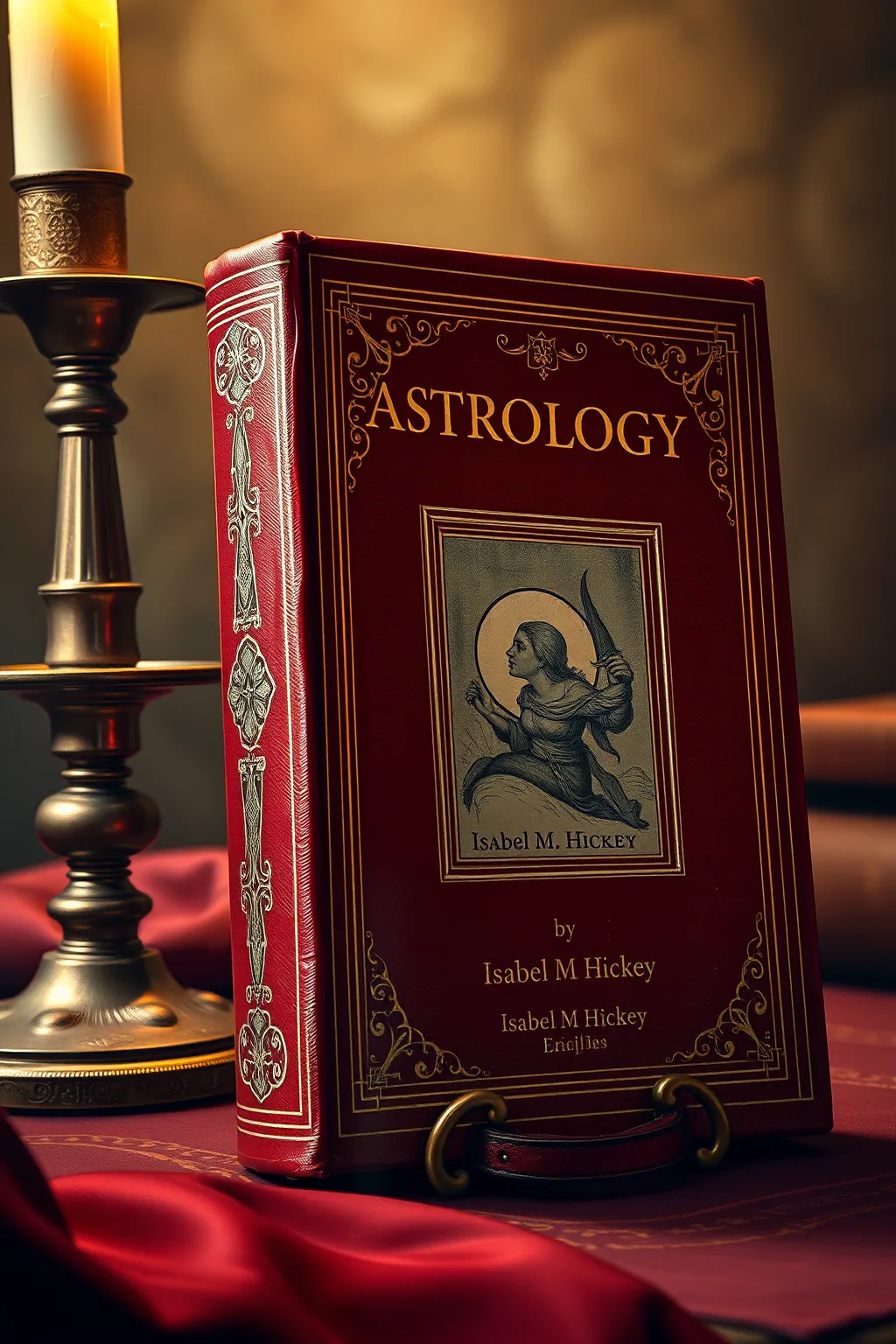
Isabel M. Hickey's "Astrology" presents a clear, if somewhat conventional, entry point into the symbolic language of the cosmos. Its strength lies in its systematic organization, breaking down the complex machinery of a natal chart into digestible parts. The explanations of planetary dignities and the houses are particularly well-articulated for a novice. However, the work can feel a bit dated, lacking the nuanced psychological depth explored by later astrological theorists. A passage discussing the Moon's influence on emotional patterns, while accurate, feels like a missed opportunity to connect more directly with contemporary psychodynamic understanding. Despite this, the book serves as a solid, reliable primer for those beginning their study.
📝 Description
73
Isabel M. Hickey's Astrology, first published in 1992, offers a systematic study of astrological principles.
This book is not a collection of horoscopes but a serious examination of astrological theory and its application to understanding human life. Hickey breaks down the elements of an astrological chart, including planetary influences, zodiac signs, and houses, showing them as parts of a larger cosmic design. The goal is to give readers the tools to read the symbolic language of the stars for personal insight and self awareness. The text is suited for students of esoteric philosophy and those at the beginner to intermediate level in astrology. It is useful for anyone wanting a structured way to learn about natal charts, planetary aspects, and the archetypal forces involved. The book will appeal to readers interested in astrology's metaphysical roots, seeing it as a path to psychological and spiritual development, not just for prediction. A curiosity for symbolism and a readiness to engage with complex ideas are beneficial.
Hickey's work appeared in the early 1990s, a time when the New Age movement's impact on esoteric thought was significant. While figures like Dane Rudhyar had already redefined psychological astrology, Hickey's book presents a more traditional yet accessible synthesis. It reflects a period of growing interest in ancient traditions, adapted for a modern audience seeking deeper meaning.
💡 Why Read This Book?
• Gain a structured understanding of natal chart components, including the 12 zodiac signs and their associated planets, enabling you to interpret basic astrological configurations. • Learn about the significance of planetary aspects, such as conjunctions and oppositions, as detailed in the text, to comprehend the dynamic interplay within a birth chart. • Explore the concept of astrological houses and their traditional meanings, as presented in Hickey's framework, to understand how celestial energies manifest in different life areas.
⭐ Reader Reviews
Honest opinions from readers who have explored this book.
❓ Frequently Asked Questions
When was Isabel M. Hickey's Astrology first published?
Isabel M. Hickey's "Astrology" was first published in 1992, offering a comprehensive guide to astrological principles for students and enthusiasts.
What is the primary focus of Hickey's Astrology book?
The book primarily focuses on the foundational elements of astrology, including planets, signs, and houses, presenting them as a system for self-understanding and interpreting natal charts.
Is this book suitable for absolute beginners in astrology?
Yes, the book is structured to guide beginners through the core concepts of astrology, making it accessible for those new to the subject.
Does the book cover modern astrological concepts?
While it presents foundational astrological concepts, it primarily focuses on established principles. It does acknowledge outer planets like Uranus, Neptune, and Pluto, which became significant in 20th-century astrology.
What distinguishes Hickey's approach to astrology?
Hickey's approach emphasizes the symbolic and psychological dimensions of astrology, viewing the birth chart as a map for personal growth and understanding karmic patterns.
Where does this book fit within the history of astrological literature?
Published in 1992, it represents a synthesis of traditional astrological knowledge adapted for a contemporary audience, following the psychological astrology developments of the mid-20th century.
🔮 Key Themes & Symbolism
The Celestial Blueprint
Hickey's "Astrology" positions the birth chart as an intricate celestial blueprint, a snapshot of the cosmos at the moment of birth. The work meticulously details how the twelve zodiac signs, the ten planets (including the outer planets that gained astrological significance in the 20th century), and the twelve houses interact. It posits that understanding these placements and their relationships (aspects) provides a symbolic map of an individual's psychological makeup, potential, and life path. The emphasis is on the chart as a guide for self-awareness rather than deterministic fate.
Planetary Archetypes and Influences
Central to the book is the exploration of planetary archetypes. Each planet is presented as embodying a distinct principle or energy, from the Sun's core identity to Saturn's lessons in structure and limitation. Hickey explains how these energies are colored by the zodiac sign they occupy and expressed through the house system. The book details these influences, encouraging readers to recognize these archetypal forces within themselves and in the unfolding of events, fostering a deeper connection to the symbolic language of the universe.
The Houses as Life Arenas
The twelve astrological houses are presented as distinct arenas of life experience. Hickey's "Astrology" breaks down what each house represents, from the self (1st House) and possessions (2nd House) to relationships (7th House) and spiritual development (12th House). The placement of planets within these houses is crucial, indicating where an individual's core energies are most likely to be activated and expressed. This framework helps readers identify specific areas of life for personal growth and potential challenges, as mapped by the stars.
Aspects: The Cosmic Dialogue
Hickey's work elucidates the concept of aspects as the angular relationships between planets in a natal chart. These connections, such as conjunctions, oppositions, and squares, are portrayed as the dynamic dialogues or tensions between different planetary energies. The book explains how these aspects create patterns of harmony, challenge, or synthesis within the psyche and life experience. Understanding aspects is presented as key to comprehending the complex interplay of forces that shape an individual's destiny and character.
💬 Memorable Quotes
Direct passages from the work, attributed to the author.
“The planets represent the forces, the signs the qualities, and the houses the conditions.”
— This concise statement captures the foundational structure of astrological interpretation as presented by Hickey. It highlights the distinct roles of each primary component of a natal chart, providing a clear mnemonic for understanding how celestial energies are filtered and expressed.
“The Ascendant signifies the door through which the soul enters the material plane.”
— This interpretation of the Ascendant, or Rising Sign, emphasizes its role as the initial point of contact between the individual consciousness and the physical world. It suggests a karmic or soul-level purpose tied to the manner in which one projects themselves and begins their earthly journey.
“Aspects are the dialogue of the planets, showing the relationship between different energies.”
— This metaphor illustrates how astrological aspects are not static placements but active communications between celestial bodies. It underscores the dynamic nature of the birth chart, where planetary influences interact and create unique patterns of psychological and life expression.
“The Midheaven indicates the highest point of achievement and public recognition.”
— This definition of the Midheaven (MC) points to its significance in understanding career aspirations, life purpose, and the culmination of one's efforts. It suggests a focus on external manifestation and the individual's place within the wider community or professional sphere.
“Every chart is a picture of the soul's journey.”
— This profound statement frames astrology as a spiritual tool. It suggests that the birth chart is not merely a description of personality but a symbolic representation of an individual's soul's evolution, past influences, and karmic path through life.
🌙 Esoteric Significance
Tradition
Hickey's "Astrology" fits within the Western Esoteric tradition, specifically drawing from the lineage of psychological and symbolic astrology that gained prominence in the 20th century. While not explicitly tied to a single lineage like Kabbalah or Gnosticism, it utilizes a symbolic language that echoes Hermetic principles of correspondence. It departs from purely predictive or fate-based astrology, aligning more with the hermeneutic approach that views the cosmos as a symbolic reflection of inner states and spiritual evolution, a hallmark of modern esoteric thought.
Symbolism
The book heavily relies on the symbolism of the twelve zodiac signs, each representing archetypal energies and personality potentials (e.g., Aries as the initiator, Cancer as the nurturer). The planets are also central symbols, representing core psychological drives and cosmic forces (e.g., Mercury for communication, Venus for attraction). The twelve houses serve as symbolic divisions of life experience, mapping where these energies are most likely to manifest, from the self to the collective unconscious.
Modern Relevance
Contemporary astrologers, particularly those focused on psychological and archetypal astrology, continue to draw upon foundational texts like Hickey's. It serves as a reliable reference for understanding the core mechanics of chart interpretation. Modern practitioners often integrate Hickey's systematic approach with more contemporary psychological theories or spiritual philosophies, using her work as a stable anchor in a field that constantly evolves with new interpretations and techniques.
👥 Who Should Read This Book
• Aspiring astrologers seeking a clear, systematic introduction to natal chart interpretation, covering planets, signs, and houses. • Students of esoteric philosophy interested in understanding the symbolic language of the cosmos as a tool for self-awareness and personal growth. • Individuals curious about the metaphysical underpinnings of astrology, looking for a text that explains the 'why' behind celestial influences, not just the 'how'.
📜 Historical Context
Isabel M. Hickey's "Astrology," first published in 1992, emerged during a period when astrological discourse was evolving rapidly. While rooted in traditional principles, it arrived after the mid-20th-century psychological astrology revolution spearheaded by figures like Dane Rudhyar and Carl Jung. The 1990s saw a continued integration of psychological depth with astrological practice, moving away from purely predictive models. Hickey's work, by offering a structured approach to planets, signs, and houses, provided a solid foundation for a generation of students. It engaged with the growing interest in esoteric studies within a broader New Age context, yet maintained a focus on systematic learning. This era also saw a diversification of esoteric thought, with various schools of Kabbalah, Hermeticism, and Eastern philosophies influencing Western esotericism, though Hickey's text primarily stayed within the Western astrological tradition.
📔 Journal Prompts
The Saturnian lessons indicated by your natal chart.
Reflect on the Moon's symbolic representation of your emotional nature.
The Jupiterian influence on your aspirations and opportunities.
Interpreting the Ascendant as the soul's entry point.
The interplay between planetary archetypes and zodiacal qualities in your chart.
🗂️ Glossary
Natal Chart
A diagram representing the positions of the Sun, Moon, planets, and astrological aspects at the exact time and place of a person's birth.
Zodiac Signs
The twelve divisions of the celestial sphere, each associated with a specific set of archetypal energies, symbols, and characteristics (e.g., Aries, Taurus, Gemini).
Planets
In astrology, celestial bodies (Sun, Moon, Mercury, Venus, Mars, Jupiter, Saturn, Uranus, Neptune, Pluto) that are considered to exert influence on human affairs and personality.
Houses
The twelve divisions of the astrological chart, representing different areas of life experience, such as self, relationships, career, and spirituality.
Aspects
The angular relationships between planets in a natal chart, indicating the nature of their interaction and influence (e.g., conjunction, opposition, square, trine).
Ascendant (Rising Sign)
The zodiac sign that was rising on the eastern horizon at the moment of birth; it represents the outward personality and initial approach to life.
Midheaven (MC)
The highest point in the astrological chart, associated with career, public image, and life direction.