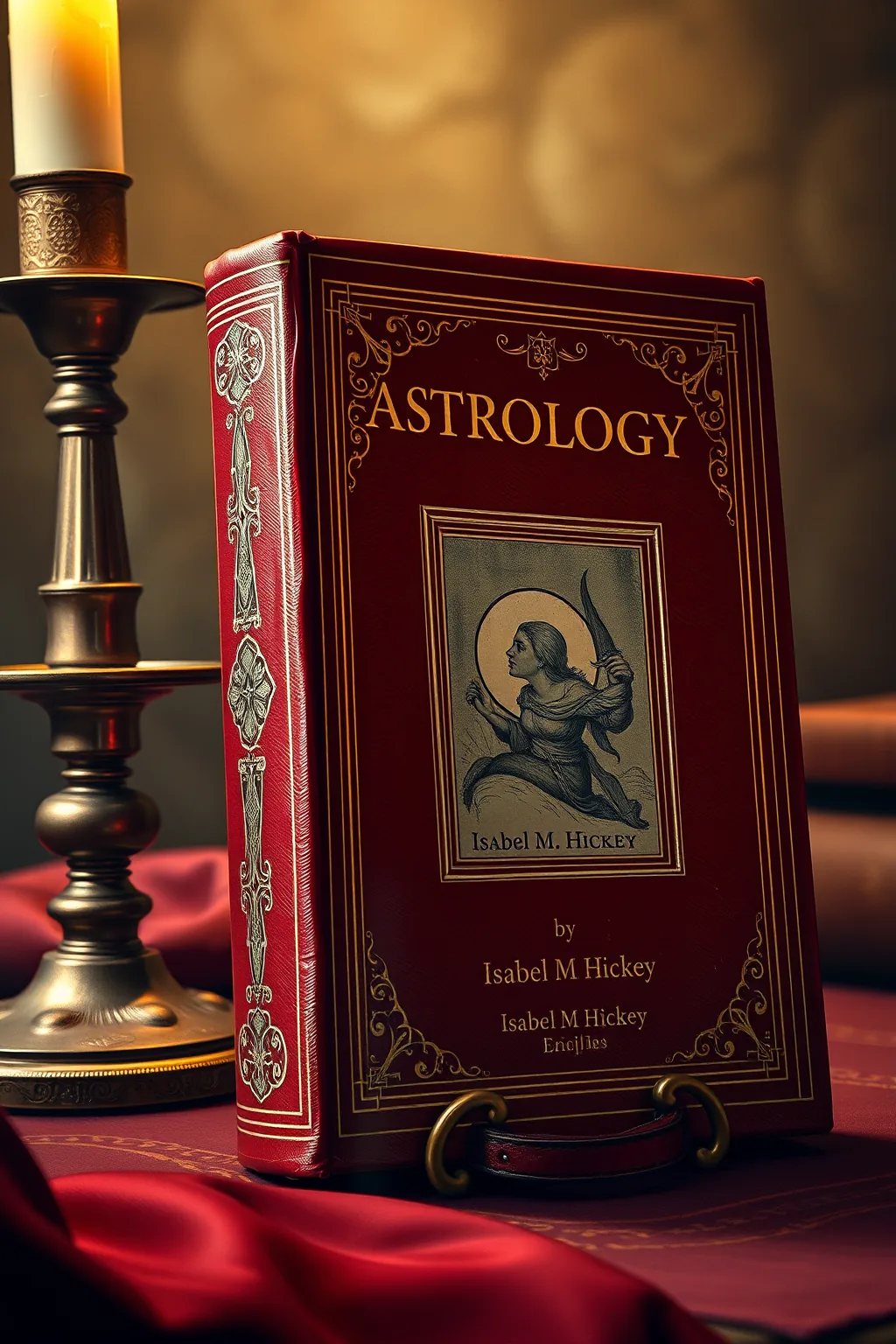
Astrology
 74
74

Astrology
Isabel M. Hickey’s Astrology is less a primer and more a philosophical treatise on the celestial art, first appearing in 1992. It stands out for its consistent emphasis on the spiritual and karmic dimensions of the birth chart, a perspective that feels particularly relevant now. Hickey navigates the complex interplay between planets, signs, and houses with a clarity that suggests a lifetime of dedicated study. A particular strength is her treatment of the Moon’s Nodes, which she frames compellingly as indicators of soul destiny and past-life patterns. However, the text can occasionally feel dense for the uninitiated; readers seeking a quick guide to basic chart interpretation might find themselves needing to consult supplementary material for foundational definitions. The work's enduring value lies in its serious, non-sensationalist approach to a subject often relegated to popular mysticism. It offers a valuable lens for understanding astrology as a profound psychological and spiritual map.
📝 Description
74
Isabel M. Hickey's Astrology, published in 1992, interprets the cosmos as a symbolic language for spiritual development.
This 1992 book presents astrology not as a simple predictive system, but as a framework for understanding human experience and spiritual growth. Hickey moves beyond basic horoscopes to examine the symbolic language of the cosmos and its relation to the soul's path. The work discusses archetypal forces that influence individual lives and collective outcomes. It is written for those who already understand astrological basics and want to explore their metaphysical foundations. Readers interested in comparative mythology, ancient traditions, and the connection between psychology and spirituality will find value here. The book is especially suited for individuals on a path of self-discovery who view celestial patterns as a guide.
Published in the early 1990s, Hickey's Astrology appeared during a revival of Western esotericism. This period saw renewed interest in Hermeticism, Kabbalah, and divination, as people sought to blend ancient practices with modern life. Hickey's work fit this context by offering a spiritual yet grounded view of astrology, differing from more superficial or predictive texts. It contributed to discussions within occult circles aiming to support esoteric knowledge using philosophical and psychological perspectives.
💡 Why Read This Book?
• Gain a unique understanding of karmic astrology and soul lessons, as Hickey details how planetary positions in your birth chart reflect past life influences and evolutionary paths, offering insights not found in generic astrological texts. • Explore the "Great Wheel" of the zodiac as a map of consciousness, learning how Hickey interprets its archetypal forces as guides for spiritual development and self-discovery, providing a metaphysical framework for personal growth. • Grasp the deeper symbolic language of the cosmos through Hickey's exploration of planets, signs, and houses as internal psychological complexes, offering a psychological and spiritual depth that moves beyond simple prediction.
⭐ Reader Reviews
Honest opinions from readers who have explored this book.
❓ Frequently Asked Questions
What is the primary focus of Isabel M. Hickey's Astrology published in 1992?
The book primarily focuses on astrology as a system for understanding spiritual development and karmic patterns, moving beyond mere prediction to explore the soul's journey and connection to universal forces.
Who is the intended audience for Hickey's Astrology?
Serious students of esoteric philosophy and those seeking a profound, metaphysical understanding of astrological symbolism are the intended audience. It appeals to readers interested in psychology, mythology, and spiritual growth.
Does Astrology by Isabel M. Hickey offer practical chart interpretation techniques?
While it provides deep symbolic interpretation, the book emphasizes the philosophical and spiritual underpinnings rather than step-by-step practical chart calculation or interpretation for beginners. It serves more as a guide to the 'why' than the 'how'.
What is the significance of the "Great Wheel" in Hickey's work?
Hickey interprets the "Great Wheel" of the zodiac as a map of consciousness, illustrating the evolutionary path of the soul and how individual lives reflect cosmic order and divine intelligence.
How does Hickey's approach to astrology differ from popular horoscopes?
Hickey distinguishes her work from popular horoscopes by focusing on the deeper, archetypal, and karmic dimensions of astrological placements, viewing them as indicators of spiritual lessons and soul evolution rather than daily fortune-telling.
When was Astrology by Isabel M. Hickey first published?
The book Astrology by Isabel M. Hickey was first published in 1992, placing it within a resurgence of interest in Western esoteric studies.
🔮 Key Themes & Symbolism
Karmic Astrology and Soul Lessons
Hickey presents a compelling framework of "karmic astrology," positing that an individual's birth chart is a blueprint detailing past-life influences and the soul's ongoing evolutionary journey. This perspective transforms astrological interpretation from a simple predictive exercise into a profound tool for self-understanding and spiritual growth. The book elucidates how planetary configurations and nodal axes, in particular, serve as indicators of karmic patterns and the lessons the soul is here to learn, encouraging a deeper engagement with one's destiny.
The Zodiac as a Map of Consciousness
Central to Hickey's thesis is the interpretation of the "Great Wheel" of the zodiac not merely as celestial divisions, but as archetypal stages in the evolution of consciousness. Each sign represents a distinct phase or quality of experience, charting a course from primal awareness to spiritual integration. This symbolic map guides the reader through the psychological and spiritual potentials inherent in each zodiacal expression, revealing how the cosmic order mirrors the inner range of the human psyche.
Planets and Houses as Inner Potentials
Hickey views the planets and houses within a birth chart as powerful representations of internal psychological complexes and spiritual capacities rather than solely external influences. The interaction between these celestial bodies and the twelve houses is explored as a dynamic interplay of inner forces that shape personality and life experiences. This approach encourages readers to look inward, recognizing the astrological chart as a symbolic mirror reflecting the soul's unique blueprint for growth and realization.
The Personal and the Universal Connection
A persistent theme in Hickey's Astrology is the profound connection between the individual horoscope and the overarching universal order. The book argues that the precise celestial configuration at birth is not random but reflects a divine intelligence and cosmic law. By understanding one's personal astrological map, individuals can better comprehend their place within the larger cosmic dance, fostering a sense of unity and purpose that transcends mundane concerns and points toward spiritual interconnectedness.
💬 Memorable Quotes
Direct passages from the work, attributed to the author.
“The birth chart is the soul's blueprint.”
— This concise statement expresses Hickey's core philosophy, suggesting that our astrological chart is not merely a snapshot of the heavens at birth but a divinely ordained map of our spiritual purpose and karmic trajectory.
“The Nodes show us where we have been and where we are going.”
— This highlights the significance of the Lunar Nodes in Hickey's system, framing them as crucial indicators of past-life patterns (South Node) and future soul growth or destiny (North Node).
“Each sign is a step on the evolutionary ladder.”
— This interpretation of the zodiac emphasizes its role as a progressive path of consciousness development, where each sign represents a distinct stage or lesson in the soul's unfolding journey.
“Astrology is the language of the soul.”
— This metaphor suggests that the symbols and patterns within astrology offer a profound, intuitive form of communication from the deepest levels of our being, guiding us toward self-awareness.
“The planets are archetypal forces within us.”
— This emphasizes the psychological dimension of astrology, presenting planets not as external entities but as fundamental aspects of human consciousness and inner drives that shape our experience.
🌙 Esoteric Significance
Tradition
Hickey's work is deeply rooted in Western Esotericism, drawing heavily from Hermetic philosophy, Pythagorean numerology, and the spiritual interpretations of astrology that have evolved through traditions like Theosophy and Anthroposophy. It aligns with the Hermetic principle of "As Above, So Below," viewing the celestial map as a direct reflection of spiritual and psychological realities. The emphasis on karma and soul evolution places it within a lineage concerned with spiritual progression and cosmic law, distinct from purely materialistic or predictive astrological schools.
Symbolism
Key symbols include the "Great Wheel" of the zodiac, interpreted as a map of consciousness and the soul's evolutionary journey. The planets are understood as potent archetypal forces and psychological complexes operating within the human psyche. The Lunar Nodes are particularly significant, symbolizing karmic connections, past-life influences (South Node), and the soul's forward trajectory or destiny (North Node), serving as focal points for understanding karmic lessons and spiritual growth.
Modern Relevance
Contemporary practitioners of psychological and evolutionary astrology, particularly those interested in karmic patterns and soul-level analysis, frequently reference Hickey's foundational concepts. Thinkers and writers exploring the intersection of consciousness studies, mythology, and spiritual psychology find her work invaluable. Her insights continue to inform modern approaches that view the birth chart as a sophisticated symbolic language for personal and spiritual development, resonating with those seeking meaning beyond superficial interpretations.
👥 Who Should Read This Book
• Students of esoteric philosophy seeking a deeper, spiritual understanding of astrological principles and their connection to karma and soul evolution. • Individuals interested in psychological astrology who wish to explore the archetypal forces and inner complexes represented by planets and zodiac signs. • Comparative religion and mythology scholars looking to understand astrology's role as a symbolic language within ancient wisdom traditions and its influence on spiritual thought.
📜 Historical Context
Isabel M. Hickey’s Astrology, first published in 1992, emerged during a period of significant revival for esoteric studies in the West. Following the popularization of astrology in the 1970s and 80s, a more serious, philosophical, and spiritual engagement with the subject gained traction. Hickey's work contributed to this by offering a deeply metaphysical and karmic perspective, distinguishing itself from the more secular or predictive approaches that often dominated popular media. It engaged with the ongoing intellectual currents seeking to reconcile ancient wisdom with modern psychology, echoing the work of figures like Dane Rudhyar who explored archetypal astrology. Unlike the astrological societies focused solely on predictive techniques, Hickey’s approach aligned with traditions emphasizing astrology as a spiritual discipline and a tool for soul evolution, fitting into a lineage that traced back to Hermetic and Neoplatonic thought.
📔 Journal Prompts
The soul's blueprint: How do the planetary archetypes described by Hickey manifest in your daily life?
Reflecting on the "Great Wheel," what stage of consciousness does your current life phase seem to represent?
Consider the symbolism of the Lunar Nodes as presented by Hickey; what past-life patterns might be influencing your current North Node pursuit?
How does the concept of "As Above, So Below" manifest in your personal experiences and your understanding of your birth chart?
Identify a planet or house interpretation from Hickey's work that challenges your current self-perception.
🗂️ Glossary
Karmic Astrology
An approach to astrology that views planetary placements and aspects in a birth chart as indicators of past-life influences, soul lessons, and the karmic patterns shaping an individual's present life.
Great Wheel
A term referring to the complete cycle of the twelve zodiac signs, interpreted here as a symbolic map of consciousness and the evolutionary journey of the soul.
Archetypal Forces
Primordial patterns of energy and consciousness, often associated with mythological figures, that are believed to influence human psychology and behavior, represented in astrology by the planets.
Lunar Nodes
The two points where the Moon's orbit intersects the ecliptic (the Sun's apparent path). In Hickey's interpretation, the North Node indicates the soul's direction of growth, and the South Node relates to past-life patterns and comfort zones.
Houses
The twelve divisions of the astrological chart, each representing a different area of life experience (e.g., self, possessions, communication, home, partnerships, spirituality).
Zodiac Signs
The twelve constellations or divisions of the ecliptic, each associated with specific symbolic qualities, energies, and archetypes that influence personality and life experiences.
Soul's Blueprint
The concept that an individual's birth chart serves as a divinely ordered map or plan for the soul's journey, outlining its purpose, challenges, and potential for growth.
🔮 Readers Also Liked
Browse all →









More by Isabel M. Hickey
All books →


More Free Astrology & Cosmology Books
View all →