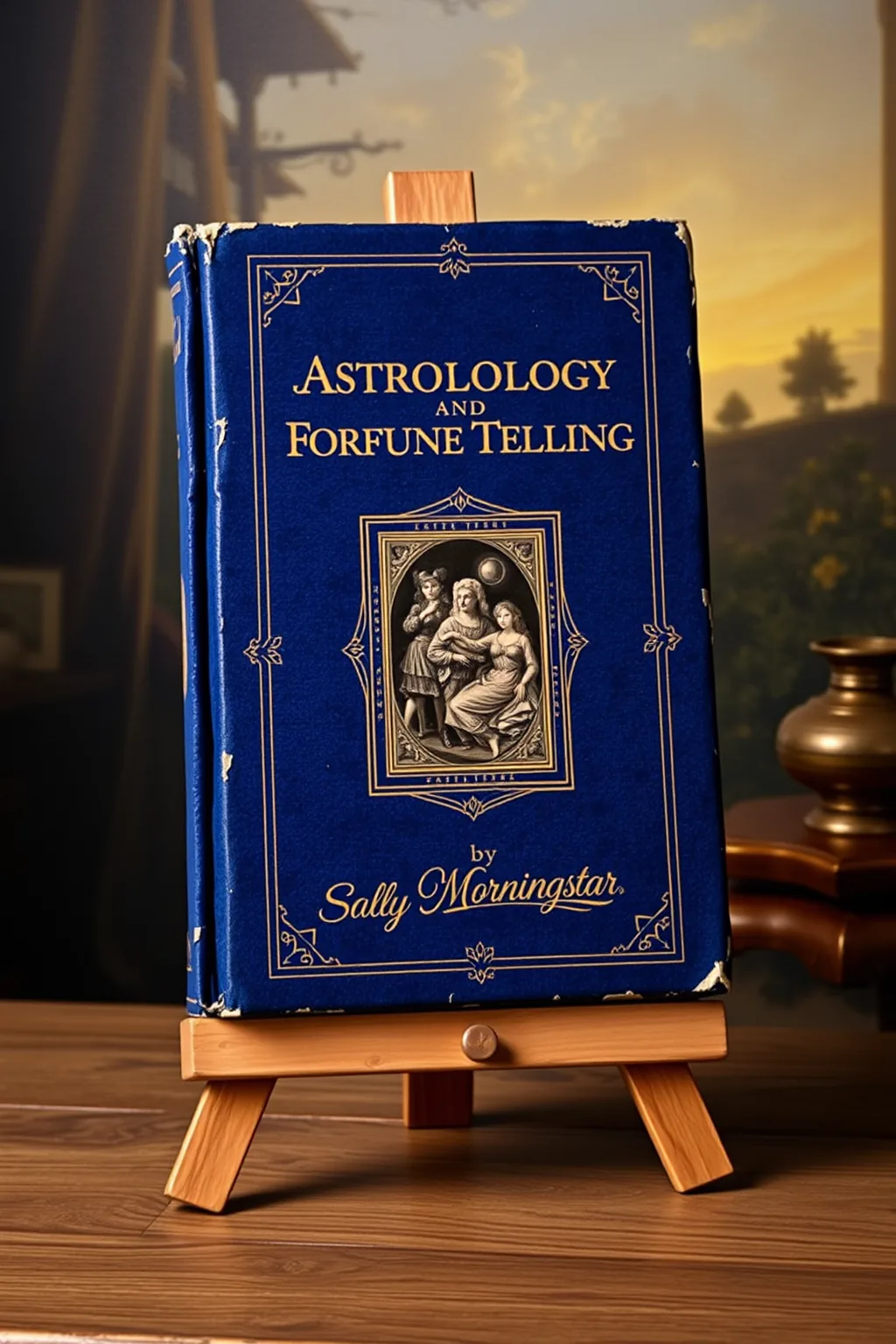
Astrology and Fortune Telling
 72
72

Astrology and Fortune Telling
Sally Morningstar’s Astrology and Fortune Telling offers a clear, if somewhat conventional, survey of divinatory practices. The book’s strength lies in its accessible breakdown of core astrological concepts, making the complex language of charts and transits understandable for newcomers. A notable passage discusses the concept of "fixed stars" and their influence, providing a concrete example of how celestial bodies beyond the traditional planets are integrated into astrological frameworks. However, the work’s exploration of non-astrological fortune-telling methods feels less developed, sometimes bordering on superficial. While informative, it doesn't always push beyond established narratives of these arts. Ultimately, it serves as a solid, if not revolutionary, primer for those beginning their journey into esoteric prediction.
📝 Description
72
Sally Morningstar's "Astrology and Fortune Telling" was published in 2012.
This book examines divinatory arts, detailing their history and practical use. Morningstar covers various methods, from reading the stars to other predictive systems, aiming to clarify these practices for modern readers. The author presents astrology not just as a way to forecast events, but as a structure for understanding personality and cosmic connections.
The work is suitable for anyone interested in the history and workings of fortune-telling traditions. It offers a clear introduction to astrological principles and related divinatory arts, providing a solid basis for further learning. Both those starting out and those with doubts will find its balanced perspective useful.
Morningstar traces the development of astrological thought from ancient Mesopotamia and Egypt through Greece and medieval Europe. These practices are placed within broader intellectual contexts, including Hermeticism and occult science revivals during the Renaissance and the late 19th century. The book notes how these traditions often existed alongside, and sometimes conflicted with, prevailing religious and scientific views of their times.
This book situates astrology and fortune-telling within a long tradition of seeking meaning through cosmic correspondences. It acknowledges the historical interplay between these practices and various philosophical and religious systems, from ancient Mesopotamian cosmology to Renaissance Hermeticism. By discussing concepts like planetary rulerships and zodiacal signs, Morningstar connects modern interpretations to older methods of understanding human personality and life patterns through celestial observation.
💡 Why Read This Book?
• Gain a foundational understanding of astrological components like zodiac signs, planetary rulerships, and houses, as detailed in the book's sections on natal charts, enabling you to interpret basic astrological configurations. • Explore the historical trajectory of divinatory arts from ancient Mesopotamia to the modern era, appreciating the cultural and intellectual shifts that shaped their reception and practice. • Understand the symbolic language of celestial bodies and their interpreted influences, as presented through the book's explanations of aspects and planetary positions, fostering a nuanced view of cosmic correspondence.
⭐ Reader Reviews
Honest opinions from readers who have explored this book.
❓ Frequently Asked Questions
When was Astrology and Fortune Telling first published?
Astrology and Fortune Telling by Sally Morningstar was first published in 2016. This edition provides a contemporary perspective on historical divinatory practices.
Does the book cover different types of fortune telling beyond astrology?
Yes, the book explores various divinatory arts, comparing their philosophies and symbolic languages alongside its primary focus on astrology, offering a broader view of predictive traditions.
What are the core astrological concepts discussed in the book?
The book details fundamental astrological concepts including planetary rulerships, zodiacal signs, houses, and aspects, which are essential for understanding natal charts and astrological interpretation.
Is the book suitable for complete beginners in esotericism?
Absolutely. The book is structured to demystify complex practices, making it an accessible starting point for individuals new to astrology and other fortune-telling traditions.
Does Sally Morningstar offer practical exercises or just theory?
While primarily informative, the book's explanations of astrological principles are designed to equip readers for practical interpretation, encouraging a deeper engagement with natal charts and cosmic influences.
What historical periods are covered in the discussion of divination?
The book traces the evolution of astrological thought from ancient Mesopotamia and Egypt through Hellenistic Greece and into medieval Europe, contextualizing its development within broader intellectual history.
🔮 Key Themes & Symbolism
Celestial Mechanics and Interpretation
The work dissects the fundamental mechanics of Western astrology, detailing how zodiac signs, planetary positions, houses, and aspects are calculated and interpreted. It explains the correspondence between celestial events and terrestrial occurrences, presenting a framework for understanding personality archetypes and life path potentials through the lens of a natal chart. The book emphasizes that astrology offers a symbolic language for exploring human experience within a cosmic context.
The Art of Prediction
Beyond natal astrology, the book examines various methods employed in fortune-telling, presenting them as systems designed to provide insight into future probabilities and challenges. It discusses techniques for forecasting, such as transits and progressions, and contrasts them with other divinatory tools. The emphasis is on understanding these practices as tools for guidance and self-reflection rather than deterministic prophecies.
Historical and Cultural Roots
Morningstar situates the practice of astrology and fortune-telling within a broad historical and cultural landscape, tracing its lineage from ancient civilizations through various epochs. It highlights how these practices interacted with philosophical movements like Hermeticism and faced scrutiny from religious and scientific establishments. This provides context for understanding the enduring human impulse to seek meaning through divination.
Symbolism and Archetypes
A core theme is the rich symbolic language inherent in astrological and divinatory systems. The book explores how planets, signs, and constellations are imbued with archetypal meanings that reflect universal human experiences and psychological patterns. It presents these symbols not as arbitrary signs but as a coherent symbolic grammar for interpreting life's events and individual destinies.
💬 Memorable Quotes
Direct passages from the work, attributed to the author.
“Planetary positions at birth offer a blueprint of potential, not a rigid destiny.”
— This interpretation highlights the book's nuanced view of astrology, presenting it as a tool for understanding innate tendencies and possibilities rather than a fixed, unavoidable fate.
“Understanding aspects reveals the dynamic interplay between different facets of the psyche.”
— This interpretation emphasizes the book's focus on astrological aspects as indicators of internal relationships and potential conflicts or harmonies within an individual's psychological makeup.
“Divination provides a framework for navigating life's uncertainties with greater awareness.”
— This concept suggests the book views fortune-telling practices not as absolute predictions but as methods for gaining perspective and making more informed choices amidst life's unpredictable nature.
“Ancient Mesopotamian astronomers laid foundational groundwork for celestial interpretation.”
— This interpretation points to the book's historical grounding, acknowledging the origins of astrology in early astronomical observation and interpretation by ancient civilizations.
💡 Key Ideas
Editorial paraphrase of the work's core concepts — not direct quotes.
The zodiac is a circle of symbolic archetypes representing fundamental human drives.
This paraphrased concept underscores the book's approach to the zodiac as a psychological and symbolic map, connecting celestial divisions to universal human energies and motivations.
🌙 Esoteric Significance
Tradition
This work fits within the broader Hermetic and Neoplatonic traditions, which view the cosmos as a divinely ordered system with correspondences between the celestial and terrestrial realms. It draws upon the Western esoteric lineage that interprets astrology not just as a predictive tool but as a symbolic language reflecting universal principles and human psychology. While not overtly Kabbalistic or Gnostic, it shares the Hermetic emphasis on "as above, so below."
Symbolism
Key symbols include the twelve zodiac signs, each representing a distinct archetypal energy or developmental stage, and the planets, seen as personifications of core psychological drives and cosmic forces. The book also explains the symbolism of the twelve houses, which represent different areas of life experience, and aspects, which denote the relationships and interactions between these celestial energies.
Modern Relevance
Contemporary practitioners of psychological astrology, self-help gurus, and even certain schools of modern paganism draw on the foundational principles presented in works like this. Thinkers who explore archetypal psychology or narrative therapy sometimes find parallels in the symbolic language of astrology for understanding personal narratives and developmental arcs.
👥 Who Should Read This Book
['• Students of Western Esotericism: Those seeking to understand the historical and symbolic underpinnings of astrological practices within a recognized esoteric lineage.', '• Aspiring Astrologers: Individuals new to chart interpretation who need a clear, foundational text explaining core concepts like signs, planets, houses, and aspects.', '• Comparative Religion and Mythology Enthusiasts: Readers interested in exploring the cross-cultural and historical development of divination and its role in human societies.']
📜 Historical Context
Published in 2016, Sally Morningstar's Astrology and Fortune Telling emerges in an era of renewed popular interest in esoteric practices, often fueled by online platforms and a desire for personalized meaning. This contemporary resurgence contrasts with earlier periods, such as the height of the Enlightenment, when astrology was largely dismissed by scientific rationalism, and the late 19th-century occult revival, which saw figures like Helena Blavatsky and the Theosophical Society re-examine and synthesize ancient traditions. Morningstar's work implicitly engages with this legacy, offering a modern synthesis that is more accessible than scholarly treatises but more structured than casual online horoscopes. The book arrives at a time when comparative mythology and psychology, particularly Jungian archetypes, are often used to interpret astrological symbolism, a trend that differentiates it from purely predictive systems favored in earlier centuries.
📔 Journal Prompts
Reflect on the symbolism of your Sun, Moon, and Ascendant signs as described in the book.
Consider the historical evolution of astrological interpretation from ancient Mesopotamia to the present day.
Analyze the concept of planetary rulerships in relation to personal strengths and challenges.
How do the described archetypes of the zodiac signs manifest in your daily interactions?
Evaluate the book's perspective on the relationship between fate and free will within astrological frameworks.
🗂️ Glossary
Natal Chart
A symbolic map of the heavens at the precise moment and location of an individual's birth, used as a primary tool for astrological interpretation and self-understanding.
Zodiac Signs
The twelve divisions of the ecliptic, each associated with a specific set of archetypal energies, symbols, and characteristics that influence personality and life events.
Planetary Rulerships
The assignment of specific zodiac signs to the planets that are considered to 'rule' them, indicating a natural affinity and influence between the planet's energy and the sign's domain.
Houses
The twelve divisions of the astrological chart, representing distinct areas of life experience, such as self, finances, communication, home, and career.
Aspects
The angular relationships between planets in an astrological chart, indicating how their energies interact, creating harmony, tension, or a combination thereof.
Hermeticism
An ancient philosophical and religious tradition based on the purported teachings of Hermes Trismegistus, emphasizing divine wisdom, magic, and the principle of "as above, so below."
Fixed Stars
Stars with a seemingly unchanging position relative to the ecliptic, distinct from the wandering planets, whose influence is sometimes incorporated into astrological interpretations.
🔮 Readers Also Liked
Browse all →









More by Sally Morningstar
All books →





More Free Divination & Tarot Books
View all →