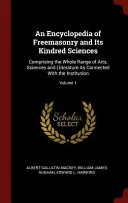
An Encyclopedia of Freemasonry and Its Kindred Sciences: Comprising the Whole Range of Arts, Sciences and Lliterature as Connected with the Institutio
 81
81

An Encyclopedia of Freemasonry and Its Kindred Sciences: Comprising the Whole Range of Arts, Sciences and Lliterature as Connected with the Institutio
The sheer breadth of "An Encyclopedia of Freemasonry and Its Kindred Sciences" is its most striking feature. Mackey and his collaborators have amassed an astonishing array of information, attempting to contextualize Masonic knowledge within a wider intellectual and historical framework. Its value lies in its encyclopedic nature, presenting a vast amount of material in a structured, albeit dense, format. However, the work’s age and its reproduction from original artifacts, while preserving authenticity, can make for challenging reading; the prose and organizational style reflect an earlier era of scholarship. A particularly illustrative section details the symbolic meaning of the Square and Compasses, linking it to ancient geometries and moral philosophy. The limitation is that it assumes a significant prior familiarity with Masonic terminology and concepts, offering less of a guided entry for absolute novices.
This is a reference work for the dedicated, not an introductory primer.
📝 Description
81
First published in 1873, Mackey's Encyclopedia details Freemasonry and related sciences.
Albert Gallatin Mackey's An Encyclopedia of Freemasonry and Its Kindred Sciences, first compiled in its present form with contributions from William James Hughan and Edward L. Hawkins, serves as a detailed reference for the arts, sciences, and literature connected to the Masonic institution. The work aims to preserve and present knowledge considered significant to civilization's intellectual history. Its meticulous reproduction from original artifacts, including copyright notices and library stamps, ensures historical accuracy and integrity.
This volume is intended for serious students of Freemasonry, offering in depth examinations of its history, philosophy, and symbolism. Researchers of esoteric traditions, secret societies, and comparative religion will find it a valuable resource, providing a unique perspective on the links between various knowledge systems. Collectors of rare occult literature and historians will also appreciate its inclusion in their archives.
This encyclopedia situates Freemasonry within a broader context of esoteric thought, examining its connections to ancient mysteries and practices like alchemy and Kabbalah. It details the symbolic language and philosophical tenets that underpin Masonic ritual and teaching. The work illuminates the 'kindred sciences' that have historically informed the Craft, presenting a systematic look at its esoteric underpinnings.
💡 Why Read This Book?
• Gain a comprehensive understanding of Masonic symbolism and philosophy by exploring specific allegorical narratives discussed in sections related to ritual degrees, offering insights not readily available in general esoteric texts. • Understand Freemasonry's historical connections to broader intellectual movements by examining its relationship with alchemy and Kabbalah, as detailed in the work's exploration of kindred sciences. • Appreciate the evolution of Masonic scholarship through the contributions of figures like Albert Gallatin Mackey, referenced in the publication's collaborative authorship, providing historical context for its specific interpretations.
⭐ Reader Reviews
Honest opinions from readers who have explored this book.
❓ Frequently Asked Questions
What is the primary focus of "An Encyclopedia of Freemasonry and Its Kindred Sciences"?
The primary focus is a comprehensive exploration of Freemasonry, encompassing its history, philosophy, rituals, and its connections to various arts, sciences, and esoteric traditions, aiming to be a definitive reference.
Who were the main contributors to this encyclopedia?
Key contributors include Albert Gallatin Mackey, a prominent Masonic scholar, alongside William James Hughan and Edward L. Hawkins, whose work collectively shaped this extensive compilation.
Is this book suitable for someone new to Freemasonry?
While comprehensive, the book's depth and reliance on established Masonic concepts might be challenging for absolute beginners. It is better suited for those with some foundational knowledge or serious researchers.
What does 'Kindred Sciences' refer to in the title?
'Kindred Sciences' refers to disciplines and fields of knowledge, such as alchemy, Kabbalah, geometry, and ancient philosophy, that have historically influenced or been influenced by Masonic thought and symbolism.
Why are original copyright and library notations present in the reproduction?
These notations are intentionally preserved to maintain the artifact's historical authenticity, reflecting its journey through important libraries and its status as a reproduced public domain work.
What is the significance of the 2015-08-08 publication date?
The 2015-08-08 date likely refers to the specific edition's publication or re-release, making it accessible in its current scholarly format, though the content itself is based on earlier Masonic literature.
🔮 Key Themes & Symbolism
Masonic Philosophy and Symbolism
The encyclopedia systematically dissects the philosophical underpinnings of Freemasonry, treating its rituals and symbols not merely as ceremonial elements but as a complex language of moral and spiritual instruction. It explores concepts like the Great Architect of the Universe and the symbolic tools of operative masons, interpreting their deeper esoteric meanings. This detailed examination reveals how Masonic teachings aim to guide the individual toward self-improvement and enlightenment, drawing parallels with ancient mystery schools.
Esoteric Connections
A central theme is the intricate web connecting Freemasonry to a constellation of esoteric disciplines. The work maps out influences from Hermeticism, Kabbalah, Pythagoreanism, and even alchemy, presenting them as integral to the Craft's development and symbolic richness. It argues that understanding these 'kindred sciences' is crucial for a complete apprehension of Masonic lore, positioning the fraternity as a nexus of diverse spiritual and intellectual currents throughout history.
Historical and Cultural Significance
The encyclopedia functions as a historical document in itself, reflecting the state of Masonic scholarship during its formative periods and its re-emergence in modern editions. It highlights Freemasonry's role in the broader cultural landscape, discussing its influence on art, literature, and philosophical discourse. By tracing the lineage of Masonic ideas and practices, the work underscores its enduring impact on Western civilization and esoteric thought.
The Art and Science of Institution Building
Beyond ritual and symbolism, the work examines the structural and organizational aspects of Freemasonry, treating its 'Institutio' as a subject of study. It examines how Masonic lodges function as centers for learning, moral development, and the preservation of esoteric knowledge. The encyclopedia implicitly analyzes the principles of institutional longevity and the transmission of complex traditions across generations.
💬 Memorable Quotes
Direct passages from the work, attributed to the author.
“The ceremonies of Freemasonry are designed to impress moral truths through symbolic action.”
— This highlights the pedagogical method of Freemasonry, where abstract ethical principles are not just stated but enacted through ritual, making them more tangible and memorable for the initiate.
“The Square and Compasses represent the geometrical principles foundational to both the physical and moral world.”
— This interpretation points to the symbolic duality within Masonic tools, suggesting they govern not only construction and order in the material realm but also uprightness and moral conduct in human life.
“Freemasonry draws from the ancient mysteries to illuminate the path of personal reformation.”
— This suggests a lineage connecting Masonic teachings to older, perhaps pagan, esoteric traditions, positioning the fraternity as a modern vehicle for ancient wisdom aimed at spiritual and ethical transformation.
“Knowledge of the liberal arts and sciences is essential for the Master Mason.”
— This emphasizes the intellectual aspect of Masonic progression, indicating that a well-rounded education, including esoteric sciences, is a prerequisite for reaching the higher degrees and fully understanding the Craft's teachings.
“The symbolism of the working tools transcends their operative use to represent virtues.”
— This captures the alchemical or allegorical process within Freemasonry, where the literal functions of tools like the plumb, level, and trowel are reinterpreted as metaphors for ethical behavior and spiritual development.
🌙 Esoteric Significance
Tradition
This work firmly sits within the Western Esoteric Tradition, specifically the branch concerned with Hermeticism, Kabbalah, and Renaissance Neoplatonism, as they intersect with Freemasonry. It attempts to synthesize these diverse streams, presenting Freemasonry not as an isolated phenomenon but as a continuation and modern expression of ancient wisdom ('prisca theologia'). It departs from purely historical or ritualistic accounts by explicitly linking Masonic tenets to Gnostic and Hermetic philosophical frameworks.
Symbolism
Central symbols explored include the Square and Compasses, representing the duality of the material and spiritual realms and the need for moral rectitude. The Blazing Star (Pentagram) is often interpreted as a symbol of divine providence and the perfected human soul, connecting to Pythagorean and Neoplatonic ideas of cosmic order. The Temple of Solomon serves as a potent allegorical structure for the individual's spiritual journey and the construction of a perfect society.
Modern Relevance
Contemporary practitioners of Western Esotericism, particularly those involved in various Masonic Rites (e.g., Scottish Rite, York Rite) and appendant bodies, continue to draw upon this encyclopedia for its authoritative exegesis. Thinkers in comparative mysticism and scholars of secret societies also reference it to understand historical linkages. Its detailed exploration of symbolism informs modern magical practices and philosophical discussions on the nature of initiation and spiritual development.
👥 Who Should Read This Book
• Students of Western Esotericism seeking to understand the historical and symbolic connections between Freemasonry and traditions like Hermeticism and Kabbalah. • Dedicated Freemasons interested in a comprehensive historical and philosophical explication of their Craft's deeper meanings and origins. • Researchers in comparative religion and intellectual history looking for a detailed resource on the development of esoteric thought in Western civilization.
📜 Historical Context
Published in its contemporary form with contributions from scholars like Albert Gallatin Mackey, William James Hughan, and Edward L. Hawkins, this encyclopedia emerges from a rich tradition of Masonic historiography. Its genesis lies in the 18th and 19th centuries, a period marked by intense intellectual curiosity about Freemasonry's origins and its relationship to ancient philosophies and esoteric traditions. This era saw a flourishing of Masonic literature, often intertwined with Rosicrucianism and Hermeticism, as authors sought to systematize and interpret the Craft's complex symbolism. The work's meticulous reproduction from original artifacts places it within a context where establishing Masonic legitimacy and intellectual depth was paramount, often in dialogue with or in contrast to speculative philosophical movements of the time. Unlike the burgeoning scientific materialism, Masonic scholarship often sought to preserve and explore esoteric knowledge.
📔 Journal Prompts
The symbolic meaning of the Square and Compasses in relation to personal ethics.
The concept of the 'Great Architect of the Universe' across different Masonic interpretations.
Connections between Masonic ritual and ancient mystery traditions.
The role of the liberal arts and sciences in Masonic progression.
How the symbolism of the Temple of Solomon informs individual spiritual architecture.
🗂️ Glossary
Great Architect of the Universe
A non-denominational term used in Freemasonry to refer to the divine creator or supreme being, emphasizing universalism and allowing members of various faiths to participate.
Prisca Theologia
Latin for 'ancient theology,' this concept posits the existence of a single, ancient, and divine truth or theology that underlies all religions, often associated with Neoplatonism.
Kindred Sciences
Fields of study, such as geometry, astronomy, alchemy, and Kabbalah, that are considered related to or influential upon Masonic philosophy and symbolism.
Initiation
The process of admission into a society or group, particularly in esoteric or religious contexts, involving rituals, symbolic teachings, and often a transformation of the candidate's understanding.
Allegory
The use of symbols and symbolic narratives to convey hidden meanings, often moral, spiritual, or philosophical, which is a primary method within Masonic instruction.
Operative Masonry
The historical practice of stonemasonry, from which speculative Freemasonry derived many of its symbols and rituals, focusing on the literal construction of buildings.
Speculative Masonry
The modern form of Freemasonry, which uses the tools and symbolism of operative masonry for moral and philosophical instruction rather than for the literal building of structures.