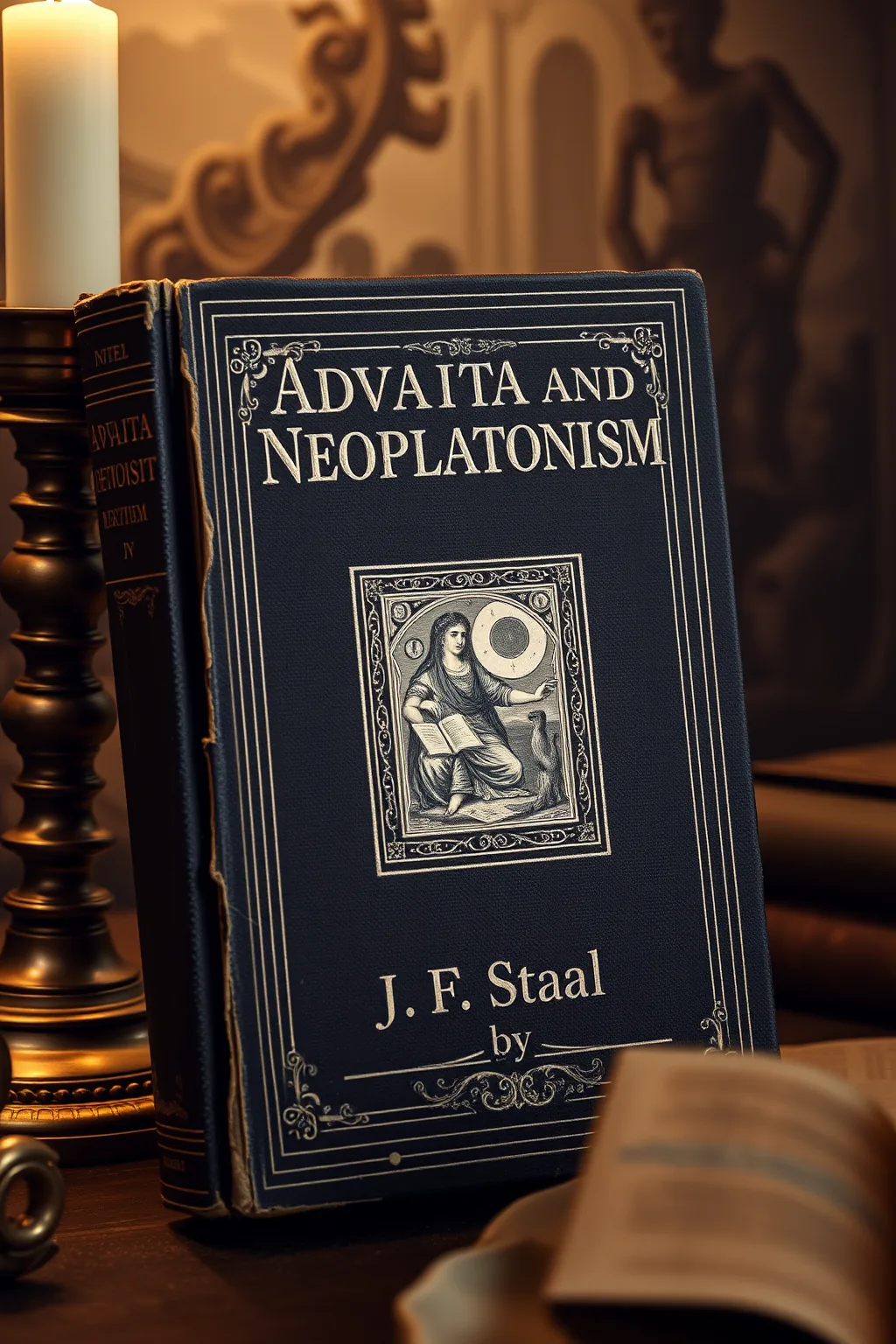
Advaita and Neoplatonism
 61
61

Advaita and Neoplatonism



Aurelia Blackwood, Occult Philosophy Critic — J. F. Staal’s 'Advaita and Neoplatonism' is a revelatory exploration, a beacon in the comparative study of esoteric thought. Staal’s erudition shines as he meticulously traces the profound resonances between the non-dualistic Vedanta and the hierarchical emanations of Neoplatonism. He unearths shared symbolic language and conceptual frameworks, offering esoteric practitioners and scholars alike a richer understanding of the perennial philosophy. The book’s strength lies in its ability to illuminate the unified spiritual impulse underlying diverse cultural expressions of ultimate truth. Essential reading for anyone seeking to grasp the deeper currents of mystical thought.
📝 Description
61
J. F. Staal's 1981 book examines the parallels between Advaita Vedanta and Neoplatonism.
This book investigates the connections between the Indian Advaita Vedanta tradition and the Greek Neoplatonism. J. F. Staal focuses on their shared ideas about a singular, ultimate reality and the path to spiritual realization. He details how both traditions describe a transcendent source from which everything emanates and the soul's eventual return to this origin.
The work considers concepts like nondual being, divine emanation, and the nature of consciousness as understood in both philosophical systems. Staal aims to show the underlying unity in these distinct metaphysical frameworks. The book is written for readers interested in comparative philosophy and the esoteric dimensions of Eastern and Western thought.
This book situates Advaita Vedanta and Neoplatonism within the broader spectrum of esoteric thought. Both traditions, though originating in different cultures and historical periods, engage with concepts of ultimate reality, consciousness, and the means of achieving spiritual union or liberation. They represent significant streams of mystical and philosophical inquiry that often intersect with or inform esoteric practices and beliefs across various traditions. Staal's work highlights these connections, suggesting a universal philosophical current beneath diverse cultural expressions.
💡 Why Read This Book?
Uncover the surprising commonalities between the wisdom of the East and the West. This book offers a profound exploration of non-duality and the divine source, essential for spiritual seekers and philosophers. If you are drawn to the esoteric dimensions of consciousness and the universal search for truth, 'Advaita and Neoplatonism' provides unparalleled insights into ancient metaphysical systems.
⭐ Reader Reviews
Honest opinions from readers who have explored this book.
❓ Frequently Asked Questions
What is Advaita Vedanta?
Advaita Vedanta is a major school of Hindu philosophy that emphasizes the non-duality of the self (Atman) and the ultimate reality (Brahman), positing that all existence is fundamentally one.
What is Neoplatonism?
Neoplatonism is a philosophical system that emerged in the Roman Empire, based on Plato's teachings but with a strong mystical and metaphysical emphasis, focusing on the One as the ultimate source of all existence.
What are the primary similarities explored?
The book highlights shared concepts such as a singular, transcendent ultimate reality, the nature of emanation or manifestation, the illusory nature of the material world, and the soul's journey toward reunion with the divine.
Is this book suitable for beginners?
While offering deep insights, the book assumes a degree of philosophical interest. Beginners may benefit from prior exposure to basic philosophical concepts, but its clarity makes it accessible to dedicated seekers.
What is the core esoteric message of the book?
The core esoteric message is that beneath the diverse expressions of human spirituality lies a universal truth about the interconnectedness of all things and the inherent divinity within each being, accessible through contemplative practices.
🔮 Key Themes & Symbolism
The Unity of the Absolute
This theme examines the profound concept of a singular, ineffable, and ultimate reality that underlies all existence in both Advaita and Neoplatonism. It explores how both traditions articulate the nature of this Absolute – whether termed Brahman or The One – as the unmanifest source from which all phenomena arise, emphasizing its transcendent yet immanent qualities. The discussion highlights the inadequacy of conceptual language to fully grasp this ultimate truth, pointing towards intuitive apprehension and direct experience as the means of realization.
Emanation and the Hierarchical Cosmos
Here, the focus shifts to the process by which the Absolute manifests or 'emanates' the multiplicity of the cosmos. The book meticulously compares the Neoplatonic hypostases (e.g., Intellect, Soul) with the Advaitic concept of Maya and the unfolding of the universe from Brahman. It examines how both systems describe a hierarchical structure of reality, where each level is dependent on the one above it, leading from the pure unity of the source to the complex phenomenal world, and the inherent order within this grand cosmic design.
The Soul's Journey and Liberation/Deification
This crucial theme investigates the individual's place within these cosmic frameworks and the path towards spiritual realization. The book contrasts the Advaitic path of Self-knowledge and Moksha (liberation from the cycle of birth and death) with the Neoplatonic ascent of the soul towards union with The One (henosis). It explores the role of ignorance (avidya/agnoia), the purification of the soul, ethical living, and contemplative practices as essential steps on this journey back to the divine source.
💬 Memorable Quotes
Direct passages from the work, attributed to the author.
“Maya veils the luminous truth, creating the illusion of a separate self.”
— This highlights the Advaitic concept of Maya (illusion) as a key obstacle to realizing our true, unified nature.
“The soul's arduous ascent is a return to its pristine source.”
— This speaks to the Neoplatonic idea of the soul's journey, not as a creation, but as a homecoming to its divine origin.
“In the stillness of contemplation, the boundaries of the self dissolve.”
— This points to the meditative practices common to both traditions, which facilitate the dissolution of ego and the realization of unity.
“The universe unfolds from an ineffable unity, a cosmic symphony of being.”
— This evocative phrase captures the idea of universal manifestation from a singular source, akin to a divine creative act.
💡 Key Ideas
Editorial paraphrase of the work's core concepts — not direct quotes.
The One, the Absolute, remains eternally beyond our grasp, yet it is the very ground of our being.
This quote expresses the paradoxical nature of ultimate reality as described in both traditions: simultaneously transcendent and intimately connected to our existence.
🌙 Esoteric Significance
Tradition
This book is deeply significant within the esoteric traditions of both Advaita Vedanta and Neoplatonism. It bridges the gap between these profound metaphysical systems, revealing their shared core principles concerning the nature of ultimate reality, the illusory nature of the material world, and the path to spiritual liberation or union with the divine. It offers a lens through which practitioners can understand their own tradition with greater depth and appreciate the universal aspects of mystical experience.
Symbolism
The symbolism explored is rich and multilayered, encompassing concepts like the 'One' or 'Brahman' as the primordial source, often represented by light or the void. The journey of the soul is frequently symbolized by ascent, descent, or return. The concept of Maya in Advaita and the 'darkness' or 'ignorance' in Neoplatonism serve as symbolic representations of the veil obscuring direct perception of ultimate truth. These shared symbolic languages offer clear insights into the human condition and the spiritual quest.
Modern Relevance
In an age often characterized by fragmentation and materialism, the convergence of Advaita and Neoplatonism offers a powerful antidote. It reminds us of the interconnectedness of all things and the profound spiritual dimension of existence, accessible through introspection and contemplation. The book's insights are highly relevant for contemporary seekers exploring consciousness, mindfulness, and the search for meaning, providing ancient wisdom applicable to modern spiritual challenges and the quest for inner peace and understanding.
👥 Who Should Read This Book
This book is an invaluable resource for a wide spectrum of readers. **Spiritual Seekers** will find a profound exploration of universal truths and pathways to enlightenment. **Scholars of Philosophy and Religion** will appreciate the rigorous comparative analysis and historical context. **Practitioners of Meditation and Contemplative Arts** will discover deeper philosophical underpinnings for their practices, revealing the shared goals of Advaita and Neoplatonism. **Those interested in Esoteric and Metaphysical thought** will find a body of interconnected ideas that illuminate the perennial wisdom traditions of humanity.
📜 Historical Context
This comparative study emerges from a rich period of intellectual and spiritual cross-pollination, particularly in the 19th and 20th centuries, when Western scholars and mystics began to deeply engage with Eastern philosophies. The rise of comparative religion and philosophy provided fertile ground for examining the universal threads of human spiritual inquiry. Advaita Vedanta, with its roots stretching back millennia in ancient India, and Neoplatonism, originating in the Hellenistic period and profoundly influencing Western thought, had long existed as distinct yet remarkably convergent traditions. Staal’s work is situated within this broader context of seeking a perennial philosophy, a unified understanding of ultimate truth that transcends cultural and temporal boundaries, offering a bridge between seemingly disparate yet spiritually aligned worldviews.
📔 Journal Prompts
Reflect on the concept of the 'One' or 'Brahman' in your own spiritual journey. How does this idea resonate with your understanding of reality?
Consider the 'illusory' nature of the material world. What aspects of your life might be perceived as Maya, and how does this perspective shift your experience?
Explore the idea of the soul's 'ascent' or 'return'. What 'steps' do you perceive in your own spiritual development or journey towards deeper understanding?
How can the principles of Advaita and Neoplatonism inform your daily life and interactions with the world around you?
Imagine a dialogue between a sage of Advaita and a philosopher of Neoplatonism. What common ground and unique perspectives might they share regarding the ultimate nature of existence?
🗂️ Glossary
Brahman
In Advaita Vedanta, the ultimate, unchanging, all-pervading reality that is the source and substance of all existence. It is considered pure consciousness and bliss, identical with Atman (the self).
The One
In Neoplatonism, the supreme, ineffable, and transcendent principle from which all reality emanates. It is the ultimate source of all being, goodness, and intelligibility.
Maya
A Sanskrit term in Advaita Vedanta referring to the cosmic illusion or power that conceals the true nature of reality (Brahman) and creates the appearance of the manifold, phenomenal world.
Emanation
A key concept in Neoplatonism describing the process by which reality flows or radiates from The One, forming a hierarchy of existence without diminishing the source.
Moksha
In Advaita Vedanta, liberation from the cycle of birth, death, and rebirth (samsara), achieved through the realization of one's identity with Brahman.
This book appears in 3 collections
🔮 Readers Also Liked
Browse all →









From the “Neoplatonism” Collection
View all →




More Free Alchemy & Hermeticism Books
View all →