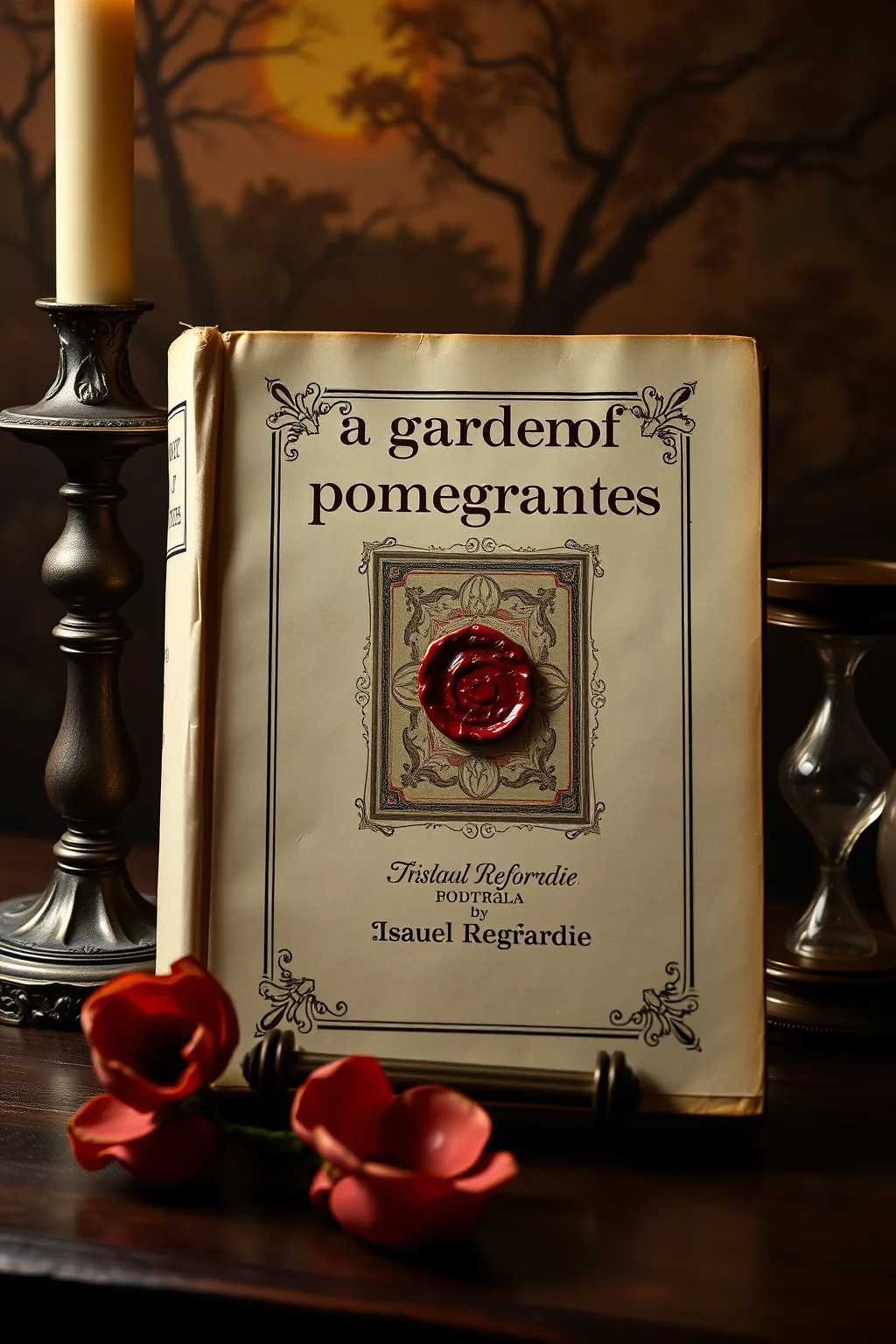
A Garden of Pomegranates
 81
81

A Garden of Pomegranates
Regardie's approach in A Garden of Pomegranates is commendably systematic. He avoids overly ornate language, opting instead for clear, if sometimes dense, exposition of the Kabbalistic Tree of Life. The book's strength lies in its comprehensive cataloging of correspondences for each Sephirah, offering a valuable reference for those initiating their study of the Qabalah. However, the text occasionally feels like a compilation of notes rather than a fully integrated narrative, leaving the reader to connect the dots between disparate symbolic systems. A passage detailing the Sephirah of Geburah, for instance, meticulously lists its associations but could benefit from a more dynamic illustration of its active principles. While not a revolutionary text, it functions effectively as a dependable primer on a complex subject.
📝 Description
81
Israel Regardie's 2015 A Garden of Pomegranates clarifies the Kabbalistic Tree of Life.
This book examines the Kabbalistic Tree of Life, a central diagram in Western esotericism. Israel Regardie breaks down each of the ten Sephiroth and their connecting paths. He draws explanations from various occult traditions to explain this symbolic system. The aim is to make its structure and potential uses for spiritual growth understandable.
The work is for serious students of esoteric philosophy and comparative religion who want a clear picture of Kabbalistic cosmology. It is especially useful for those interested in the Golden Dawn tradition, given Regardie's connection to its later stages. People looking into the links between psychology and spirituality will also find his symbolic interpretations valuable.
Published in 2015, A Garden of Pomegranates speaks to a renewed interest in esoteric traditions that influenced early 20th-century occultism. Regardie's study continues a long history of Kabbalistic scholarship. He incorporates ideas from figures like Aleister Crowley and the Hermetic Order of the Golden Dawn, in which he was active. The book addresses how Kabbalistic principles can be applied in personal development.
💡 Why Read This Book?
• Gain a structured understanding of the Kabbalistic Tree of Life, a core map in Western esotericism, by examining Regardie's detailed breakdown of its ten Sephiroth and twenty-two paths, as presented in the original 2015 publication. • Explore the specific correspondences of each Sephirah—divine names, planets, tarot archetypes—to deepen your grasp of esoteric symbolism, a key element Regardie systematically outlines. • Understand the practical applications of Kabbalistic cosmology for spiritual development, as Regardie connects these ancient principles to personal growth and magical practice.
⭐ Reader Reviews
Honest opinions from readers who have explored this book.
❓ Frequently Asked Questions
When was Israel Regardie's 'A Garden of Pomegranates' originally published?
Israel Regardie's 'A Garden of Pomegranates' was first published on April 9, 2015. This edition made his detailed exploration of the Kabbalistic Tree of Life accessible to a new generation of esoteric students.
What is the primary focus of 'A Garden of Pomegranates'?
The book primarily focuses on the Kabbalistic Tree of Life, systematically detailing each of its ten Sephiroth and twenty-two connecting paths, along with their associated esoteric correspondences.
Is 'A Garden of Pomegranates' suitable for beginners in Kabbalah?
Yes, it is designed to be an accessible introduction to the Kabbalistic Tree of Life. Regardie's methodical approach breaks down complex concepts for those new to esoteric studies.
What esoteric tradition heavily influences this book?
The book is deeply rooted in the Western Hermetic tradition, particularly as developed by the Hermetic Order of the Golden Dawn, of which Regardie was a prominent member.
What kind of symbolic correspondences are explored in the book?
Regardie explores correspondences such as divine names, angelic orders, planetary influences, Hebrew letters, and tarot archetypes for each of the Sephiroth on the Tree of Life.
Does the book offer practical applications of Kabbalistic knowledge?
Yes, Regardie connects the study of the Tree of Life to practical spiritual development and magical practice, aiming to demystify its use for personal growth.
🔮 Key Themes & Symbolism
The Kabbalistic Tree of Life
This work centers on the Qabalistic Tree of Life, a fundamental symbolic map in Western esotericism. Regardie meticulously breaks down its structure, comprising ten Sephiroth and twenty-two paths. He elucidates the layered meanings and correspondences associated with each sphere, presenting it as a framework for understanding both the cosmos and the human psyche, crucial for practitioners of ceremonial magic and spiritual development.
Esoteric Correspondences
A core element is the detailed cataloging of correspondences linked to each Sephirah on the Tree of Life. Regardie maps divine names, angelic hierarchies, planetary energies, Hebrew letters, and tarot archetypes onto this structure. This systematic approach aids students in building a comprehensive symbolic vocabulary, essential for interpreting esoteric texts and practices within traditions like the Golden Dawn.
Spiritual Ascent and Inner Work
Beyond mere description, the book implies a path of spiritual progression through understanding the Tree of Life. Regardie frames the Sephiroth and paths as stages or aspects of consciousness that can be worked with. The symbolism is presented not just for intellectual comprehension but as a guide for inner transformation and the attainment of higher spiritual states.
Hermetic Order of the Golden Dawn
Regardie’s deep involvement with the Hermetic Order of the Golden Dawn heavily informs this work. The book reflects the Order’s systematic approach to Kabbalistic study and magical training. It serves as an accessible manual for those interested in the curriculum and theoretical underpinnings of this influential magical society, bridging its teachings to a wider audience.
💬 Memorable Quotes
Direct passages from the work, attributed to the author.
“The Tree of Life is not merely a diagram but a symbolic representation of the entire universe and of man himself.”
— This highlights the holistic nature of the Kabbalistic Tree, positioning it as a comprehensive cosmology and a map for the individual soul's journey, relevant for both macrocosmic and microcosmic understanding.
“Each Sephirah possesses its own specific divine name, angelic order, and planetary correspondence.”
— This emphasizes the interconnectedness of various esoteric systems, showing how different symbolic languages (divine names, angels, planets) map onto the core structure of the Tree of Life.
“Understanding the paths between the Sephiroth is as crucial as understanding the spheres themselves.”
— This points to the dynamic aspect of the Tree, suggesting that the pathways represent processes, transitions, and the flow of energy, essential for grasping its functional rather than static nature.
“The Qabalah provides a framework for the magical and mystical aspirations of the Western world.”
— This positions Kabbalah not just as an ancient system but as a living tradition with direct relevance to modern esoteric practice and spiritual seeking.
“The work explores the correspondences between the Hebrew alphabet and the paths on the Tree of Life.”
— This points to a specific, detailed area of study within the book, emphasizing the intricate relationship between language, symbolism, and the structure of consciousness as depicted in the Qabalah.
🌙 Esoteric Significance
Tradition
This work is firmly situated within the Western Esoteric Tradition, specifically drawing from Hermeticism and Kabbalah. It represents a modern interpretation and systematization of Kabbalistic principles, heavily influenced by the magical practices and organizational structure of the Hermetic Order of the Golden Dawn, of which Regardie was a prominent member. It aims to present Kabbalah not just as a mystical philosophy but as a practical framework for spiritual development.
Symbolism
The central symbol is the Kabbalistic Tree of Life, depicted as a map of creation and consciousness. Each of the ten Sephiroth (spheres) and twenty-two Paths are imbued with detailed symbolism, including divine names, planetary influences, Hebrew letters, and tarot archetypes. Regardie elucidates these correspondences, presenting the Tree as a symbolic language through which the dynamics of the cosmos and the human psyche can be understood and navigated.
Modern Relevance
Regardie's systematic approach to the Tree of Life continues to influence contemporary esoteric practitioners, occultists, and those interested in comparative mysticism. Modern Kabbalistic study groups, ceremonial magicians, and even some psychological therapists exploring archetypal patterns find value in his clear exposition of the Sephiroth and their associated symbolism, making it a recurring reference point.
👥 Who Should Read This Book
• Aspiring practitioners of Western esotericism: Those beginning their study of Hermeticism, Kabbalah, or ceremonial magic will find a clear, structured introduction to the Tree of Life's fundamental concepts and correspondences. • Students of the Hermetic Order of the Golden Dawn: Individuals interested in the theoretical underpinnings and symbolic systems taught within the Golden Dawn tradition will benefit from Regardie's authoritative yet accessible presentation. • Comparative religion scholars: Researchers exploring the cross-pollination of mystical ideas and symbolic systems across different spiritual traditions will find valuable insights into Kabbalah's role in Western occultism.
📜 Historical Context
Published in 2015, Israel Regardie’s A Garden of Pomegranates enters a landscape where interest in esoteric traditions, particularly those stemming from the Hermetic Order of the Golden Dawn, has continued to grow since the late 20th century. Regardie himself was a central figure in disseminating the Golden Dawn’s teachings, often in response to the fragmentation and secrecy that followed the Order’s initial influential period in the late 19th and early 20th centuries. His work engages with the legacy of figures like Aleister Crowley, who also drew heavily on Kabbalistic frameworks, but often presents a more structured, less overtly theatrical interpretation. While contemporaries like Dion Fortune were also exploring Kabbalistic concepts in accessible prose, Regardie’s focus remained steadfastly on the systematic presentation of the Tree of Life as a foundational esoteric map.
📔 Journal Prompts
Reflect on the Sephirah of Kether as the 'Crown' or 'Beginning'.
Consider the symbolic meaning of the paths connecting the Sephiroth.
Analyze the planetary correspondences associated with specific Sephiroth.
Explore the relationship between a Hebrew letter and its corresponding path.
Contemplate the concept of 'Malkuth' as the manifested world.
🗂️ Glossary
Sephirah (plural: Sephiroth)
In Kabbalah, one of the ten divine emanations or attributes through which God manifests in the universe. Each Sephirah represents a distinct aspect of divine energy and consciousness.
Tree of Life
A central diagram in Kabbalah, consisting of ten Sephiroth and twenty-two connecting paths, symbolizing the structure of the universe, divine emanation, and the path of spiritual ascent.
Path
The connections or pathways between the Sephiroth on the Tree of Life. Each path is often associated with a Hebrew letter and specific symbolic meanings or magical operations.
Kabbalah
A system of Jewish mysticism and esoteric interpretation concerning the nature of God and the universe, often represented symbolically by the Tree of Life.
Hermeticism
A religious, philosophical, and esoteric tradition based on writings attributed to Hermes Trismegistus, emphasizing divine wisdom, the interconnectedness of all things, and the potential for human spiritual transformation.
Correspondence
In esoteric traditions, the symbolic relationship or link between different elements, such as planets, elements, colors, Hebrew letters, and divine names, often mapped onto structures like the Tree of Life.
Qabalah
An alternative spelling and pronunciation of Kabbalah, commonly used in Western esoteric contexts.