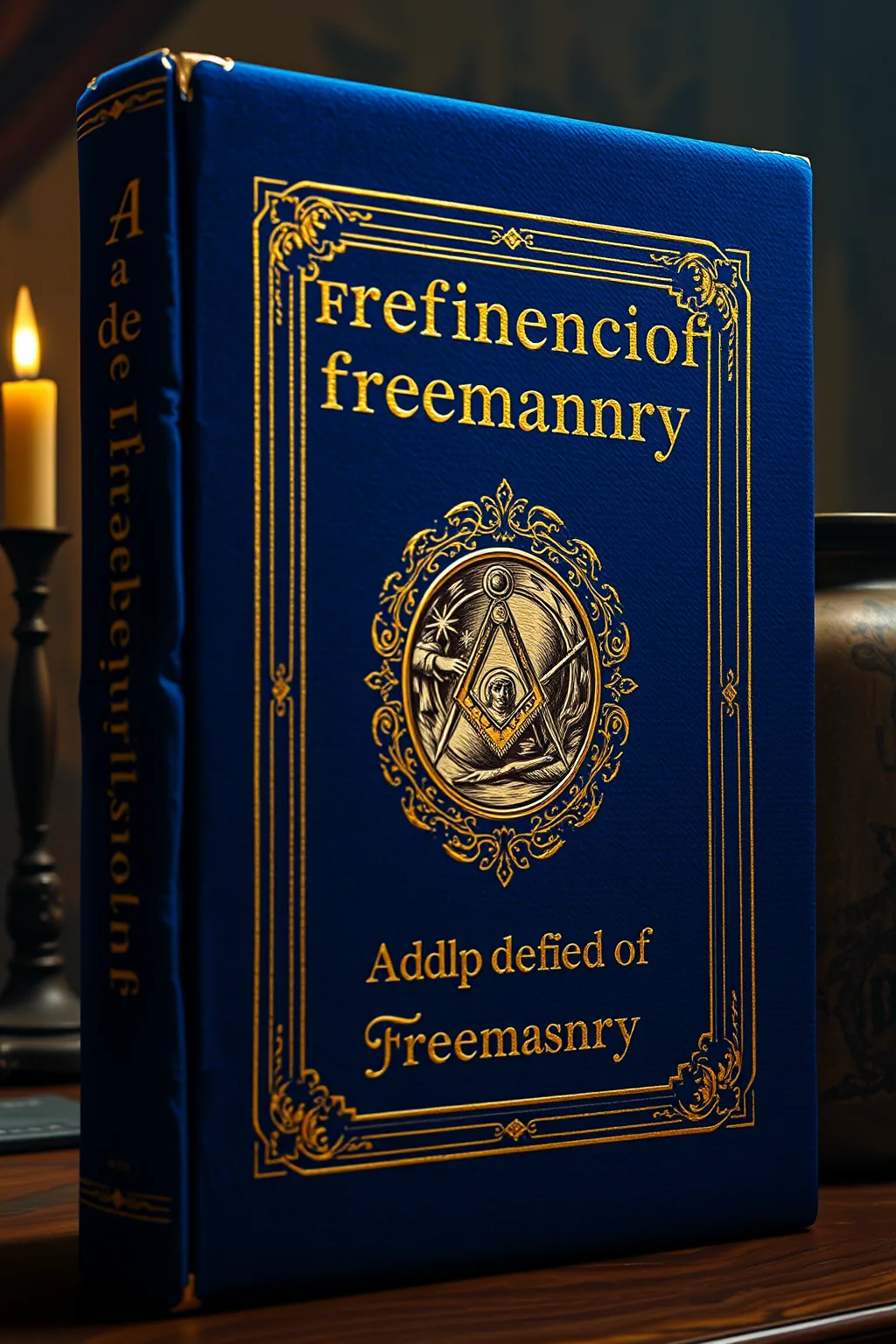
A defence of freemasonry
 74
74

A defence of freemasonry
Woodford’s 1874 text offers a systematic defense of Freemasonry, meticulously addressing common criticisms of his time. He argues cogently that the fraternity is fundamentally a moral and philosophical institution, using historical precedents and an examination of its allegorical language to support his claims. The work’s strength lies in its detailed exposition of Masonic tenets, particularly its insistence on a non-sectarian approach to belief, emphasizing a universal divine architect. However, the prose, while learned, can feel somewhat dense to a modern reader, requiring patience to unpack its 19th-century rhetorical style. A notable passage is the detailed explanation of how Masonic symbols, such as the square and compasses, serve as moral instructors rather than arcane devices. Woodford provides a solid, if somewhat dated, defense of Masonic principles.
📝 Description
74
Adolph Frederic Alexander Woodford defended Freemasonry in 1874 against prevalent Victorian criticisms.
Published in 1874, Adolph Frederic Alexander Woodford's "A Defence of Freemasonry" argues for the fraternity's ethical foundation and legitimacy. The book addresses widespread criticisms and misunderstandings common in the late Victorian era. Woodford's work serves as both an explanation and a defense, outlining the society's origins, core principles, and its place in society from his viewpoint. He writes for those seeking an understanding of Freemasonry beyond sensationalism and rumor, appealing to interests in fraternal organizations, 19th-century philosophical currents, and Masonic doctrines. Readers who have encountered Masonic symbolism and wish to learn about its meaning will also find value here.
The text emerges from a time of intense public examination of secret societies, particularly Freemasonry. The late 1800s saw both increased membership and a rise in opposition fueled by religious and political concerns. Woodford directly confronts accusations of irreligion, sedition, and occultism often aimed at the fraternity. His defense is situated within a scholarly environment that was developing in comparative religion and historical studies, impacting how institutions like Freemasonry were perceived and analyzed.
Woodford's defense places Freemasonry within the tradition of esoteric societies that sought to preserve and transmit moral and philosophical teachings through symbolic language and ritual. The book acknowledges the fraternity's claims to ancient lineage and its development through various historical and philosophical streams. It frames Freemasonry not as a religion or political movement, but as a system of moral instruction, using allegory to convey its lessons. This perspective aligns with how other esoteric traditions of the era understood themselves and their relationship to broader society, often facing similar scrutiny.
💡 Why Read This Book?
• Learn about the historical context of Freemasonry in the late 19th century, understanding specific criticisms leveled against it in 1874 and how Woodford countered them. • Gain insight into the author's interpretation of Masonic symbolism, particularly how concepts like the 'square and compasses' are presented as tools for moral development. • Understand the author's argument for Freemasonry as a system of morality veiled in allegory, a key concept for appreciating its philosophical underpinnings.
⭐ Reader Reviews
Honest opinions from readers who have explored this book.
❓ Frequently Asked Questions
What was the primary motivation behind writing 'A Defence of Freemasonry' in 1874?
The primary motivation was to counter prevailing criticisms and misconceptions about Freemasonry during the late Victorian era. Woodford aimed to demonstrate the fraternity's moral, ethical, and philosophical legitimacy to a skeptical public.
How does Woodford address accusations of Freemasonry being a secret society with dangerous aims?
Woodford argues that while Freemasonry has private ceremonies, its aims are benevolent and focused on moral improvement. He emphasizes its commitment to virtue, charity, and brotherhood, portraying it as an open system of ethical instruction.
What historical lineage does Woodford attribute to Freemasonry?
Woodford traces Freemasonry's conceptual lineage through various historical periods and philosophical traditions, suggesting its roots lie in ancient wisdom and operative masonry, emphasizing its continuity as a system of moral philosophy.
Does the book discuss specific Masonic rituals or degrees?
Yes, the book discusses the allegorical and symbolic meanings behind Masonic rituals and degrees. It focuses on explaining the moral lessons conveyed through these elements rather than revealing procedural details.
Is 'A Defence of Freemasonry' considered an primary source for Masonic history?
Yes, as a defense published in 1874 by a prominent Mason, Adolph Frederic Alexander Woodford, it serves as a valuable primary source for understanding Masonic thought and public relations efforts of the era.
What is the author's view on Freemasonry's relationship with religion?
Woodford asserts that Freemasonry is not a religion but a patron of all religions. It requires belief in a Supreme Being but does not prescribe specific doctrines, aiming for universal moral principles.
🔮 Key Themes & Symbolism
Moral Philosophy as Foundation
Woodford posits that the core of Freemasonry is not ritualistic secrecy but a profound system of moral philosophy. He argues that the fraternity's teachings are designed to cultivate virtue, integrity, and brotherly love among its members. This is illustrated through the symbolic language of the craft, where tools and implements are presented as allegorical guides for ethical conduct in daily life. The work emphasizes that adherence to Masonic principles leads to personal improvement and a more just society.
Allegory and Symbolism in Instruction
Central to Woodford's defense is the concept of Freemasonry as a system 'veiled in allegory and illustrated by symbols.' The book meticulously dissects various symbols, such as the square, compasses, and level, explaining their intended meanings within a moral and philosophical framework. These symbols are not presented as arcane mysteries but as mnemonic devices and teaching tools designed to impart lessons on rectitude, proportion, and equality, accessible to all who engage with them thoughtfully.
Historical Continuity and Legitimacy
Woodford seeks to establish the historical legitimacy of Freemasonry by tracing its conceptual lineage. He argues that its principles are not novel but have roots in ancient wisdom traditions and the practices of operative masons. By presenting Freemasonry as a continuation of a long-standing tradition of moral instruction and brotherhood, the work aims to counter claims that it is a recent, potentially subversive, or irreligious invention. This historical framing lends weight to its ethical claims.
Universalism and Non-Sectarianism
A significant theme is Freemasonry's capacity to unite men of diverse religious and political backgrounds. Woodford stresses that the fraternity requires a belief in a Supreme Being but remains neutral on specific religious dogmas. This universalist approach, he contends, allows for genuine brotherhood and shared moral pursuit without compromising individual faith. The emphasis is on common ethical ground rather than divisive theological specifics.
💬 Memorable Quotes
Direct passages from the work, attributed to the author.
“Freemasonry is a system of morality, veiled in allegory and illustrated by symbols.”
— This is a foundational statement for Woodford, encapsulating his view that the fraternity's essence lies in its ethical teachings, communicated through symbolic narratives rather than explicit dogma. It suggests that true understanding requires contemplation of these allegorical layers.
“We are commanded to hold as a principle that all men are brethren.”
— This highlights the universalist and egalitarian aspect of Masonic philosophy as presented by Woodford. It underscores the ideal of brotherhood that transcends social, religious, or political distinctions among members.
“The fraternity requires of its members a belief in the Supreme Being.”
— This clarifies the theological requirement within Freemasonry according to Woodford, differentiating it from atheism while maintaining a non-sectarian stance by not enforcing specific creeds.
“The tools of the operative mason are made instruments of moral instruction.”
— This points to the core method of Masonic pedagogy, where the practical implements of stonework are recontextualized as symbols conveying ethical lessons on conduct and character.
💡 Key Ideas
Editorial paraphrase of the work's core concepts — not direct quotes.
The principles of Freemasonry are not new; they are as old as the world.
This quote emphasizes the perceived ancient origins and enduring nature of Masonic wisdom. Woodford uses this to bolster the fraternity's legitimacy, suggesting its moral teachings are timeless truths.
🌙 Esoteric Significance
Tradition
Woodford's work aligns with the Western Esoteric tradition, specifically within the Hermetic and philosophical Masonic lineage. It emphasizes a non-dogmatic, symbolic approach to universal truths, drawing parallels with ancient wisdom and moral philosophy. While not explicitly Kabbalistic or Gnostic, it shares the Hermetic principle of 'as above, so below' by relating celestial order to terrestrial morality through symbolic correspondences. It represents a rationalist-inflected esotericism, seeking to ground esoteric principles in demonstrable morality and historical continuity.
Symbolism
Key symbols discussed include the square and compasses, representing morality and restraint, and the tessellated pavement, symbolizing the diversity of humanity united on a common ground. Woodford interprets these not as arcane keys to hidden powers, but as pedagogical tools designed to instruct members in virtue, temperance, justice, and the recognition of shared humanity. The symbolism serves to reinforce the fraternity's ethical framework, making abstract moral concepts tangible and memorable.
Modern Relevance
Contemporary practitioners of Western Esotericism, particularly those within Masonic study groups or interested in the philosophical underpinnings of fraternal orders, find Woodford's work relevant. It informs discussions on the historical evolution of Masonic ritual interpretation and the enduring appeal of symbolic moral instruction. Modern esotericists studying comparative systems of ethics and symbolism can use this text to understand the historical positioning of Freemasonry within broader esoteric discourse.
👥 Who Should Read This Book
• Students of 19th-century Western Esotericism: Those researching the intellectual currents and philosophical defenses of secret societies during the Victorian era will find Woodford's text provides specific context and arguments. • Freemasonry Inquirers: Individuals curious about the philosophical and ethical foundations of Freemasonry, seeking a reasoned explanation beyond popular misconceptions, can benefit from Woodford's systematic approach. • Comparative Religion and Ethics Scholars: Researchers interested in how moral and philosophical systems are constructed and defended in historical contexts will find this book a case study in apologetics and symbolic interpretation.
📜 Historical Context
Adolph Frederic Alexander Woodford's 'A Defence of Freemasonry' emerged in 1874, a period marked by both burgeoning interest in and significant opposition to Freemasonry across Europe and North America. The late 19th century saw a rise in anti-Masonic literature, often fueled by religious anxieties, particularly from Catholic circles, and political suspicions of secret societies influencing state affairs. Thinkers like Albert Pike were active during this period, though their approaches to Masonic philosophy differed; Pike delved more into comparative mythology and Kabbalistic interpretations, whereas Woodford focused on a direct, reasoned defense of Masonic ethics against public criticism. The publication of Woodford's work can be seen as part of a broader effort by Masonic bodies to articulate their principles and demonstrate their societal value in an era of increasing public scrutiny and the rise of organized anti-Masonic movements. Reception was generally within Masonic circles, serving as an internal justification and external outreach tool.
📔 Journal Prompts
The symbolic meaning of the square and compasses as presented by Woodford.
Woodford's argument for Freemasonry's historical continuity.
The role of allegory in transmitting moral teachings in the 19th century.
Reflecting on the concept of universal brotherhood as described in the text.
The author's interpretation of the requirement for belief in a Supreme Being.
🗂️ Glossary
Allegory
A literary or symbolic work in which characters, events, and settings represent abstract ideas or moral qualities. Woodford argues Freemasonry uses allegory extensively to teach ethical principles.
Symbolism
The use of symbols to represent ideas or qualities. In Freemasonry, as discussed by Woodford, symbols are visual or ritualistic elements intended to convey moral and philosophical lessons.
Supreme Being
A universal concept of a divine creator or ultimate reality, which Woodford states is a requirement for Freemasons, while emphasizing the fraternity's non-sectarian nature.
Operative Masonry
Refers to the historical craft guilds of stonemasons who built cathedrals and other structures. Woodford links speculative (philosophical) Freemasonry to these operative roots.
Speculative Masonry
The modern form of Freemasonry, concerned with philosophical and moral teachings rather than the literal building of structures. Woodford defends this aspect.
Tessellated Pavement
A mosaic pavement, often depicted as black and white squares, symbolizing the duality of human existence and the ground upon which all men stand equally.
Virtue
Moral excellence; the quality of being good. Woodford identifies the cultivation of virtue as a primary aim of Freemasonry.
🔮 Readers Also Liked
Browse all →





More by Adolph Frederic Alexander Woodford
All books →
More Free Freemasonry & Secret Societies Books
View all →