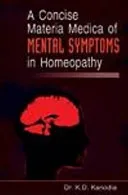
A Concise Materia Medica of Mental Symptoms in Homeopathy
 78
78

A Concise Materia Medica of Mental Symptoms in Homeopathy
Kanodia’s *A Concise Materia Medica of Mental Symptoms in Homeopathy* offers a focused exploration of the psychological landscape as viewed through a homeopathic lens. The book's strength lies in its systematic organization, making the vast array of mental rubrics more accessible for practitioners. It effectively reiterates the core homeopathic principle, famously articulated by James Tyler Kent, that mental and emotional states are paramount in understanding disease. One particularly useful section details the nuances of anxiety states, differentiating subtle symptom presentations. However, the text could benefit from more direct engagement with contemporary psychological research, which feels absent, limiting its appeal to those solely within the homeopathic fold. The presentation, while clear, occasionally leans towards a didactic tone rather than an analytical one. Ultimately, it serves as a valuable, albeit specialized, reference for homeopaths seeking to refine their understanding of mental symptomology.
📝 Description
78
K. D. Kanodia's 2007 Materia Medica catalogs mental symptoms within homeopathy.
Published in 2007, A Concise Materia Medica of Mental Symptoms in Homeopathy systematically lists mental and emotional symptoms as understood by homeopathic principles. The book is designed as a reference for practitioners, detailing how psychological states can guide diagnosis and treatment. It operates on the principle that mental disturbances are significant indicators of underlying physical imbalances, emphasizing the connection between the mind and body.
The work is intended for homeopathic practitioners, students of classical homeopathy, and anyone interested in the psychological aspects of natural healing. It also holds relevance for those studying medical history or alternative therapeutic systems that focus on mental and emotional well-being. The text builds on the tradition established by Samuel Hahnemann and further developed by figures such as James Tyler Kent, who stressed the importance of mental symptoms in selecting remedies.
This materia medica emerges from the vitalistic tradition of homeopathy, which began with Samuel Hahnemann's Organon of the Healing Art (1810). This approach posits that illness arises from a disturbance in the vital force, an animating principle. Homeopathy seeks to restore health by administering substances that produce similar symptoms in a healthy person. The focus on mental and emotional symptoms, particularly in the work of James Tyler Kent, reflects a view that the inner life and consciousness are primary expressions of the vital force and therefore central to understanding and treating disease.
💡 Why Read This Book?
• Gain a structured understanding of homeopathic mental rubrics, drawing directly from K. D. Kanodia's detailed symptom catalog, which offers a more nuanced approach than general medical texts. • Explore the foundational homeopathic principle, emphasized since Samuel Hahnemann's original work in the early 19th century, that mental and emotional states are central to healing, providing a unique perspective on well-being. • Deepen your appreciation for the diagnostic significance of emotional reactions, as highlighted by the text's focus on affections, a concept central to homeopathic philosophy, offering practical insights for personal health.
⭐ Reader Reviews
Honest opinions from readers who have explored this book.
❓ Frequently Asked Questions
What is the primary focus of A Concise Materia Medica of Mental Symptoms in Homeopathy?
The book focuses on cataloging and understanding mental and emotional symptoms within the homeopathic system of medicine, emphasizing their importance in diagnosis and treatment.
Who is the intended audience for this homeopathic materia medica?
It is primarily intended for homeopathic practitioners, students of homeopathy, and individuals interested in the psychological aspects of natural healing and the history of alternative medicine.
When was A Concise Materia Medica of Mental Symptoms in Homeopathy first published?
The book was first published on January 1, 2007, reflecting a modern compilation of classical homeopathic principles.
What historical figures or texts influence the approach taken in this book?
The work is influenced by classical homeopathic figures such as Samuel Hahnemann and James Tyler Kent, building upon their foundational writings on symptomology and prescribing.
How does this book relate to the broader field of psychology?
While rooted in homeopathic philosophy, the book addresses mental and emotional states, offering a different perspective than conventional psychology, focusing on energetic and symptom-based understanding.
What is the core philosophy regarding mind and body presented in the book?
The core philosophy is that the mind and body are intrinsically linked, and mental/emotional symptoms are crucial indicators of underlying health imbalances that guide homeopathic treatment.
🔮 Key Themes & Symbolism
Mental Symptomology
The work systematically organizes a vast spectrum of mental and emotional symptoms, which are considered paramount in homeopathic prescribing. It posits that the patient's subjective experience of their inner world—their fears, anxieties, moods, and desires—offers the most direct path to understanding and rectifying the root cause of illness, a principle deeply embedded in homeopathic practice since Hahnemann's era.
Mind-Body Connection
Central to the book's thesis is the inseparable link between mental states and physical health. It argues that emotional reactions are not peripheral but fundamental to a person's overall well-being. The text elaborates on how disturbances in affections, as noted by figures like Kent, can manifest physically, underscoring the holistic approach of homeopathy.
Homeopathic Prescribing
This materia medica serves as a practical guide for homeopathic practitioners, providing detailed symptom pictures to aid in selecting the correct remedy. It emphasizes careful observation and differentiation of mental rubrics, aiming to match the totality of the patient's unique mental and emotional state with the known therapeutic actions of homeopathic substances.
Emotional Well-being
Beyond disease treatment, the book implicitly advocates for emotional well-being as a core part of health. By understanding the language of mental symptoms, practitioners can guide patients toward greater happiness and balance, aligning with the homeopathic goal of restoring the vital force and promoting a healthy, joyful existence.
💬 Memorable Quotes
Direct passages from the work, attributed to the author.
“Man's mind is wider than the widest of ocean, and deeper than the deepest of sea.”
— This opening statement from the original blurb poetically emphasizes the immense complexity and depth of the human psyche, setting the stage for the book's detailed exploration of mental symptoms in homeopathy.
“The reaction of emotions has a great role to play in keeping a man happy and healthy.”
— This highlights the central homeopathic tenet that emotional balance is intrinsically linked to overall health, suggesting that understanding emotional responses is key to achieving and maintaining well-being.
“As certain Kent observes, man's affections are more important than his intelligence.”
— This references James Tyler Kent's philosophy, prioritizing the emotional and affective nature of individuals over purely intellectual faculties as a guide to understanding health and disease.
“Homeopathy wants to make you healthy and happy and so the mental and emotional framework and its deep study becomes highly important.”
— This captures the ultimate goal of homeopathy as presented in the text: not just physical cure, but the attainment of both health and happiness, achievable through diligent study of the mental and emotional states.
“Intelligence can explore the physical world, but it cannot help him in being happy.”
— This contrasts the limitations of intellect in achieving inner contentment with the potential of addressing the emotional core, reinforcing the book's focus on the mental and emotional aspects of healing.
🌙 Esoteric Significance
Tradition
This work falls within the broad lineage of Vitalism and Energetic Medicine, which underpins homeopathy. While not strictly Hermetic or Kabbalistic, it shares with these traditions a focus on unseen forces and the interconnectedness of the individual's internal state with their external manifestations. The emphasis on the 'vital force' (vis vitalis) and the energetic nature of remedies aligns with esoteric philosophies that posit life-energy as fundamental.
Symbolism
While the text is primarily a clinical reference, the underlying symbolism revolves around the human psyche as a microcosm reflecting the macrocosm. The 'affections' and 'emotions' are symbolic of the vital force's state; their disturbance signifies disharmony. The 'mind' itself, described as wider than the ocean, symbolizes the vast, often unexplored, inner landscape that homeopathy seeks to bring back into balance.
Modern Relevance
Contemporary practitioners of classical homeopathy continue to rely on detailed materia medicas like Kanodia's for precise prescribing. Furthermore, the increasing interest in mind-body medicine and holistic health approaches within mainstream wellness circles provides fertile ground for the principles espoused in this book, even if the specific homeopathic methodology isn't adopted.
👥 Who Should Read This Book
• Homeopathic practitioners and students seeking a comprehensive reference for mental and emotional symptomology to refine their prescribing accuracy. • Individuals interested in the historical development of psychological assessment within alternative healing modalities, particularly those tracing back to 19th-century medical philosophies. • Researchers of comparative medicine and healing systems who wish to understand the specific diagnostic framework and therapeutic focus of classical homeopathy regarding mental states.
📜 Historical Context
Published in 2007, K. D. Kanodia's work emerges within a long-standing homeopathic tradition that gained significant momentum in the 19th century, often existing alongside other vitalistic philosophies. The 19th century saw homeopathy flourish in Europe and North America, frequently championed by physicians who were also engaged with movements like spiritualism or the burgeoning field of psychology. Homeopathy's emphasis on individual symptom totality, particularly mental symptoms, contrasted sharply with the reductionist tendencies of allopathic medicine developing concurrently. Figures like James Tyler Kent, whose emphasis on mental symptoms heavily influences this text, were key in shaping homeopathic thought in the late 19th and early 20th centuries. While Kanodia's work is a modern compilation, it directly engages with these historical underpinnings, offering a focused materia medica based on principles established over a century prior, without significant engagement with contemporary psychological paradigms.
📔 Journal Prompts
The mental and emotional framework: How do your core affections influence your daily experience?
Reflection on 'wider than the ocean': What aspects of your inner world remain unexplored?
The role of emotions: Identify one emotional reaction and its impact on your physical state.
Homeopathic happiness: What does 'healthy and happy' signify for your personal well-being?
Intelligence vs. Affections: How do you balance your intellectual pursuits with your emotional needs?
🗂️ Glossary
Materia Medica
A foundational text in homeopathy that details the pathogenetic effects of medicinal substances on the healthy human body, serving as a reference for symptom pictures.
Mental Symptoms
In homeopathy, these refer to disturbances in a person's thoughts, emotions, moods, memory, and behavior, considered crucial for identifying the correct remedy.
Rubric
A specific symptom or characteristic listed in a homeopathic repertory, used to categorize and search for remedies that cover a particular condition.
Vital Force (Vis Vitalis)
A central homeopathic concept referring to the inherent animating principle or life energy of an organism, believed to be the source of health when in balance.
Affections
In the context of homeopathic philosophy, this term broadly encompasses emotions, feelings, and the capacity for love or connection, considered highly significant indicators of health.
Prescribing
The process in homeopathy of selecting and recommending a specific remedy based on the totality of the patient's symptoms, particularly the mental and emotional ones.
Hahnemannian Homeopathy
Refers to the practice of homeopathy strictly adhering to the principles and methods laid down by its founder, Samuel Hahnemann, emphasizing classical approaches.