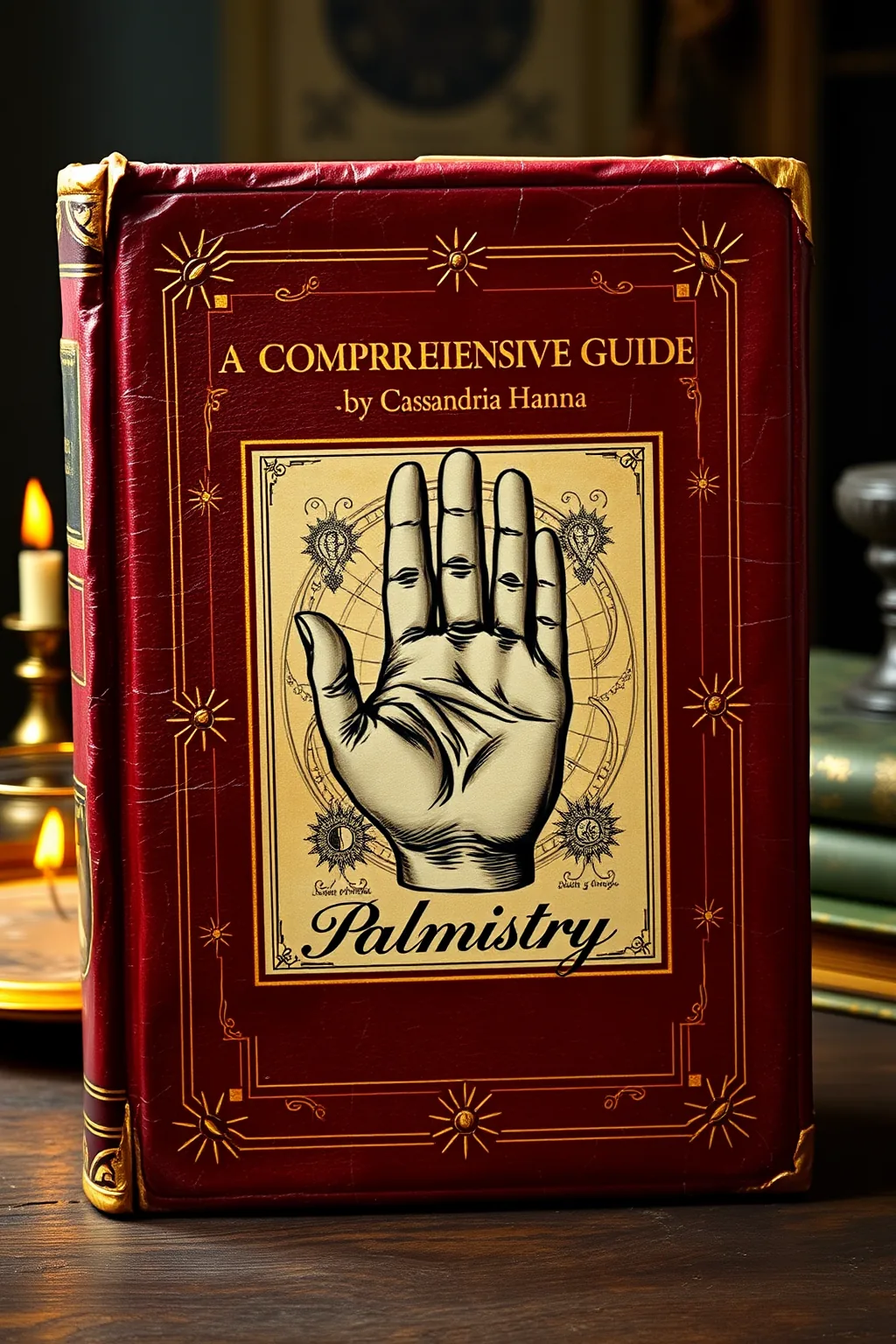
A COMPREHENSIVE GUIDE TO PALMISTRY
 80
80

A COMPREHENSIVE GUIDE TO PALMISTRY
Cassandria Hanna’s A COMPREHENSIVE GUIDE TO PALMISTRY offers a refreshingly direct approach to a subject often shrouded in mystique. The clarity with which Hanna breaks down the major hand lines, such as the Life Line and Head Line, is a significant strength, making complex interpretations feel manageable for the uninitiated. However, the text occasionally leans towards a deterministic view; for instance, the discussion of the Fate Line, while informative, could benefit from more emphasis on agency and choice rather than solely on preordained paths. A particularly insightful passage details the significance of the Mount of Jupiter, linking its development to ambition and leadership qualities, which feels well-supported by the book’s framework. It serves as a competent, if somewhat conventional, introduction to the art of reading palms.
📝 Description
80
Cassandria Hanna's 2019 guide makes the ancient art of palm reading accessible.
This book, first published in 2019, aims to demystify chiromancy, the practice of interpreting the hand. It presents palmistry as a way to understand a person's life path, potential, and past experiences. The text breaks down the complexities of reading palms into manageable parts, allowing readers to interpret the markings on their own hands.
It is written for anyone interested in self-discovery through palmistry, whether they are new to the subject or have some familiarity. The book provides the basic knowledge needed for accurate interpretation. Readers can learn about their personal strengths, challenges, and life directions as shown by the lines and features of their hands, using it as a practical tool for gaining insight.
Palmistry has ancient roots in traditions from India, China, and Greece, with figures like Aristotle writing about it. The practice faced periods of both popularity and suppression in Europe, sometimes linked to fortune telling and viewed with suspicion. This 2019 edition appears during a revival of interest in esoteric subjects and personal growth, echoing earlier occult revivals influenced by figures such as Helena Blavatsky and the Theosophical Society.
💡 Why Read This Book?
• Gain practical skills to interpret the Life Line and Head Line, understanding how their formations on your own palm can reflect your personal vitality and cognitive patterns, as detailed in the book's early chapters. • Learn to identify and analyze the seven planetary mounts, such as the Mount of Venus, and understand how their prominence correlates with specific character traits and potentials discussed within the guide. • Decipher subtle hand markings like stars and islands, moving beyond basic line readings to grasp nuanced indicators of life events and influences, a skill honed through the book's detailed section on palmographic signs.
⭐ Reader Reviews
Honest opinions from readers who have explored this book.
❓ Frequently Asked Questions
When was A COMPREHENSIVE GUIDE TO PALMISTRY first published?
The revised edition of A COMPREHENSIVE GUIDE TO PALMISTRY, also titled The Language of Hands, was first published on October 25, 2019. This edition aims to provide an accessible entry point into the practice of palmistry for a modern audience.
What are the main lines discussed in palmistry?
The primary lines typically analyzed in palmistry, as covered in the book, are the Life Line (vitality, physical well-being), Head Line (intellect, mental state), Heart Line (emotions, relationships), and Fate Line (career, life path). Their characteristics reveal much about an individual.
Are there specific hand shapes associated with personality types in this book?
While the book primarily focuses on lines and mounts, it implicitly acknowledges that hand shapes can offer broader personality indicators. The detailed analysis of lines and mounts provides a more granular understanding of individual characteristics.
Does the book discuss minor lines or markings?
Yes, beyond the major lines, A COMPREHENSIVE GUIDE TO PALMISTRY explores various minor lines and specific markings such as stars, crosses, and islands. These are presented as offering more detailed insights into specific events or potentials.
Is this book suitable for someone with no prior knowledge of palmistry?
Absolutely. The book is designed for beginners, presenting the information in an easy-to-read and understand format. It systematically guides the reader through the fundamental principles and interpretive techniques of palmistry.
What is the significance of the mounts on the palm?
The mounts are fleshy pads at the base of each finger and below the thumb. According to the book, their prominence, influenced by planetary associations, indicates strengths and tendencies related to areas like love (Venus), ambition (Jupiter), and creativity (Apollo).
🔮 Key Themes & Symbolism
The Hand as a Life Map
This work posits the palm as a literal cartographic representation of an individual's existence. The intricate network of lines—Life, Head, Heart, Fate—are presented not as static indicators but as dynamic pathways detailing potential challenges and accomplishments. The book encourages readers to view their hands as personal atlases, where each crease and contour offers a clue to their unique journey, emphasizing self-awareness through the physical manifestation of one's destiny.
Planetary Influences on the Palm
A core tenet explored is the connection between the seven planetary energies and specific areas of the hand, known as mounts. The prominence or lack thereof on mounts like Jupiter (ambition), Saturn (discipline), Apollo (creativity), and Venus (love) is interpreted as reflecting corresponding personality traits and life experiences. This framework integrates astrological principles directly onto the physical hand, providing a layered approach to character analysis.
Interpreting Palm Markings
Beyond the primary lines, the book details the significance of various smaller markings found on the palm. Symbols such as stars, crosses, squares, islands, and tridents are presented as nuanced indicators that can modify or specify the meaning of the major lines. Understanding these signs allows for a more precise interpretation of potential obstacles, fortunate events, or specific talents, transforming the palm from a simple map into a complex textual document.
Palmistry as a Tool for Self-Discovery
The overarching theme is the utility of palmistry for introspection and personal growth. By learning to read the 'language of hands,' individuals are empowered to understand their inherent strengths, potential pitfalls, and the unfolding narrative of their lives. The book frames this practice not as deterministic fortune-telling, but as a method for gaining self-knowledge, fostering acceptance, and potentially guiding one's choices with greater awareness.
💬 Memorable Quotes
Direct passages from the work, attributed to the author.
“The palm is like a road map of lines and markings telling whether your travels in life will be smooth or bumpy.”
— This highlights the central metaphor of the book: the hand as a guide to life's journey. It suggests that the physical features of the palm are direct indicators of the ease or difficulty one might encounter.
“It tells of your potential and what you have accomplished in life.”
— This emphasizes the dual nature of palmistry as presented here—it's not just about future possibilities but also a reflection of past achievements and inherent capabilities.
“All answers can be found in the palms.”
— This bold statement underscores the comprehensive scope the book aims to provide, positioning palmistry as a complete system for understanding oneself.
“The Language of Hands is the titled of the revised edition of the book.”
— This clarifies the alternative title and the nature of this publication as an updated version, suggesting a focus on clear communication and accessibility of the subject matter.
“It is easy to read and understand for everyone wanting to read palms.”
— This conveys the author's intention to explain palmistry, making it approachable for beginners rather than remaining an exclusive or esoteric discipline.
🌙 Esoteric Significance
Tradition
This work fits within the Western esoteric tradition, specifically its branch focused on divination and physiognomy. While palmistry has ancient roots across multiple cultures, its integration with planetary symbolism aligns it with Hermetic principles, where celestial bodies are seen as influencing terrestrial matters and human character. It departs from purely mystical or theological traditions by focusing on a tangible, physical method of interpretation believed to reflect inner states and life trajectories.
Symbolism
Key symbols include the major palm lines (Life, Head, Heart, Fate), each representing fundamental aspects of human existence: vitality, intellect, emotion, and destiny. The mounts, named after planets like Jupiter, Saturn, and Venus, symbolize corresponding archetypes and potentials—ambition, responsibility, love. Other markings like stars and islands function as specific omens or indicators of concentrated energy or disruption within these broader themes.
Modern Relevance
Contemporary practitioners of New Age spirituality, self-help advocates, and those exploring mindfulness often draw upon palmistry as a tool for self-awareness. This guide's accessible format makes it relevant for modern seekers interested in understanding their personal narratives through accessible esoteric frameworks, complementing practices like astrology or tarot by offering another symbolic language for introspection.
👥 Who Should Read This Book
• Aspiring practitioners of divination seeking a foundational text on chiromancy, who will learn to interpret the primary lines and mounts of the hand. • Individuals interested in self-discovery and personal development, who can utilize the book's insights to better understand their inherent traits and life path. • Students of esoteric history and comparative occultism, who will find this a contemporary example of a long-standing divinatory practice presented in a modern context.
📜 Historical Context
Published in 2019, A COMPREHENSIVE GUIDE TO PALMISTRY arrives in a contemporary landscape where esoteric practices have seen a significant resurgence, partly fueled by online communities and a growing interest in alternative forms of self-understanding. This revival echoes earlier waves of occult interest in the late 19th century, influenced by figures like Madame Blavatsky and the Theosophical Society, which sought to synthesize Eastern and Western mystical traditions. While modern palmistry draws from ancient roots in Hellenistic Greece and India, Hanna’s work is situated within a specific lineage of accessible guides that emerged throughout the 20th century, aiming to popularize chiromancy. It contrasts with more academic or deeply traditionalist approaches, such as those found in some Vedic texts or the more complex Kabbalistic interpretations of the hand, by prioritizing clarity and practical application for the layperson. The book’s reception is within a digital age where information is readily available, yet the need for curated, structured guidance like this remains.
📔 Journal Prompts
Analyze the starting point and trajectory of your Head Line.
Reflect on the development of your Mount of Venus.
Compare the clarity of your Heart Line to its described meaning.
Examine any islands present on your Fate Line.
Consider the relationship between your Life Line's length and your perceived vitality.
🗂️ Glossary
Chiromancy
The practice of interpreting the lines, marks, and features of the human hand to understand character and predict future events. It is synonymous with palmistry.
Life Line
The semi-circular line originating near the thumb and curving around the base of the palm. It is traditionally associated with physical health, vitality, and major life events.
Head Line
The horizontal line extending across the middle of the palm. It relates to intellectual capacity, learning style, communication, and mental processes.
Heart Line
The horizontal line across the upper palm, below the fingers. It signifies emotional nature, romantic relationships, and heart health.
Fate Line
A vertical line running up the center of the palm, often starting near the wrist. It is linked to career, life purpose, and external influences affecting one's path.
Mounts
The fleshy pads on the palm, named after classical planets (e.g., Jupiter, Saturn, Apollo, Venus). Their size and prominence are believed to indicate corresponding personality traits and potentials.
Markings
Specific symbols or patterns on the palm, such as stars, crosses, squares, and islands, which offer more detailed interpretations and modify the meaning of the major lines and mounts.