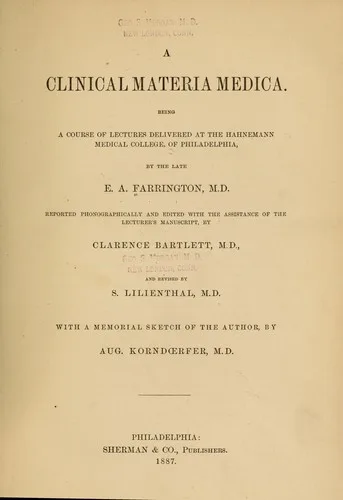
A clinical materia medica
 75
75

A clinical materia medica
Farrington’s work, a product of 1890, offers a dense, almost architectural, presentation of homeopathic remedies. Its strength lies in its sheer comprehensiveness and the clear, albeit sometimes stark, delineation of symptom profiles for each substance. The methodical approach, detailing everything from the source of a remedy to its most minute indications, provides a solid foundation for understanding. However, the text can feel overwhelmingly clinical, lacking the narrative or philosophical explorations found in some contemporary esoteric works. The section on *Lachesis* (a snake venom), for instance, meticulously lists symptoms like "pain in left temple, throbbing, worse from sun" but offers little on the symbolic or energetic underpinnings often sought in occult studies. It’s a reference book, first and foremost, and excels at that, but readers seeking broader metaphysical connections might find it arid. Still, for the dedicated student of materia medica, its precision is undeniable.
📝 Description
75
First published in 1890, Farrington's A Clinical Materia Medica systematically lists homeopathic remedies.
This work compiles descriptions of various remedies, focusing on homeopathic principles. It details the characteristics, indications, and therapeutic applications of substances derived from organic and inorganic sources. The book functions as a reference for practitioners, outlining symptom profiles and their corresponding remedies. It is structured around the examination of individual remedies, with each entry covering the source, characteristic symptoms (physical, mental, emotional), and specific conditions for which the remedy is indicated. The text stresses the need for precise symptom matching between a patient's condition and a chosen remedy, a central tenet of homeopathic practice.
Farrington's materia medica was published in 1890, a time when alternative healing systems like homeopathy were gaining notice alongside established medical practices. Homeopathy, founded by Samuel Hahnemann, proposed a philosophy of 'like cures like' and the use of minimal dosages. This book speaks to students and practitioners of homeopathy interested in a detailed study of remedies and their use in treating illnesses. It also holds relevance for historians of medicine and alternative healing, providing insight into diagnostic and therapeutic methods from the late 19th century.
Published in the late 19th century, this materia medica sits within the tradition of vitalistic medicine, particularly homeopathy. Homeopathy, established by Samuel Hahnemann, operated on principles distinct from conventional allopathic medicine of the era, emphasizing the body's inherent healing capacity and the use of highly diluted substances. Farrington's work details the specific 'pictures' of illness that each substance is believed to address, reflecting a holistic view of health where mental, emotional, and physical symptoms are interconnected and inform remedy selection.
💡 Why Read This Book?
• Learn the precise indications and symptom pictures for over 100 homeopathic remedies, as detailed in Farrington's original 1890 publication, enabling a deeper understanding of their therapeutic applications. • Gain insight into the foundational principles of homeopathic prescribing by examining how Farrington correlates specific physical and mental symptoms to distinct remedies, a method crucial to its practice. • Understand the historical development of materia medica in the late 19th century, a period of robust growth for homeopathy, by engaging with this seminal text from 1890.
⭐ Reader Reviews
Honest opinions from readers who have explored this book.
❓ Frequently Asked Questions
When was A Clinical Materia Medica first published?
A Clinical Materia Medica by E. A. Farrington was first published in 1890, making it a significant text from the late Victorian era of homeopathic practice.
What is the primary focus of Farrington's Materia Medica?
The book's primary focus is on the detailed study and application of homeopathic remedies. It systematically lists substances, their origins, and the specific symptom profiles that indicate their use in treating illness.
Who is the author of A Clinical Materia Medica?
The author is E. A. Farrington, with contributions or later editions potentially involving Clarence Bartlett. The original 1890 publication is attributed to E. A. Farrington.
Is this book suitable for beginners in homeopathy?
While comprehensive, its dense, clinical nature might be best suited for students or practitioners with some foundational knowledge of homeopathy who wish to deepen their understanding of materia medica.
Does the book discuss the energetic or spiritual aspects of remedies?
The book is primarily clinical and symptom-focused. While it details indications, it does not extensively explore the energetic or spiritual interpretations often associated with remedies in other esoteric traditions.
What kind of remedies are covered in the book?
The book covers a wide range of remedies derived from organic (plant, animal) and inorganic (mineral) sources, all organized according to homeopathic principles and their observed effects on the human system.
🔮 Key Themes & Symbolism
Symptom Specificity
The core of Farrington's work lies in the meticulous detailing of symptoms. Each remedy is presented with a precise symptom picture, encompassing physical sensations, locations, modalities (what makes them better or worse), and even mental states. For example, the description of *Belladonna* would list its characteristic sudden onset of fever, delirium, and red, hot skin. This specificity is crucial for homeopathic practitioners aiming to match the remedy to the individual's unique presentation, distinguishing it from generalized medical texts.
Source and Potency
Farrington details the origin of each substance used as a remedy, whether it be a plant like *Nux Vomica*, a mineral like *Sulphur*, or an animal product like *Apis Mellifica*. While the book focuses on the clinical application, the implicit understanding within homeopathic practice is that these substances are prepared through specific processes of dilution and succussion (potentization) to activate their healing properties without retaining toxicity. The materia medica serves as the catalog of these prepared energetic medicines.
Therapeutic Indications
Beyond symptomology, the text provides clear therapeutic indications – the conditions or diseases for which a particular remedy has historically proven effective. This section guides the practitioner towards selecting the most appropriate medicine based on the totality of the patient's symptoms. The work compiles years of clinical observation and provings (testing remedies on healthy individuals) to establish these reliable therapeutic links, forming a practical guide for treatment.
Historical Practice
As a text from 1890, Farrington's materia medica offers a window into the practice of homeopathy at a significant point in its development. It reflects the knowledge base and diagnostic approaches prevalent at the time, before many modern medical advancements. Studying this work allows for an appreciation of the evolution of homeopathic materia medica and its enduring principles, providing context for contemporary practice and historical research.
💬 Memorable Quotes
Direct passages from the work, attributed to the author.
“Each remedy has its own pathogenesis.”
— This refers to the unique set of symptoms that a specific substance is known to produce in a healthy person when administered, which in turn dictates its therapeutic use for similar symptoms in a sick person.
“Select the remedy that covers the most characteristic symptoms.”
— This highlights the core principle of homeopathic case-taking and remedy selection: prioritizing the most unusual, peculiar, or striking symptoms of the patient to find the best match with a remedy's known effects.
“The study of materia medica is a life-long pursuit.”
— This sentiment, often echoed in homeopathic literature, emphasizes the depth and breadth of knowledge required to master the materia medica, suggesting continuous learning and experience are necessary for proficiency.
💡 Key Ideas
Editorial paraphrase of the work's core concepts — not direct quotes.
The symptoms of the patient are the language of nature.
This paraphrased concept underscores the homeopathic philosophy that the symptoms experienced by an individual are not random but are a deliberate expression of the body's state, guiding the practitioner towards the correct remedy.
It is the totality of symptoms that we must cure.
This paraphrased concept points to the homeopathic method of considering all aspects of a patient's condition – physical, mental, and emotional – rather than focusing on a single disease label, for effective treatment.
🌙 Esoteric Significance
Tradition
While primarily a clinical text rooted in homeopathy, Farrington's work implicitly engages with esoteric principles through its foundation in vitalism. Homeopathy posits a 'vital force' or life energy that maintains health, and disease is seen as a disturbance of this force. This concept aligns with broader esoteric traditions that view the physical world as an expression of subtler energetic and spiritual planes. The meticulous symptomology can be seen as mapping the energetic signature of substances onto the human energetic system, a practice found in various forms of energetic medicine and occult pharmacopoeia.
Symbolism
Although not overtly symbolic, the remedies themselves carry layers of meaning derived from their sources and observed effects. For instance, remedies derived from venomous creatures like *Lachesis* (snake venom) are often associated with themes of transformation, danger, and primal energy, reflecting the symbolic nature of the creature. Similarly, mineral remedies like *Sulphur* might be linked to themes of purification or fire. The 'pathogenesis' of a remedy—the symptoms it produces—can be interpreted as its energetic or symbolic language, speaking to specific states of imbalance within the vital force.
Modern Relevance
Contemporary practitioners of holistic medicine, energetic healing, and even some branches of naturalistic psychology draw upon the principles articulated in works like Farrington's. The emphasis on individualized treatment and the detailed exploration of mind-body connections remains relevant. While modern approaches may integrate scientific research or expand on energetic concepts, the foundational understanding of remedy-patient correlation established in classical materia medica texts continues to inform practices focused on restoring balance at multiple levels of being.
👥 Who Should Read This Book
• Homeopathic students and practitioners seeking a foundational text to deepen their understanding of remedy profiles and therapeutic indications, as compiled in 1890. • Researchers of medical history and alternative healing modalities interested in the development of homeopathic materia medica during the late Victorian era. • Holistic health enthusiasts curious about the detailed symptomology and historical practice of a significant system of medicine that predates many modern pharmaceutical approaches.
📜 Historical Context
Published in 1890, E. A. Farrington's *A Clinical Materia Medica* emerged during a period of robust expansion for homeopathy in the United States and Europe. The late 19th century was marked by intense debate between burgeoning alternative medical systems and the established allopathic medical profession. Homeopathy, championed by figures like Samuel Hahnemann, offered a distinct philosophical and therapeutic approach. Farrington's work served as a vital educational tool for practitioners and students, consolidating the detailed knowledge of remedies that had been gathered through provings and clinical experience. This era also saw the rise of scientific medicine, with advancements in germ theory and pharmacology, creating a contrasting intellectual current. While allopathic medicine focused on physiological mechanisms and chemical interventions, homeopathy emphasized vital force and symptom totality. Farrington’s text, therefore, stands as a key artifact of this medical pluralism, reflecting a significant school of thought that challenged mainstream medical paradigms of the time.
📔 Journal Prompts
The symptom picture of *Belladonna* as described by Farrington.
Energetic correspondences between mineral remedies and their historical symbolic associations.
The principle of 'pathogenesis' in relation to remedy selection.
Comparing Farrington's 1890 clinical indications with contemporary homeopathic texts.
The concept of the 'vital force' as presented implicitly in materia medica study.
🗂️ Glossary
Materia Medica
A body of knowledge detailing the medicinal properties of substances, particularly in homeopathy, outlining their source, symptoms produced, and therapeutic uses.
Homeopathy
A system of alternative medicine based on the principle of 'like cures like' (similia similibus curentur), using highly diluted substances to stimulate the body's healing response.
Pathogenesis
The set of symptoms, signs, and diseases that a specific substance (remedy) is known to produce when administered to healthy individuals (provings).
Potentization
The homeopathic process of diluting a substance and vigorously shaking it (succussion) to increase its therapeutic efficacy while reducing toxicity.
Indications
The specific symptoms or conditions for which a particular remedy is considered appropriate for treatment.
Symptom Totality
The complete picture of a patient's illness, encompassing all physical, mental, and emotional symptoms, which is used in homeopathy to select the most similar remedy.
Allopathic Medicine
The conventional system of medicine that treats diseases by using remedies that produce effects different from or opposite to those produced by the disease; often contrasted with homeopathic medicine.
🔮 Readers Also Liked
Browse all →








More by Farrington, E. A., Ernest Albert Farrington, Clarence Bartlett
All books →
More Free Occult Philosophy Books
View all →