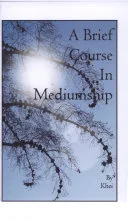
A Brief Course in Mediumship
 76
76

A Brief Course in Mediumship
Khei's *A Brief Course in Mediumship* provides a refreshingly direct and disciplined framework for aspiring mediums. Unlike many texts that rely on anecdotal evidence or purely philosophical musings, Khei grounds the practice in specific techniques, particularly evident in the chapter on "Trance - Conscious & Unconscious." The author's strength lies in demystifying complex phenomena, presenting them as accessible skills. However, the brevity of the course, as the title suggests, means that some topics, such as the nuanced dynamics of "Physical Mediumship," are covered at a pace that may leave dedicated practitioners wanting more depth. The 1996 publication date also means it predates some contemporary discussions in consciousness studies, though its core principles remain relevant. This is a valuable primer for those seeking systematic instruction.
📝 Description
76
Khei's 'A Brief Course in Mediumship' (1996) presents mediumship as a cultivable skill.
Published in 1996, Khei's book outlines a systematic approach to developing psychic abilities. It bypasses general ideas of spiritual talent, instead detailing mediumship as a discipline that requires specific methods and practice. The text is divided into sections that cover different stages of psychic growth, starting with initial inspiration and progressing to more complex physical manifestations.
This book targets individuals serious about cultivating their psychic potential. It is best for readers who have moved beyond basic spiritual ideas and want practical techniques to refine their intuitive and mediumistic skills. Those interested in active practice, rather than passive spiritual experiences, will find this work valuable. Khei focuses on the concrete steps involved in honing these faculties.
Khei's work appeared in the mid-1990s, a time when interest in esoteric studies was reawakening. Following the earlier movements of Spiritualism and Theosophy, and a period of skepticism in the mid-20th century, the late 1990s saw a rise in attention to parapsychology and alternative spiritual paths. This book contributes to that trend by merging older esoteric teachings with a more contemporary, practical focus on psychic development.
💡 Why Read This Book?
• Learn specific methods for developing clairvoyance and clairaudience, as detailed in the relevant chapter, to enhance your intuitive perception. • Understand the difference between conscious and unconscious trance states, a crucial distinction explored in its dedicated section, for controlled psychic engagement. • Gain practical techniques for "Entering the Silence," a concept presented as a gateway to inspiration, enabling direct spiritual communication.
⭐ Reader Reviews
Honest opinions from readers who have explored this book.
❓ Frequently Asked Questions
What are the main psychic abilities discussed in Khei's book?
The book covers psychometry (reading objects), clairvoyance (psychic sight), clairaudience (psychic hearing), and various forms of trance and inspiration. It aims to provide a structured understanding of these faculties.
Is 'A Brief Course in Mediumship' suitable for absolute beginners?
Yes, while it expects a serious commitment, its structured approach makes it suitable for beginners who are ready to engage in disciplined practice and study the foundational concepts of mediumship.
When was 'A Brief Course in Mediumship' first published?
The book was first published in September 1996. This places it within a specific era of esoteric publishing that synthesized earlier spiritualist teachings.
What is 'Entering the Silence' in the context of this book?
'Entering the Silence' refers to a specific meditative or inspirational technique detailed by Khei, designed to quiet the mind and create receptivity for higher guidance or spiritual communication.
Does the book cover physical phenomena like table tipping?
Yes, the chapter on 'Physical Mediumship' addresses phenomena such as these, presenting them as potential outcomes of developed mediumistic ability and specific conditions.
What distinguishes Khei's approach to mediumship from other books?
Khei's approach emphasizes a systematic, disciplined cultivation of abilities, rather than relying solely on innate talent or passive spiritual influx. It presents mediumship as a learnable skill set.
🔮 Key Themes & Symbolism
Disciplined Psychic Cultivation
The core of Khei's teaching is that mediumship is not merely an inherited gift but a faculty that can be systematically developed. The book emphasizes discipline, practice, and understanding the underlying principles of psychic reception. This contrasts with more passive or purely faith-based approaches to spiritual communication, presenting a practical methodology for honing one's abilities through focused effort and study of specific techniques outlined in chapters like 'Trance - Conscious & Unconscious'.
The Spectrum of Mediumistic Phenomena
Khei meticulously categorizes and explains various forms of mediumistic expression. From the subtle reception of psychometric impressions and clairaudient messages to the more overt manifestations of trance states and physical mediumship, the book provides a framework for understanding the breadth of psychic experience. This comprehensive view helps readers identify and work with their particular strengths and areas for development.
Inner Silence and Inspiration
A significant theme is the concept of 'Entering the Silence' as a prerequisite for true inspiration. Khei suggests that by quieting the incessant chatter of the ego and the external world, one can achieve a state of receptivity conducive to receiving higher guidance or intuitive insights. This process is presented as a vital step in developing authentic mediumship, moving beyond mere psychic impression to spiritual connection.
Understanding Trance States
The book dedicates considerable attention to the nature of trance, differentiating between conscious and unconscious states. This exploration is crucial for mediums to understand the different levels of awareness and control they can achieve during psychic work. By distinguishing these states, Khei offers guidance on how to engage with them safely and effectively, maximizing their utility for mediumistic purposes.
💬 Memorable Quotes
Direct passages from the work, attributed to the author.
“The commencement of things it was given to all to know alike the mysteries of the k.”
— This opening sentiment suggests an inherent, universal capacity for spiritual knowledge or psychic perception present in humanity from its earliest stages, implying that the ability to connect with higher truths is a fundamental aspect of our being.
“Psychometry: reading the past of an object through touch.”
— This succinctly defines psychometry, highlighting its practical application in accessing historical or emotional residues imprinted upon physical items through direct physical contact.
“Inspiration: entering the silence for guidance.”
— This captures the essence of Khei's teaching on inspiration, framing it as an active process of achieving inner stillness to become receptive to spiritual or intuitive direction.
“Trance: conscious and unconscious states of altered awareness.”
— This highlights Khei's methodical breakdown of trance phenomena, differentiating between levels of consciousness during altered states, essential for understanding and managing mediumistic work.
“Physical Mediumship: externalized spiritual manifestations.”
— This offers a concise definition for the more outwardly observable aspects of mediumship, suggesting phenomena that extend beyond the individual's internal experience.
🌙 Esoteric Significance
Tradition
Khei's work aligns with the broader Western Esoteric Tradition, particularly drawing from currents influenced by Spiritualism and Theosophy, which sought to systematize and explain psychic phenomena within a spiritual framework. It departs from purely mystical or philosophical traditions by focusing on the practical, actionable techniques for developing specific faculties. The emphasis on disciplined practice echoes some Hermetic principles of 'as above, so below,' applied to the inner workings of the human psyche and its connection to higher realms.
Symbolism
While not overtly symbolic in its presentation, the book's structure itself can be seen as symbolic. The progression through distinct chapters—Psychometry, Clairvoyance, Trance, Inspiration, Physical Mediumship—represents a symbolic journey of unfoldment, moving from the tangible (reading objects) to the subtle (inspiration) and the manifest (physical phenomena). The 'Silence' itself acts as a potent symbol for the unmanifest potential and the void from which divine inspiration can arise.
Modern Relevance
Contemporary practitioners in fields like intuitive development, energy healing, and even certain branches of transpersonal psychology can find value in Khei's systematic approach. Thinkers exploring the nature of consciousness and non-local awareness might reference the book's practical exercises. While the specific terminology may differ, the underlying principles of focused attention, altered states, and receptivity are echoed in modern mindfulness practices and the ongoing exploration of psychic phenomena in less institutionalized spiritual circles.
👥 Who Should Read This Book
• Aspiring mediums seeking a structured curriculum to develop their innate psychic abilities, moving beyond theoretical understanding to practical application. • Students of parapsychology interested in historical and practical methodologies for exploring clairvoyance, psychometry, and trance states, as presented in a 1996 context. • Individuals exploring inner development who wish to understand the mechanics of inspiration and spiritual communication through disciplined mental and energetic cultivation.
📜 Historical Context
Published in September 1996, *A Brief Course in Mediumship* emerged during a period of sustained interest in esoteric and parapsychological studies, following the cultural shifts of the 1960s and 70s. While the mid-20th century had seen figures like J.B. Rhine pioneering scientific approaches to parapsychology, the late 20th century witnessed a broader spiritual marketplace where books synthesizing traditional occultism with New Age concepts found audiences. Khei's work can be seen as a contemporary articulation of mediumistic practices, building upon traditions established by earlier movements like Spiritualism and Theosophy, championed by figures such as Helena Blavatsky. Unlike purely academic explorations or the more sensationalist accounts of Spiritualism's early days, Khei offers a structured, almost pedagogical approach. It engaged with a public increasingly open to alternative perspectives on consciousness, distinct from the burgeoning New Age movement's often less structured spiritual philosophies.
📔 Journal Prompts
The concept of 'Entering the Silence' as a gateway to inspiration.
Your personal experiences with clairvoyance and clairaudience.
The distinction between conscious and unconscious trance states.
Reflections on psychometry and object readings.
Observations of physical mediumship phenomena.
🗂️ Glossary
Psychometry
The purported psychic ability to read the history of an object or location by touching it. This includes sensing past events, emotions, or the identities of previous owners associated with the item.
Clairvoyance
The psychic capacity to perceive visual images or information beyond the normal range of sight. This can manifest as visions, mental pictures, or symbolic imagery.
Clairaudience
The psychic capacity to perceive sounds or auditory information beyond the normal range of hearing. This may include hearing voices, messages, or ethereal sounds.
Trance
An altered state of consciousness characterized by profound relaxation, detachment from the immediate environment, and heightened receptivity to subconscious or spiritual influences.
Conscious Trance
A state of trance where the individual retains a degree of awareness and control over their actions and perceptions, often used for deliberate psychic work or communication.
Unconscious Trance
A deeper state of trance where awareness of the physical self and surroundings is significantly diminished or absent, often associated with automatic writing or profound channelled communication.
Physical Mediumship
A category of mediumship involving the manifestation of phenomena observable in the physical environment, such as materializations, levitations, or apports, allegedly caused by discarnate entities.