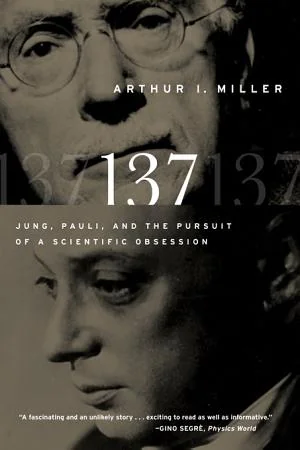
137: Jung, Pauli, and the Pursuit of a Scientific Obsession
 73
73

137: Jung, Pauli, and the Pursuit of a Scientific Obsession
Arthur I. Miller's account of the Jung-Pauli collaboration is less a hagiography and more a meticulous tracing of intellectual threads. The book excels in detailing the painstaking correspondence between the psychoanalyst and the physicist, revealing the genuine intellectual struggle to reconcile the empirical with the symbolic. Miller’s strength lies in his ability to situate their work within the tumultuous scientific landscape of the early 20th century, particularly the rise of quantum mechanics. A limitation, however, is that the sheer volume of detail can sometimes obscure the core narrative, making the pursuit feel more like an academic exercise than a grand discovery. The exploration of Pauli's anxieties surrounding the number 137 and its potential connection to his personal life offers a particularly poignant moment, demonstrating the human element behind the scientific quest. Ultimately, "137" provides a valuable, if dense, window into a unique intellectual partnership.
📝 Description
73
Arthur I. Miller's 2009 book examines Jung and Pauli's obsession with the number 137.
In "137: Jung, Pauli, and the Pursuit of a Scientific Obsession," Arthur I. Miller details the intellectual partnership between psychoanalyst Carl Jung and physicist Wolfgang Pauli. Their shared focus was the fundamental nature of reality, particularly how it might be expressed numerically. The book chronicles their correspondence and joint efforts to find a link between psychological archetypes and physical laws.
This connection centered on the fine-structure constant, alpha, which has a value close to 1/137. Miller shows how this dimensionless number became a point of intense fascination for both men. They believed it could serve as a bridge between the material world and the inner workings of the psyche. The work is for those interested in the history of science, the philosophical questions at the heart of modern physics and psychology, and the lives of thinkers driven by deep curiosity.
Miller places their collaboration within the fertile interdisciplinary climate of the early to mid-20th century. Quantum mechanics was rapidly reshaping physics, while Jung was developing his theories of archetypes and the collective unconscious. This era also saw a significant interest in synchronicity and the search for a unified worldview, a quest that deeply engaged both Jung and Pauli.
This book situates the scientific and psychological inquiries of Jung and Pauli within a broader historical context of seeking universal principles. Their focus on the number 137 as a potential bridge between the physical and mental realms reflects a tradition of numerology and Pythagorean thought, where numbers are seen as more than mere quantities but as fundamental organizing forces of reality. The collaboration between Jung, a pioneer of depth psychology, and Pauli, a Nobel laureate in physics, highlights an esoteric impulse to unify seemingly disparate domains of knowledge, suggesting that underlying mathematical or symbolic structures might connect consciousness and the cosmos.
💡 Why Read This Book?
• Understand the specific intellectual drive behind Carl Jung and Wolfgang Pauli's unusual collaboration concerning the fine-structure constant, alpha, and its potential symbolic meaning. • Gain insight into the scientific and psychological milieu of the early 20th century, specifically the period when quantum physics was nascent and Jung was developing his theories of archetypes. • Explore the concept of synchronicity and how two eminent figures attempted to find mathematical and psychological order in a universe that seemed increasingly unpredictable.
⭐ Reader Reviews
Honest opinions from readers who have explored this book.
❓ Frequently Asked Questions
What is the significance of the number 137 in Arthur I. Miller's book?
The number 137 refers to the approximate value of the fine-structure constant (alpha), a fundamental physical constant. Jung and Pauli became obsessed with this number, believing it held a deeper, possibly symbolic, meaning connecting physics and psychology.
Who were the main figures discussed in '137: Jung, Pauli, and the Pursuit of a Scientific Obsession'?
The central figures are the renowned psychoanalyst Carl Jung and the Nobel Prize-winning physicist Wolfgang Pauli. Their intellectual relationship and shared pursuit of understanding the number 137 are the book's primary focus.
What is the nature of the relationship between Jung and Pauli explored in the book?
The book details their extensive correspondence and collaborative discussions from the 1930s onward. They sought to bridge the gap between analytical psychology and quantum physics, using the fine-structure constant as a focal point.
What historical period does the book cover regarding Jung and Pauli's work?
The book primarily covers the period from the 1930s through the mid-20th century, a time of significant development in both quantum physics and Jungian psychology, and a period of intense intellectual exchange between the two thinkers.
Does the book explain the fine-structure constant in detail?
Yes, Arthur I. Miller, a physicist himself, provides explanations of the fine-structure constant and its significance within physics, contextualizing why it became such a compelling subject for both Jung and Pauli.
What is the 'scientific obsession' mentioned in the title?
The 'scientific obsession' refers to Jung and Pauli's intense, shared focus on the number 137 (the fine-structure constant), believing it to be a key to understanding fundamental principles of the universe and human consciousness.
🔮 Key Themes & Symbolism
The Number as a Bridge
The work meticulously examines how the fine-structure constant, 1/137, became a focal point for Carl Jung and Wolfgang Pauli. They viewed this dimensionless number not merely as a physical parameter but as a potential symbol, a nexus where the objective laws of the universe might intersect with the subjective field of the psyche. Their correspondence reveals a shared conviction that such fundamental constants could encode profound meaning, challenging the purely materialistic worldview prevalent in much of early 20th-century science and hinting at an underlying order accessible through both scientific inquiry and psychological exploration.
Synchronicity and Meaning
Central to Jung and Pauli's shared intellectual pursuit was the concept of synchronicity – meaningful coincidences that transcend causality. The book illustrates how their collaboration sought to find empirical and theoretical support for this idea, particularly through the lens of numbers. They explored whether patterns observed in the physical world, like the value of 137, could be mirrored or understood in conjunction with psychological archetypes. This exploration aimed to establish a framework for understanding reality where acausal connecting principles played a significant role, moving beyond strict determinism.
Physics Meets Psychology
Arthur I. Miller charts the challenging dialogue between a pioneering psychoanalyst and a leading quantum physicist. The book details their efforts to synthesize Jung's theories of archetypes and the collective unconscious with Pauli's understanding of quantum mechanics. This interdisciplinary approach sought to demonstrate that the human mind and the external universe were not entirely separate domains but were, in fact, deeply interconnected, perhaps even governed by shared principles or symbolic structures, with the number 137 serving as a prime example of this potential unity.
The Search for Underlying Order
The obsession with 137 by Jung and Pauli stemmed from a deeper desire to uncover an ultimate order in the cosmos. As the 20th century progressed, bringing quantum uncertainty and psychological complexity, they sought a unifying principle. Miller's work highlights their belief that numbers, particularly fundamental constants, might provide clues to this hidden order. Their quest was an attempt to find rational, albeit unconventional, explanations for the universe's structure and humanity's place within it, pushing the boundaries of both scientific and philosophical thought.
💬 Memorable Quotes
Direct passages from the work, attributed to the author.
“The number 137 became for them a symbol of the world's irrationality.”
— This interpretation highlights how the fine-structure constant, a seemingly arbitrary physical value, transcended its scientific definition for Jung and Pauli. It represented a point of mystery, a numerical enigma that hinted at deeper, perhaps non-rational, principles governing existence.
“Jung saw in the number a connection to ancient wisdom.”
— This interpretation points to Jung's tendency to link contemporary discoveries with historical and mythological patterns. He likely perceived the significance of 137 as echoing older traditions or archetypal understandings of cosmic order.
“Miller details the scientific and personal pressures on Pauli.”
— This interpretation emphasizes Arthur I. Miller's role in contextualizing Pauli's obsession. It suggests the book explores not just the abstract ideas but also the real-life circumstances and psychological states that fueled Pauli's intense focus on the number 137.
💡 Key Ideas
Editorial paraphrase of the work's core concepts — not direct quotes.
Pauli was deeply worried about the number 137.
This paraphrase suggests Pauli's significant personal and intellectual investment in the number 137. It implies that his fascination went beyond mere scientific curiosity, touching upon anxieties and profound questions about reality that deeply affected him.
Their correspondence explored the possibility of acausal connections.
This paraphrase captures the essence of their collaboration: a search for relationships between events or concepts that could not be explained by conventional cause and effect, suggesting a deeper, more meaningful synchronicity.
🌙 Esoteric Significance
Tradition
This work touches upon themes resonant with Hermeticism and Neoplatonism, traditions that explore the idea of a divine, ordered cosmos accessible through reason and symbolism. While not directly a Hermetic text, it engages with the Hermetic principle of 'As Above, So Below' by seeking correlations between the macrocosm (physical laws) and the microcosm (human psyche). The pursuit of a unifying number like 137 reflects a Gnostic-like search for hidden knowledge and a fundamental truth underlying apparent reality.
Symbolism
The number 137 itself functions as a potent symbol within the book, representing the fine-structure constant and, for Jung and Pauli, a potential key to universal order. Beyond this, the concept of archetypes, central to Jung's work and explored here, serves as symbolic motifs. These archetypes, like the Anima/Animus or the Self, are understood as universal patterns of the human psyche, suggesting a symbolic language inherent in both nature and consciousness.
Modern Relevance
Contemporary thinkers in areas like transpersonal psychology, integral theory, and even certain branches of quantum mysticism draw upon the legacy of figures like Jung and Pauli. The book's exploration of synchronicity and the potential for a unified worldview continues to inspire those seeking to reconcile scientific understanding with subjective experience, particularly in fields that investigate consciousness and its relationship to the physical universe.
👥 Who Should Read This Book
• Students of Jungian psychology and the history of psychoanalysis: Gain direct insight into Jung's later intellectual pursuits and his engagement with contemporary physics. • Researchers in the history and philosophy of science: Understand a unique interdisciplinary dialogue that challenged prevailing scientific paradigms in the mid-20th century. • Individuals interested in the intersection of science, spirituality, and numbers: Explore how fundamental physical constants can become objects of profound philosophical and even esoteric contemplation.
📜 Historical Context
The intellectual ferment of the mid-20th century, particularly the period following World War I and leading up to World War II and beyond, provided fertile ground for unconventional scientific and philosophical inquiries. Quantum mechanics, developed by figures like Heisenberg and Schrödinger, had introduced profound uncertainty into the physical world, challenging deterministic views. Simultaneously, Carl Jung was solidifying his theories on archetypes and the collective unconscious, proposing a structure to the human psyche that resonated with a growing interest in symbolism and meaning. It was within this climate that Wolfgang Pauli, a central figure in quantum physics, began a significant intellectual exchange with Jung. Their correspondence, spanning from the 1930s onward, represented a notable attempt to bridge the apparent chasm between the objective, quantifiable world of physics and the subjective, symbolic field of psychology. This collaboration was not universally embraced; many scientists of the era remained staunchly materialist, viewing Jung's work as unscientific speculation. However, figures like physicist Max Born, while critical, acknowledged the intellectual curiosity driving such interdisciplinary ventures.
📔 Journal Prompts
The fine-structure constant (1/137) as a point of convergence for physics and psyche.
Wolfgang Pauli's personal anxieties and their connection to numerical symbolism.
Carl Jung's interpretation of scientific discoveries through the lens of archetypes.
The concept of synchronicity as a bridge between objective and subjective reality.
The search for a unified worldview in the early 20th century.
🗂️ Glossary
Fine-structure constant (alpha)
A fundamental dimensionless constant in quantum electrodynamics, approximately equal to 1/137. It characterizes the strength of interaction between electrons and photons.
Archetype
In Jungian psychology, an inherited, universal pattern or image that is part of the collective unconscious, influencing human behavior and perception.
Collective Unconscious
A concept developed by Carl Jung, referring to a shared layer of the unconscious mind containing inherited structures and predispositions common to all humans.
Synchronicity
A concept introduced by Carl Jung, describing the occurrence of two or more events that appear meaningfully related but lack a direct causal connection.
Quantum Mechanics
The fundamental theory in physics that describes nature at the smallest scales of energy and matter, characterized by concepts like quantization and wave-particle duality.
Psychoanalysis
A set of psychological theories and therapeutic techniques originating with Sigmund Freud, focused on exploring unconscious thoughts and motivations, with Carl Jung developing his own distinct school.
Dimensionless Quantity
A quantity that has no physical dimensions or units, often a ratio of two quantities with the same dimensions, such as the fine-structure constant.
This book appears in 1 collection
🔮 Readers Also Liked
Browse all →









From the “Numerology” Collection
View all →








More Free Occult Philosophy Books
View all →