Zeus
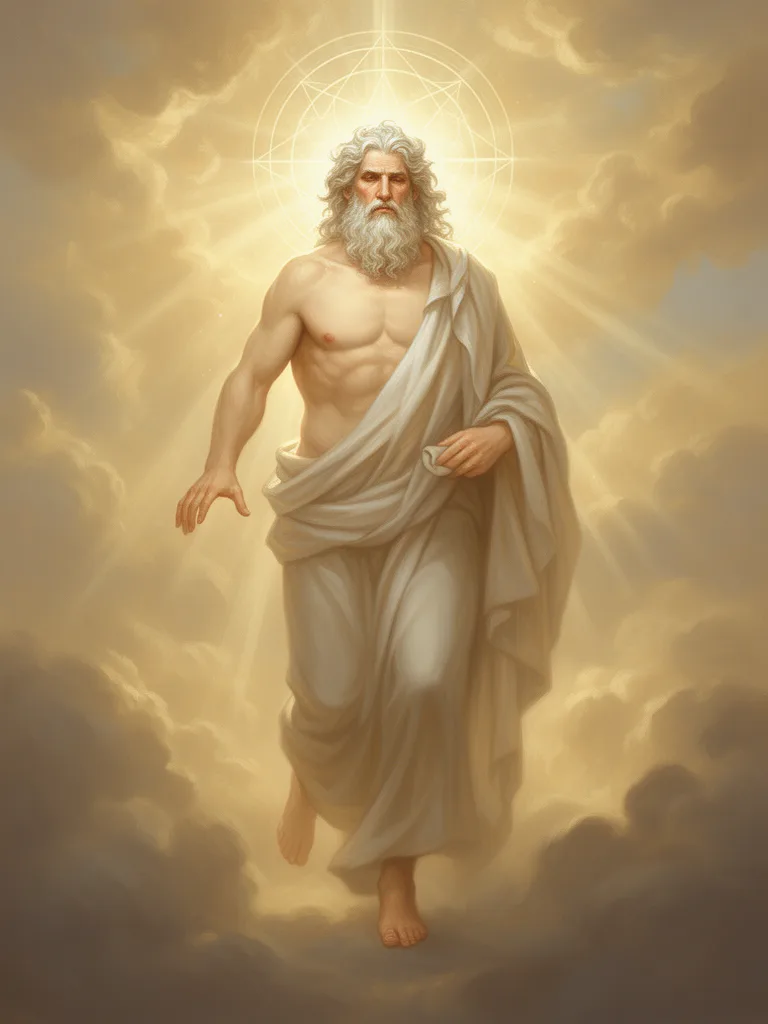
The supreme god of the ancient Greek pantheon, associated with the sky, thunder, and kingship. Often depicted as a bearded man wielding a thunderbolt, Zeus presided over the Olympian gods and mortals, embodying cosmic order and divine authority.
Where the word comes from
The name Zeus derives from Proto-Indo-European dyḗws ph₂tḗr, meaning "sky father." This etymological root connects it to similar sky-god figures in other Indo-European mythologies, such as the Roman Jupiter and the Vedic Dyaus Pita. Its earliest attestations appear in Mycenaean Greek inscriptions.
In depth
The "Father of the ^'ods". Zcus-Zcn is ./Ether, therelore .lupitt-r was Pater ^tlier by .some Latin races.
How different paths see it
What it means today
Blavatsky's brief gloss on Zeus, linking him to "Ether" and "Father," points toward a deeper, more philosophical interpretation than the common mythological understanding. In her view, the supreme deity often transcends anthropomorphic limitations to represent a fundamental cosmic principle. The Greek Zeus, as the ruler of Olympus and wielder of thunderbolts, is more than a king of gods; he is the embodiment of atmospheric power, the force that governs the heavens and, by extension, the cycles of nature and the fate of mortals. This resonates with Mircea Eliade's observations on the primordial role of the sky god in many ancient religions, often seen as the prime mover and the source of cosmic order. The very name "Zeus" itself, tracing back to the Proto-Indo-European "sky father," underscores this foundational connection to the celestial realm. For the ancient Greeks, Zeus's thunder was not just a sound but a manifestation of divine will, a reminder of the awesome power that maintained the equilibrium of the universe. He was the guarantor of oaths, the protector of guests, and the ultimate judge, his pronouncements shaping the destinies of both gods and humans. In this sense, Zeus serves as a potent symbol of sovereignty, not just political but cosmic, a force that establishes and upholds the fundamental laws of existence. His thunderbolt, a symbol of both creative and destructive power, illustrates the dual nature of divine authority, capable of both fostering life and enacting judgment.
The contemplation of such figures, even through the lens of ancient mythology, offers a glimpse into humanity's enduring quest to comprehend the forces that govern our reality and our place within the grand cosmic design.
Related esoteric terms
Books on this concept








No reflections yet. Be the first.
Share your interpretation, experience, or question.
