Rama
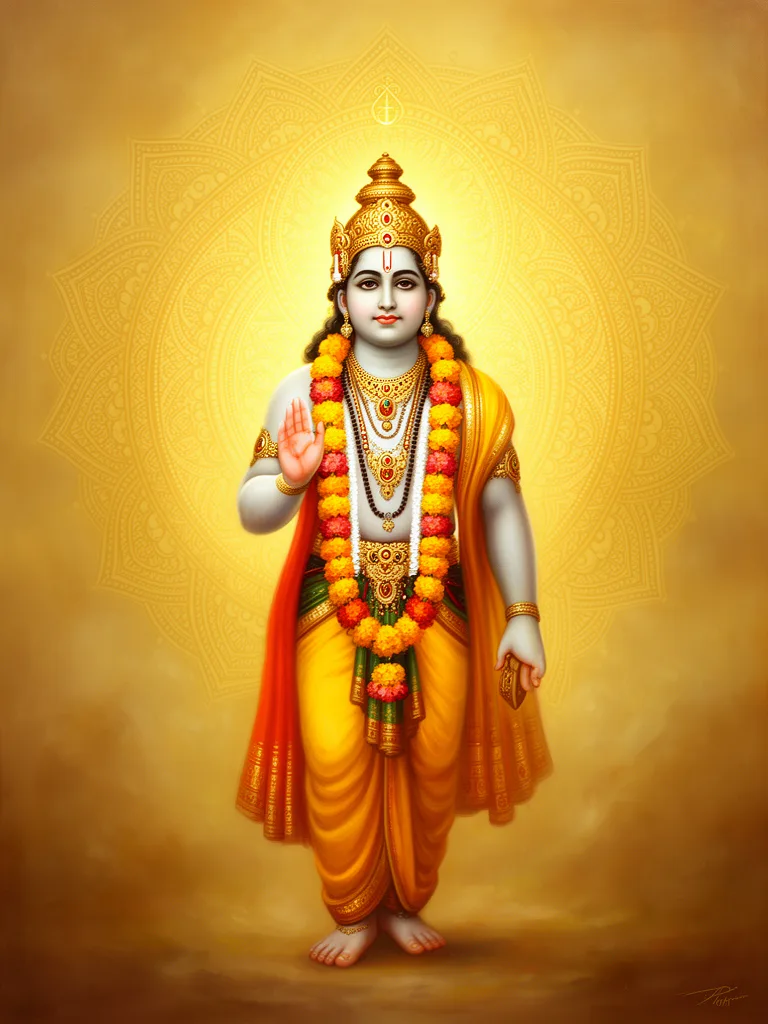
Rama is a central deity in Hinduism, revered as the seventh avatar of Vishnu, the preserver god. He is the protagonist of the epic Ramayana, embodying ideal kingship, righteousness (dharma), and devotion. His life story illustrates the triumph of good over evil.
Where the word comes from
Sanskrit, from the root "ram," meaning "to delight," "to please," or "to be joyful." The name signifies one who gives delight. The full name, Ramachandra, combines "Rama" with "Chandra" (moon), suggesting a radiant or auspicious presence. It is a foundational name in Vedic literature.
In depth
The seventh avatar or incarnation of Vishnu; the eldest son of Kinjr Dasaratha. of the Solar Race. Ilis full name is RTimaChandra. and he is the hero of the RamCvjana. He married Sita, who was tht> ft-male avatar of Lakshmi. Vishnu's wife, and was carried away by Ravana the Demon-King: of Lanka which act led to the famous war.
How different paths see it
What it means today
The figure of Rama, the seventh avatar of Vishnu, resonates through the vast expanse of Hindu thought not simply as a divine king but as the very embodiment of dharma. Mircea Eliade, in his explorations of myth and reality, would recognize in Rama's narrative a potent archetype, a terrestrial manifestation of celestial perfection that guides human conduct. The Ramayana, that epic saga of his life, is more than a historical account; it is a living scripture, a blueprint for righteous living.
Rama’s journey, from his idyllic youth in Ayodhya to his exile and the epic battle to reclaim his abducted wife Sita, presents a profound exploration of duty and sacrifice. He is the ideal son, the ideal husband, the ideal ruler, yet he is also a figure who experiences profound sorrow, separation, and the weight of kingship. This relatable humanity, woven into his divine essence, allows devotees to connect with him on a deeply personal level. His unwavering commitment to truth, even when it leads to personal hardship, offers a timeless lesson in integrity.
The story of Rama is not a passive contemplation of virtue but an active demonstration of its pursuit. His legendary bow, the Gandiva, and his prowess in battle against the demon king Ravana symbolize the constant struggle against ignorance and malevolence, both within the individual and in the wider world. As Carl Jung might observe, Rama represents the integration of the shadow, the conscious effort to bring order and light to the darker aspects of existence. His reign, known as Rama Rajya, remains an aspirational ideal of a just and prosperous society, a testament to the enduring power of righteous governance. The very name "Rama" itself, derived from the root ram, meaning to delight, suggests that the highest form of joy is found in living in accordance with divine law.
RELATED_TERMS: Vishnu, Ramayana, Sita, Dharma, Avatar, Krishna, Hanuman, Moksha
Related esoteric terms
Books on this concept






No reflections yet. Be the first.
Share your interpretation, experience, or question.
