Lotus
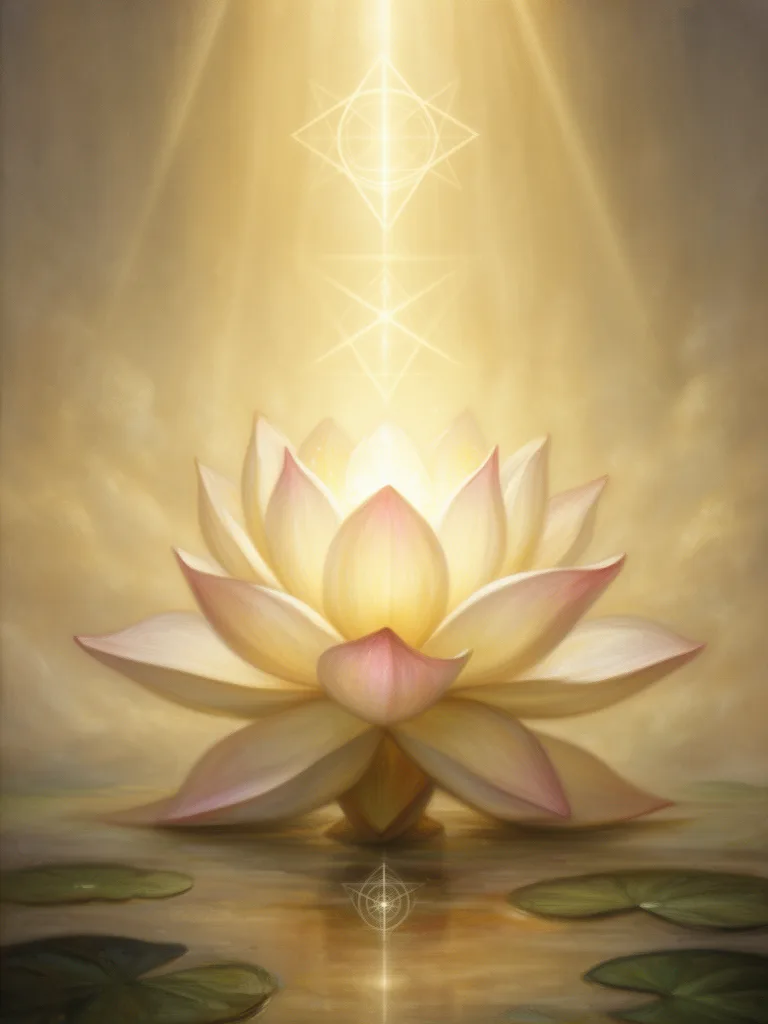
The lotus is a sacred aquatic flower, symbolizing purity, rebirth, and spiritual enlightenment across many ancient cultures. Its ability to rise from murky waters to bloom unsullied makes it a potent metaphor for transcending worldly defilements and achieving spiritual perfection.
Where the word comes from
The English word "lotus" derives from the Greek lōtos, a term used for various plants, including the water lily. Its origins are ancient, possibly tracing back to Semitic roots. In Sanskrit, the related term padma denotes the lotus, a word deeply embedded in Indic traditions.
In depth
A most occult plant, sacred in E«rypt. India and els«'where ; called "the child of the I'liivcrse bearinj; the likeness of its mother in its bosom". There was a time "when the world was a golden lotus" (pa<hna) says the allegory. A great variety of these plants, from the majestic Indian lotus, down to the nuirsh-lotus (bird's foot trefoil) and the Grecian " Dioscoridis". is eaten at Ci-ctc and other islands. It iS a species of nympha^a. first introduced from hulia to Egypt to which it was not indigenous. .See the text of Archaic Symbolism in the Appendix VIII. ''The Lotus, as a Universal Symbol". Lotus, Lord of iht . A title ai>i)lied to the various creative gods, as also to the Lords of the rniverse of wliicli this i>laiit is tlie symbol. (See "Lotus"). Love Feasts, Af/upin (Gr.). Tliese banquets of charity held by the earliest Christians were founded at Rome by Clemens, in the reign of Domitian. Professor A Kestner's The Agaim or the Secret World Soriitif (W'ilibund) of the Primitin Christians (pu])lished 1S19 at Jena) speaks of these Love Feasts as "having hierarchical constitution, and a groumlwork of Masonic symbolism and Mysteries"; and shows a direct connection between the old Agapie and the Table Lodges or Banquets of the Freemasons. Having, however, exiled from their suppers the "holy kiss" and women, the banquets of the latter are rather "drinking" than "love" feasts. The eai-ly Agapa' were certainly the same as the Phallica, which ''were once as pure as the Love Feasts of early Christians" as j\Ir. Bonwick very justly remarks, "though like them rapidly degenerating into licentiousness". {Eg. Bel. and Mod. Thought, p. 260 V Lower Face mJjower Countenance (Kah.). A tei-ni ai)plied to .Microprosopus, as that of "Higher Face" is to Macroprosopus. The two are identical with Long Face and Short Face. Lubara fChald.). The god of Pestilence and Disease.
How different paths see it
What it means today
The lotus, that ethereal bloom born from the dark embrace of the water's floor, offers a perennial lesson in spiritual resilience. Mircea Eliade, in his seminal works on comparative religion, recognized such natural phenomena as potent archetypal symbols, capable of conveying profound truths across disparate cultures. The lotus, in particular, with its roots firmly anchored in the muddy depths while its radiant blossom greets the sun, has long served as a universal emblem of purity and spiritual rebirth. In ancient Egypt, it was associated with the sun god Ra, emerging daily from the primordial waters, a daily resurrection mirroring the soul's potential for renewal.
For the modern seeker, adrift in the often murky waters of contemporary life, the lotus is not merely a decorative motif but a call to inner discipline. It suggests that true spiritual progress does not necessitate withdrawal from the world, but rather a cultivated detachment, an ability to maintain one's inner radiance amidst external challenges. Carl Jung might have seen in its unfolding petals a manifestation of the individuation process, the gradual realization of the self, moving from the unconscious depths towards conscious integration. The practice, then, is to cultivate this "lotus-consciousness"—to remain grounded in reality yet aspire to the light, to be present in the world without being consumed by its imperfections. This ancient symbol invites us to find our own unsullied center, even as the currents of life swirl around us.
Related esoteric terms
Books on this concept








No reflections yet. Be the first.
Share your interpretation, experience, or question.
