Larva
A "larva" in esoteric thought refers to the lingering energetic imprint or "shadow" of a deceased being, particularly one whose consciousness has not fully dissolved or integrated after death. It represents a form of psychic residue, often associated with unresolved desires or unfinished earthly business, that can persist and potentially influence the living.
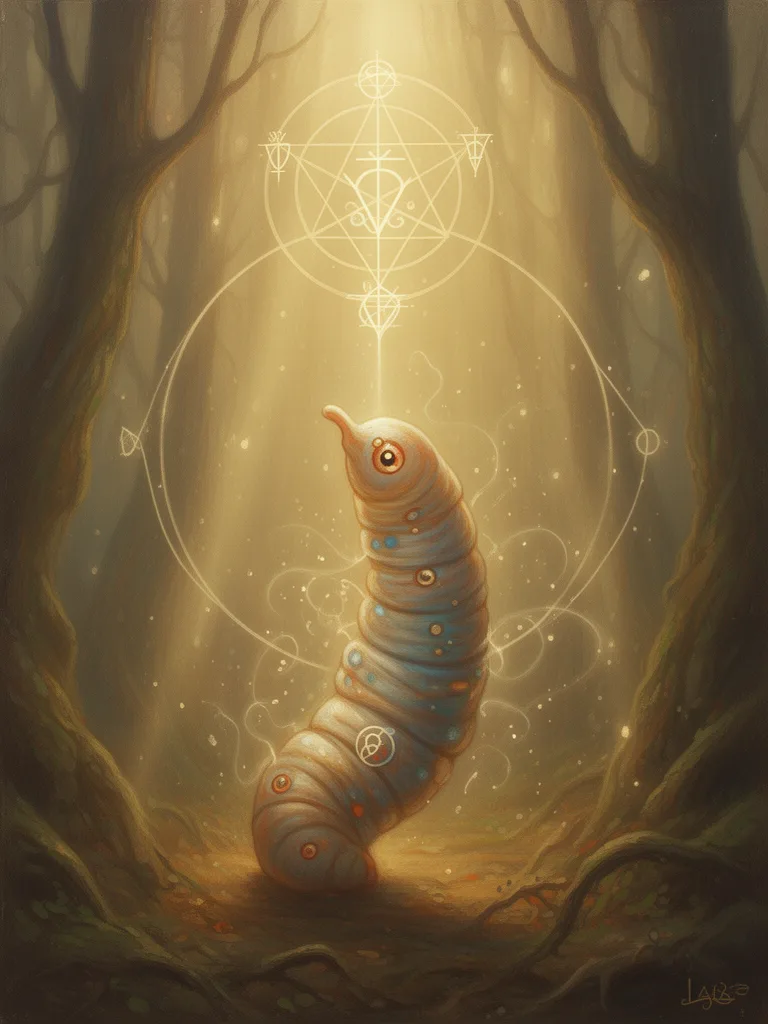
Where the word comes from
The term "larva" derives from Latin, meaning "mask" or "specter," evoking an image of something that conceals or mimics a former presence. In occultism, it's used metaphorically to describe the disembodied, unintegrated psychic remnants left behind by a soul, distinct from the soul's true essence.
In depth
The animal Soul. Larva are the shadows of men that have lived and died. 17 1 THIXXSOPHIC.U. Law of Retribution. i,Sn•'Karma"). Laya or Latfum (Sk.V From the root Li "to (lis.solvr, to disiii tijrrati'" a point of o(iiiilil>i"iMm {zrro-poini) in jihysics and chemistry. In oi'i'ultism, that point where .sul)stanee becomes liomoj^eiu'oiis and is unable to act or differentiate.
How different paths see it
What it means today
Blavatsky's definition of "larva" as the "animal soul" or "shadows of men that have lived and died" offers a potent, if somewhat stark, lens through which to view the persistence of consciousness beyond the physical form. It speaks to a form of psychic archaeology, where the energetic residue of past lives, or even intense moments within a single life, can leave imprints on the subtle planes. This is not so far removed from the psychological concept of the shadow, as described by Carl Jung, the disowned aspects of the self that can manifest in unexpected and sometimes disruptive ways. The "larva" suggests a similar phenomenon on a broader, cosmic scale, a psychic detritus that arises from incompletely resolved earthly existences.
The term also touches upon the idea of "laya centers" or points of dissolution, a concept found in Sanskrit traditions, where substance becomes undifferentiated. In the context of a larva, this might imply a state where the individual consciousness has not fully dissolved into the universal, nor fully integrated its experiences, thus remaining in a liminal, undifferentiated state. This echoes the Sufi notion of the nafs, the lower self or ego, which, if not purified, can persist as a source of illusion and attachment even after physical death, hindering the soul's ascent. The persistent energy of a larva, therefore, can be seen as a consequence of an unfulfilled journey, a soul tethered by the very desires and identifications it sought to transcend. It serves as a potent reminder that the work of integration and dissolution is not confined to the living hours but may, in its incomplete forms, extend into the post-mortem existence.
Related esoteric terms
Books on this concept



No reflections yet. Be the first.
Share your interpretation, experience, or question.
