Theli
Theli is a symbolic name for the encompassing serpent or dragon that represents the universe in esoteric traditions. It signifies the totality of existence, often associated with the primordial waters and cosmic cycles of creation and dissolution.
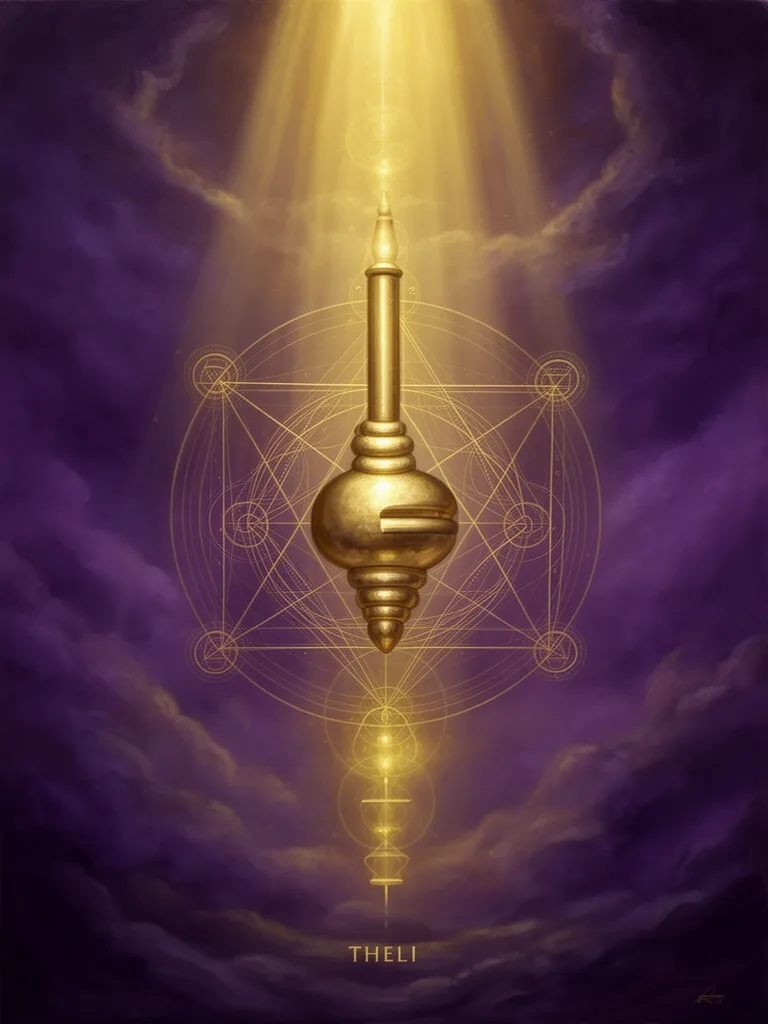
Where the word comes from
The term "Theli" originates from Chaldean, meaning "the serpent" or "the dragon." In Hebrew gematria, it is represented by the letters TLI (תלי), which numerically equals 440. This number is linked to Mem (מ), symbolizing water, the primordial element.
In depth
The great dragon said to environ tlie universe svmbolieally. In Hebrew letters it is TLI=400-h304-10=440 : when "its crest [initial letter] is repressed", said the Rabbis, 40 remains, or the equivalent of Mem; ]\r=Water, the waters above th(^ firmament. Evidently the same idea as s^'mbolised by Shesha — the Serpent of Vishini. Theocrasy. Lit., "mixing of gods". The worship of various gods, as that of Jehovah and the gods of the Gentiles in the ease of the idolatrous Jews. Theodicy. "Divine riglit". i.e.. the privilege of an all-merciful and just God to afflict tlie innocent, and damn those predestined, and still I'emain a loving and just Deity: theologically — a mystery.
How different paths see it
What it means today
Theli, as rendered by Blavatsky, is more than a mere esoteric term; it is an invitation to perceive the universe as a living, breathing, and self-encompassing entity. The image of the great dragon or serpent, encircling all, evokes the profound antiquity of this cosmological vision, a concept that echoes across disparate cultures and epochs. Mircea Eliade, in his seminal works on myth and religion, frequently explored the archetype of the cosmic serpent as a symbol of primordial unity and the cyclical nature of time, a concept deeply embedded in the earliest human cosmogonies.
This serpentine totality speaks to a non-dual understanding of existence, where the boundaries between creator and creation, beginning and end, dissolve. It is akin to the Hermetic principle of "As Above, So Below," suggesting that the macrocosm, the universe represented by Theli, is mirrored in the microcosm, the individual soul. The numerical value of TLI (440) and its connection to Mem, the Hebrew letter for water, further anchors this concept in the primordial waters from which all life emerges and to which it ultimately returns, a theme explored by Carl Jung in his analyses of archetypal imagery.
Theli, in its encapsulation, suggests a divine immanence, a presence that is not merely external but is the very fabric of reality. This resonates with Sufi notions of the divine encompassing all existence, a concept often expressed through metaphors of divine love or light that permeates every atom. Theli thus challenges a fragmented worldview, urging us to recognize the interconnectedness of all phenomena and the singular, animating principle that binds them together. It is a reminder that we are not merely inhabitants of the universe, but are, in a profound sense, part of its very being, a serpentine coil of cosmic consciousness.
RELATED_TERMS: Ouroboros, Shesha, Primordial Waters, Cosmic Serpent, Macrocosm, Microcosm, Non-duality, Eternity
Related esoteric terms
Books on this concept







No reflections yet. Be the first.
Share your interpretation, experience, or question.
