India
The primordial, sacred syllable "Om" (or "Aum") is a foundational mantra in Indic religions, representing the ultimate reality, the cosmos, and the divine. It is chanted to invoke spiritual awareness and connect with universal consciousness.
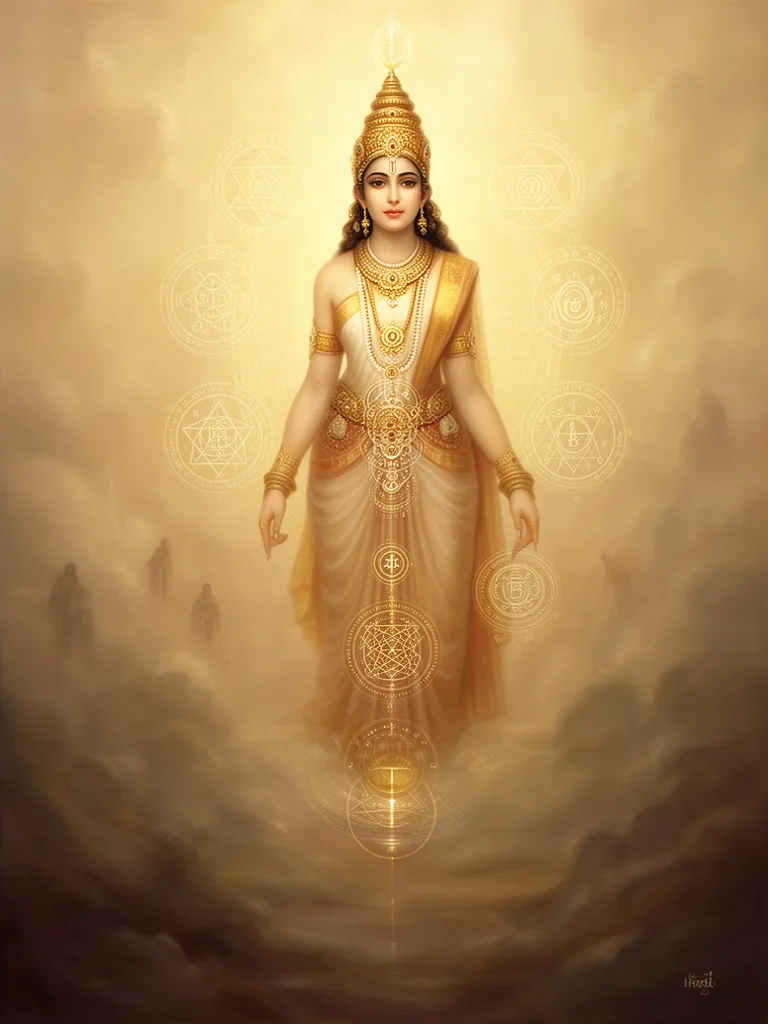
Where the word comes from
The Sanskrit word "Om" (also transliterated as "Aum") is derived from the Vedic tradition. Its roots are ancient, appearing in the Upanishads. The three phonetic components, A, U, and M, are often interpreted as representing creation, preservation, and destruction, or the three states of consciousness: waking, dreaming, and deep sleep.
In depth
It is "an invocation, a benediction, an affirmation and a ])romise"; and it is .so sacred, as to be indeed ihe word at low breath of occult, primitive masonry. No one must be near when the syllable is pronounced for a purpose. This word is usually placed at the beginning of sacred Scriptures, and is prefixed to prayers. It is a compound of three letters a, ii, m, which, in the popular belief, are typical of the three Vedas, also of the three gods — A (Agni) V (Varuna) and M (jMaruts) or Fire, Water and Air. In esoteric philosophy these are the three sacred fires, or the "triple fire" in the Universe and Man, besides many other things. Occultly, this "triple fire" represents the highest TctraMfjn also, as it is typified by the Agni named Abhimanin and his transformation into his three sons, Pavana, Pavamana and Suchi, "who drinks up water", i.e., destroys material desires. This monosyllable is <'alled T^dgitta, and is sacred with both Brahmins and Buddhists.
How different paths see it
What it means today
The monosyllable Om, or Aum, is far more than a simple utterance; it is a sonic microcosm of the universe, a whispered secret of existence itself. As Helena Blavatsky astutely notes, it is a "compound of three letters" that, in their popular and esoteric interpretations, encapsulate the totality of creation, preservation, and dissolution, mirroring the divine trinity found across many spiritual systems. In the Hindu tradition, it is the primordial sound, the vibration that birthed the cosmos, the very breath of Brahman. Its chanting is a practice that transcends mere recitation, becoming a form of sonic meditation, a way to attune the individual consciousness to the universal rhythm.
The scholar Mircea Eliade, in his explorations of archaic religions, often highlighted the power of sacred sounds and words to connect the human realm with the divine. Om functions in this capacity, acting as a bridge, a conduit for spiritual energy. Its tripartite nature, A-U-M, has been interpreted in myriad ways, each layer offering a deeper insight. The A, the initial guttural sound, can be seen as the unmanifest potential, the primal urge to be. The U, the sustained hum, represents the active unfolding of creation, the ongoing process of existence. And the M, the nasal resonance, signifies the dissolution, the return to the unmanifest, or the deep, silent awareness that underlies all states. This cyclical understanding is fundamental to many Eastern philosophies, reflecting a cosmic dance of emergence and absorption.
Beyond its cosmological significance, Om is a potent tool for inner transformation. The practice of chanting Om, particularly in its prolonged form, can induce a meditative state, quieting the incessant chatter of the egoic mind. As D.T. Suzuki observed regarding Buddhist meditation, the repetition of mantras helps to focus the mind and cultivate a state of mindful presence. The vibration of Om resonates within the body, stimulating the chakras and harmonizing the subtle energies. It is an invitation to listen not just with the ears, but with the entire being, to the silent music of the soul. This ancient sound continues to offer modern seekers a profound pathway to inner peace and a direct apprehension of the interconnectedness of all things, reminding us that within the seemingly small, the infinite is contained.
Related esoteric terms
Books on this concept








No reflections yet. Be the first.
Share your interpretation, experience, or question.
