Dises
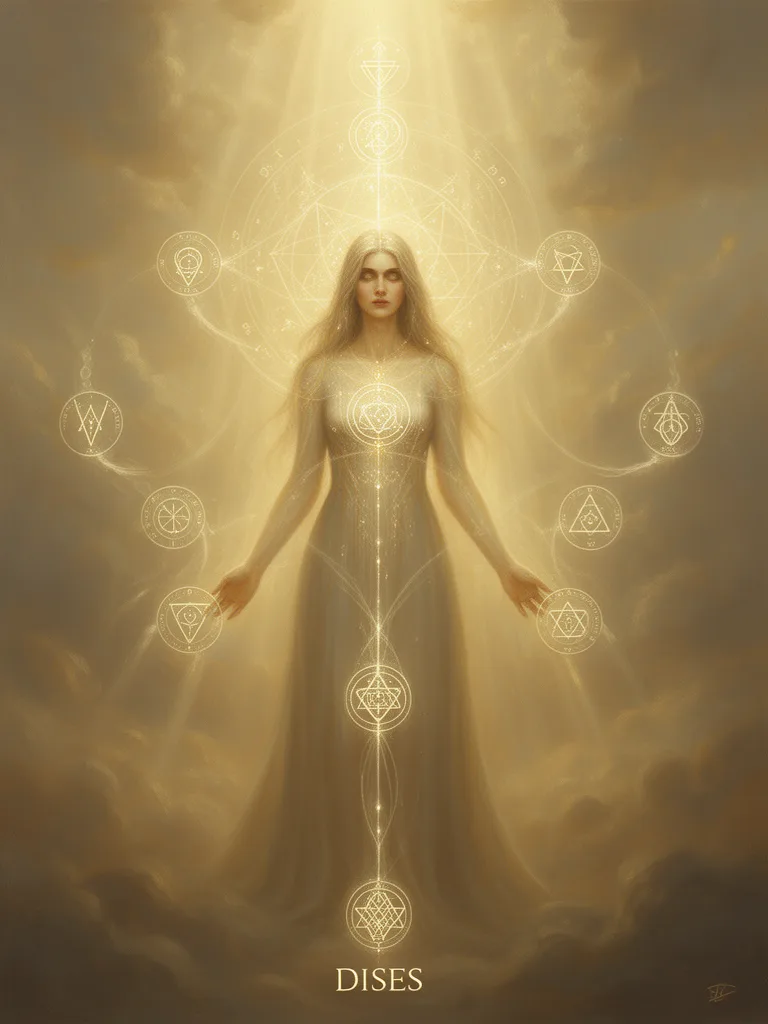
Dises refers to a form of sun worship, particularly associated with the Aten disk in ancient Egypt. It signifies the celestial body as a symbol of universal deity, creation, and the soul's emblem, echoing across various ancient traditions as a representation of divine power.
Where the word comes from
The term "Dises" is presented by Blavatsky as a later name for figures like Valkyries or Norns, directly linked to "disk-worship." This worship, particularly of the Aten disk in Egypt, is connected to sun veneration, with roots possibly tracing to Dravidian influences from Southern India and Ceylon, linking it to the concept of Adonai, the "Lord of Heaven."
In depth
The later nanif for the divine women called Walk\ries, Xorns, etc., in the Edda. Disk-worshij). This was very eominon in Ejryi)t but not till later times, as it began with Amenoph III., a Dravidian. who brought it from Soutiiern India and Ceylon. It was Sun-worship under another form, the Aten-Ncphru, Aten-Ra being identical with the Adonai of the Jews. the "Lord of Heaven" or the Sun. The winged disk was the emblem of the Soul. The Sun was at one time the symbol of Universal Deity shining on the whole world and all creatures; tlie Sabteans regarded the Sun as the Demiurge and a Universal Deity, as did also tiie Hindus, and as do the Zoroastrians to this day. The Sun is undeniably the one creator of physical nature, Lenormant was obliged, notwithstanding his orthodox Christianity, to denounce the resemblance between disk and Jewish worship. "Ateu represents the Adona'i or Lord, the Assyrian Tammuz, and the Syrian Adonis. . . ." {The Gr. Dionys. Myth.)
How different paths see it
What it means today
Blavatsky's "Dises" offers a fascinating, if somewhat conflated, lens through which to view the pervasive ancient veneration of the Sun. While the etymological leap to Valkyries and Norns might be a point of scholarly contention, the core concept of "disk-worship" as a manifestation of solar divinity speaks to a fundamental human impulse to find the sacred in the celestial. Mircea Eliade, in his seminal works on shamanism and the history of religions, consistently highlights the Sun's role as a primeval source of life and spiritual power, a cosmic father figure whose light banishes darkness and ignorance. The Egyptian Aten, a radiant disk, embodies this perfectly, representing not just a physical orb but the very essence of creative energy.
The association with "Adonai" and other solar deities across cultures—Tammuz, Adonis—underscores a pan-cultural archetype. This isn't simply about worshipping a star; it's about recognizing a principle of illumination, of consciousness, that is both immanent and transcendent. The winged disk as an emblem of the soul is particularly resonant. It suggests a soul that is not earthbound but capable of soaring, of connecting to the divine light from which it originates. This echoes the Gnostic concept of the spark of divine light trapped within the material world, yearning for its celestial home, or the Sufi notion of the heart as a mirror reflecting the divine Sun. The Dises, in this light, become a symbol of that luminous journey, a reminder that the divine is not only above us but within us, a radiant disk waiting to be recognized. The persistence of solar symbolism across millennia suggests a deep psychological and spiritual need to align with this ultimate source of life and consciousness.
RELATED_TERMS: Aten, Sun worship, Solar deities, Divine Light, Cosmic Egg, Aura, Soul, Logos
Related esoteric terms
Books on this concept








No reflections yet. Be the first.
Share your interpretation, experience, or question.
