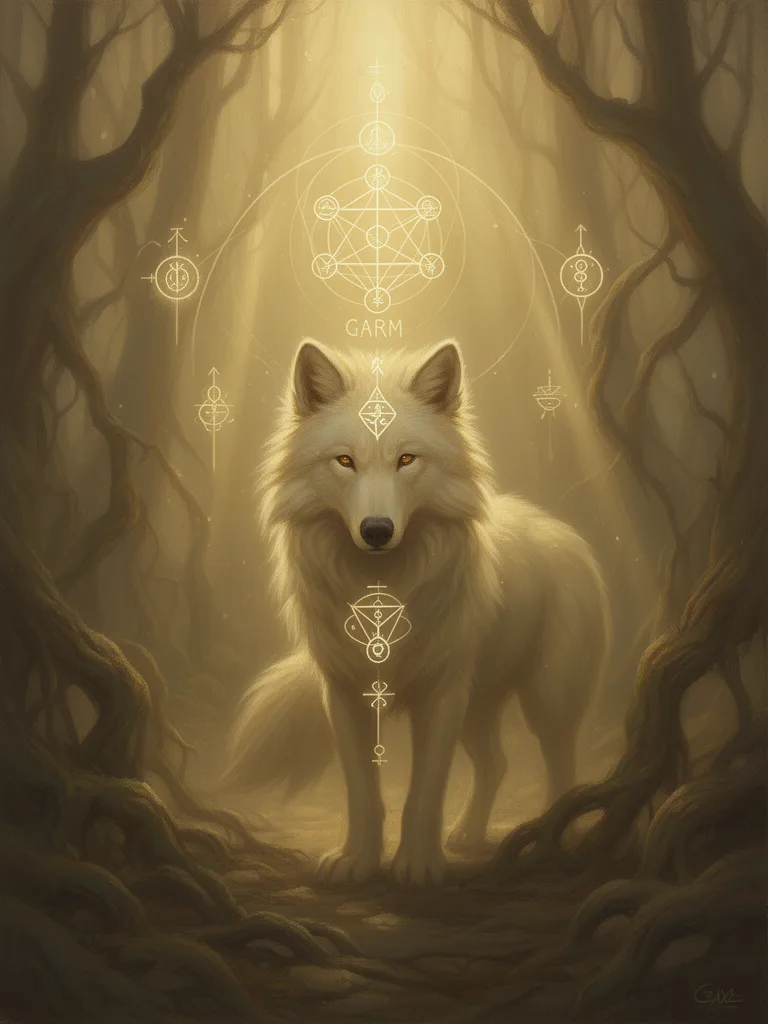
Garm
Garm is a monstrous hound from Norse mythology, guarding the underworld and its queen, Hel. He is depicted as a fearsome creature, often associated with the abyss and the final battle of Ragnarök, where he is prophesied to fight and be slain by the god Tyr.
Where the word comes from
The etymology of "Garm" is uncertain, though it is likely related to Proto-Germanic words for "dog" or "wolf." Some scholars suggest a connection to the Old Norse word "garðr" meaning "enclosure" or "yard," hinting at his role as a guardian. The term appears in the Poetic Edda and Prose Edda.
In depth
The Cerberus of the Edda. This monstrous dog lived in the Gnypa cavern in front of the dwelling of Hel, the goddess of the nether-world.
What it means today
Garm, the monstrous hound of Norse lore, is more than a mere beast guarding the gates of Helheim. He is a profound symbol of the boundary between the known and the unknown, the living and the dead, the ordered cosmos and the primal chaos that lurks at its edges. Like Cerberus in the Greek tradition, Garm’s role is to keep what is within, within, and what is without, without. Yet, in Norse mythology, this boundary is not static; it is destined to be breached. Garm's ultimate fate is intertwined with Ragnarök, the twilight of the gods, where he is prophesied to break free and engage in a final, fatal struggle with Tyr, the god of law and heroic glory.
This confrontation is deeply resonant. It suggests that even the most formidable guardians of the underworld, the embodiments of the abyss, are subject to the inexorable march of cosmic destiny. Garm's ferocity is not merely a threat but a manifestation of the untamed energies that must be contained for the world to function, and whose eventual release signifies a cataclysmic transformation. Mircea Eliade, in his explorations of the sacred and the profane, would recognize in Garm the archetypal guardian of liminal spaces, a figure whose presence defines the threshold and whose eventual overthrow heralds a new epoch. The dog, as a domesticated animal, often bridges the human and wild realms, but Garm is the wildness unleashed, the primal fear given form. His gnashing teeth and howling are the sounds of the unconscious, the deep earth, the forces that lie beyond human control, forces that must be acknowledged, even as they are held at bay.
The struggle between Garm and Tyr is not just a physical battle; it is a symbolic clash between primal chaos and divine order, a battle that ends in mutual destruction, paving the way for a reborn world. This echoes the cyclical nature of existence, where destruction is not an end but a prelude to creation. Garm, in his terrifying aspect, reminds us that the journey into the depths of the psyche, or the mysteries of existence, often requires confronting that which guards the threshold of the unknown, a guardian whose very nature is a testament to the power of what lies beyond.
RELATED_TERMS: Cerberus, Helheim, Ragnarök, Underworld, Chaos, Threshold Guardian, Archetype, Liminality
Related esoteric terms
Books on this concept








No reflections yet. Be the first.
Share your interpretation, experience, or question.
