Ad
Ad is an ancient Aramaic term for "father," signifying a primal, singular source. Its root implies "one" or "the only one," pointing to an ultimate, indivisible divine principle or primordial being from which all existence emanates.
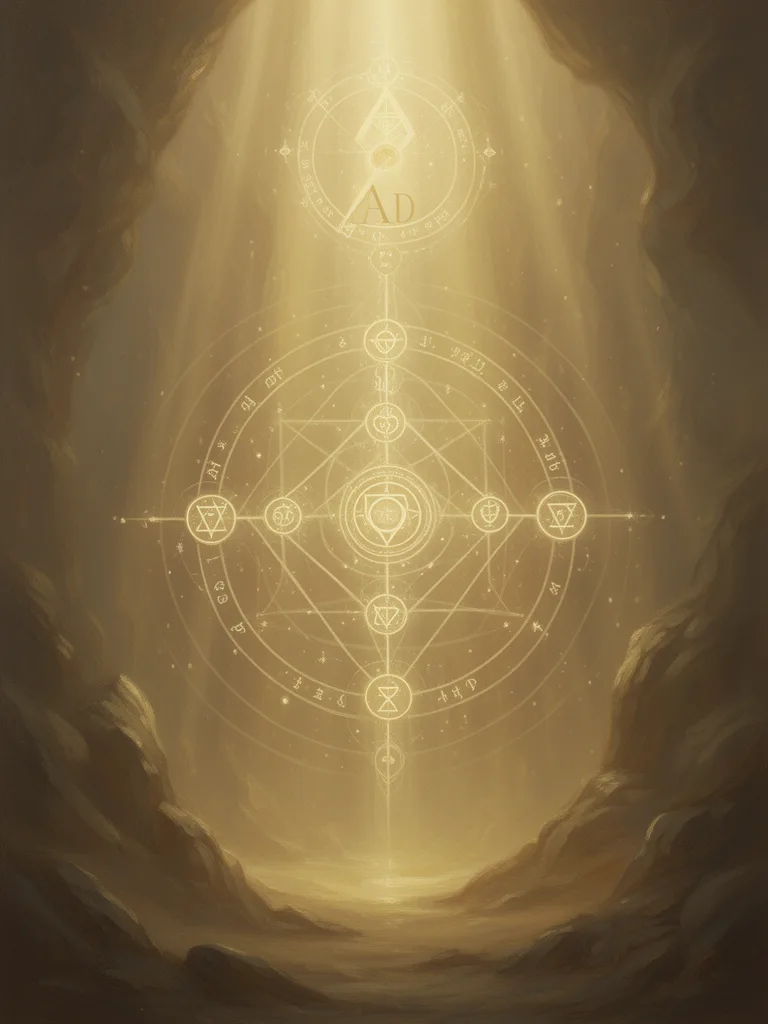
Where the word comes from
The word "Ad" derives from the Aramaic 'ād, meaning "father." The construction 'ād-'ād signifies "the only one" or "the one and only." This linguistic structure highlights a singular, ultimate progenitor, a concept found in various ancient Near Eastern languages and theological frameworks.
In depth
Ad, "the P^ather". In Aramean ad means one, and ad-ad ' ' the only one ' '.
How different paths see it
What it means today
Blavatsky's inclusion of "Ad" in her lexicon, even with its seemingly simple etymology, gestures toward a profound theological and philosophical bedrock that underpins many traditions. The Aramaic root, signifying both "father" and, through repetition, "the only one," speaks to a primal unity, a solitary source from which all differentiation springs. This is not the distant, anthropomorphic father of some later theological interpretations, but a more elemental, ontological principle. Think of it as the singular point of light before the prism fractures it into a spectrum, or the silent hum from which all sound emerges.
Mircea Eliade, in his exploration of the sacred, often highlighted how archaic cosmogonies begin with a state of undifferentiation, a primordial unity that is later broken to create the world. "Ad," in its implication of singular fatherhood, embodies this initial, unbroken state. It is the ultimate progenitor, yes, but also the sole existing entity before the act of creation. This resonates deeply with the Hindu concept of Brahman as the sole, undifferentiated reality, or the Kabbalistic Keter, the Crown, representing the ultimate divine will and the unknowable source of all emanation. The term invites contemplation of ultimate origins, not as a historical event, but as an ongoing ontological reality. It challenges the modern mind, accustomed to fragmentation and multiplicity, to conceive of a fundamental, irreducible oneness.
The profound intimacy of the Aramaic "Abba," a term Jesus used to address God, carries this paternal aspect, yet it also implies a direct, unmediated relationship to this singular source. It is a fatherhood that is both generative and absolute, encompassing all of existence within its singular being. This concept encourages a return to the root, to the primordial, to the One that precedes the Many, fostering a sense of connection to the fundamental fabric of reality. It is a reminder that beneath the apparent chaos and diversity of the cosmos, there may lie an essential, singular unity, a divine paternity that is the ultimate ground of all being.
RELATED_TERMS: Brahman, Keter, Ein Sof, Logos, Monad, Tao, Abba, Primordial Substance
Related esoteric terms
No reflections yet. Be the first.
Share your interpretation, experience, or question.
