Magus
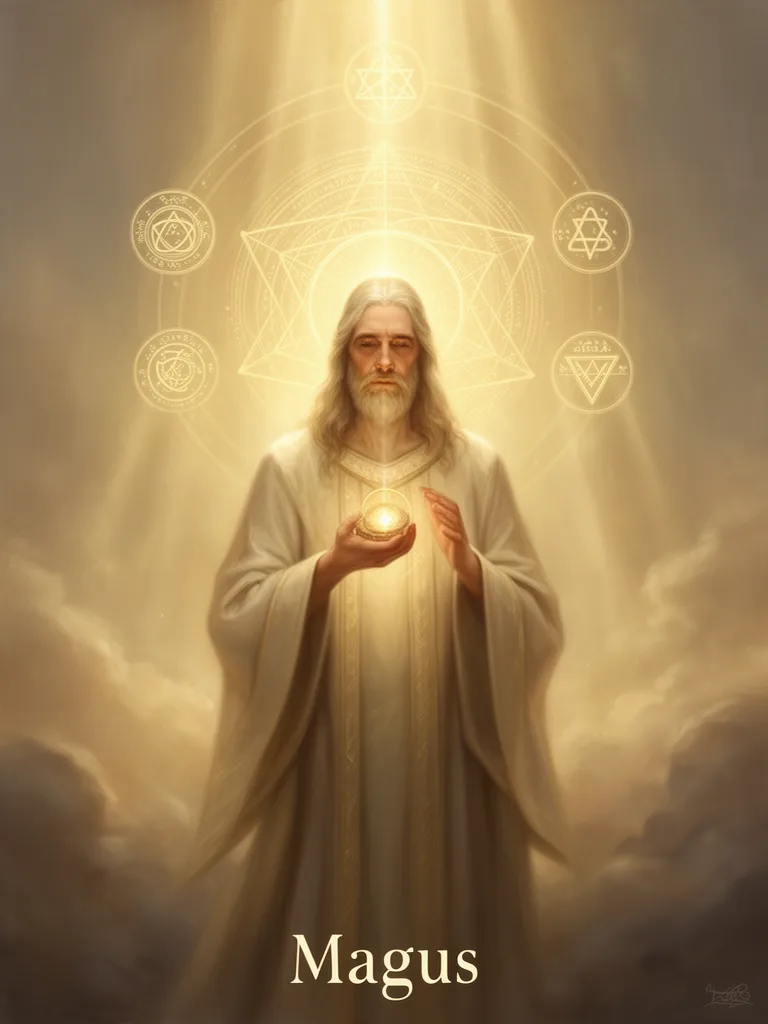
A Magus is a wise person, historically associated with ancient Persian or Chaldean sages. In later esoteric traditions, the term evolved to signify a practitioner of occult arts or a high-ranking member of secret societies, embodying profound spiritual and intellectual mastery.
Where the word comes from
The term "Magus" originates from the Latin "magus," derived from Greek "magos." This, in turn, comes from Old Persian "maguš," referring to a Zoroastrian priest or astrologer. The term first appears in classical Greek texts around the 6th century BCE, denoting a member of the Median priestly caste.
In depth
In the New Testament it means a Sage, a wise man of the Chaldeans ; it is in English often used for a ^Magician, any wonderworker ; in the Rosicrucian Society it is the title of the highest members, the IXth grade; the Supreme Magus is the Head of the Order in the "Outer"; the Magi of the "Inner" are unknown except to those of the Vlllth grade, [w.w.w.]
How different paths see it
What it means today
The figure of the Magus, as it emerges from the mists of antiquity and is refracted through Blavatsky's lens, offers a compelling archetype for the modern seeker yearning for more than superficial knowledge. The term, rooted in the priestly caste of Zoroastrianism, carried connotations of wisdom, astrological insight, and a profound connection to the divine order. Mircea Eliade, in his seminal works on shamanism and the sacred, often points to such figures as intermediaries, those who possess the "science of the ancients," capable of traversing the veiled thresholds between the seen and the unseen.
In the Western esoteric tradition, particularly as inherited by figures like Blavatsky, the Magus transcends the simplistic caricature of a conjurer. He is the adept, the one who has undergone a rigorous process of initiation, not just into secret societies, but into the very mechanics of the cosmos. This is a wisdom that requires not only intellectual acumen but also a profound ethical and spiritual discipline. It is the mastery of the self, as Carl Jung might suggest, the integration of the shadow and the ascent of consciousness, that truly empowers the Magus. The Rosicrucian hierarchy, mentioned by Blavatsky, where "Magus" denotes a high grade, speaks to this progression, a journey of increasing responsibility and esoteric understanding.
The Magus, therefore, is not a passive recipient of power but an active participant in the unfolding of reality. His "wonderworking" is not magic in the theatrical sense, but the intelligent application of spiritual laws, a consequence of his deep understanding of the interconnectedness of all things. This resonates with the contemplative traditions where profound insight leads to a transformation of being, allowing one to act with a grace and efficacy that appears miraculous to the uninitiated. The path of the Magus is one of sustained effort, a lifelong dedication to the pursuit of truth and the cultivation of inner light, a beacon for those who seek to understand the deeper currents that shape our world.
RELATED_TERMS: Gnosis, Adept, Initiate, Rishi, Yogi, Tzadik, Sage, Mystic ---
Related esoteric terms
Books on this concept






No reflections yet. Be the first.
Share your interpretation, experience, or question.
