Eagle
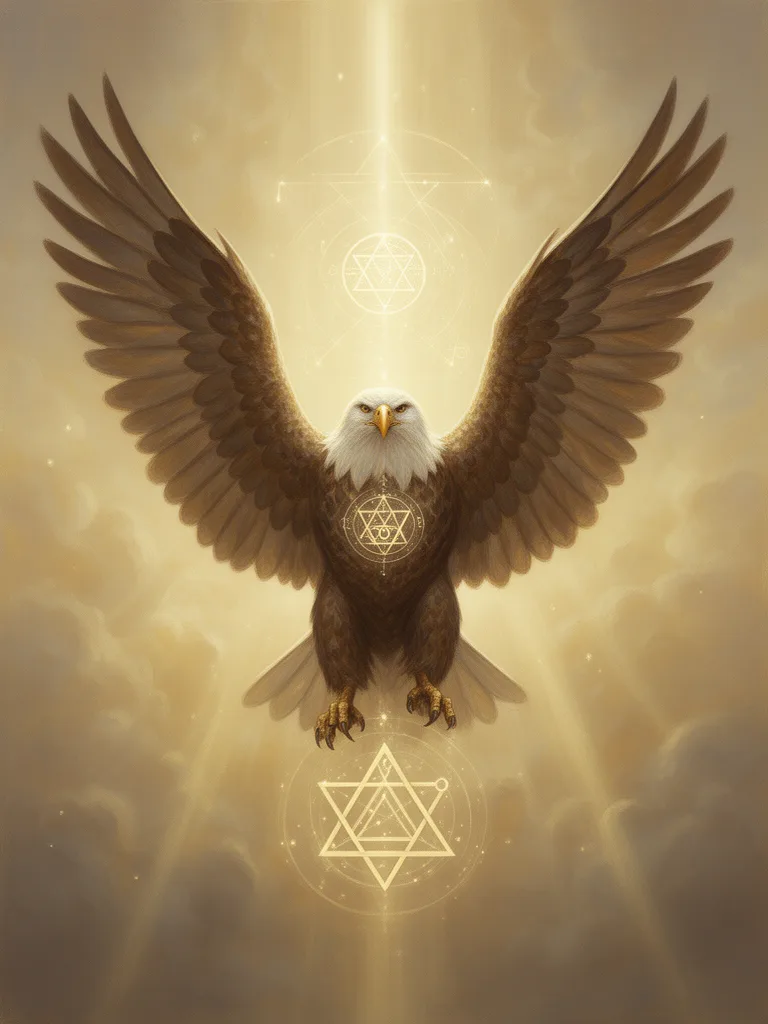
The eagle, an ancient symbol sacred to the sun and sky deities across cultures, represents divine power, swiftness, and spiritual ascent. Its image, often depicted with two heads in later traditions, signifies sovereignty and the union of opposing forces or realms.
Where the word comes from
The term "eagle" derives from the Latin "aquila," possibly from "aquilus" meaning dark-colored or dusky. Its symbolic lineage is ancient, appearing in Egyptian hieroglyphs as "Ah" and associated with Horus, the sun god. The Greeks linked it to Zeus, and Druids to their supreme deity.
In depth
This syml)ol is one of the most ancient. Witii the Greeks and Persians it was sacred to the Sun; with the Egyptians, under the name of Ah, to Horus, and the Kopts worshipped the eagle under the name of Ahom. It was regarded as the sacred emblem of Zeus by the Greeks, and as that of the highest god by the Druids. The symbol has pass(?d down to our day, when following the exami)le of the jiagan ]\Iarius. who, in the second century u.c. used the double-iieaded eagle as the ensign of Kome, the Christian crowned heads of Europe made the doubleheaded sovereign of the air sacred to themselves and their scions. Jupiter was satisfied with a one-headed eagle and so was the Sun. The imperial houses of Russia, Poland, Austria, Germany, and the late Empire of tlie Napoleons, have adopted a two-headed eagle as their device.
How different paths see it
What it means today
The eagle, that sovereign of the air, carries within its image a profound resonance for the seeker of hidden wisdom. It is not merely a bird of prey, but a celestial messenger, a visual poem of ascent. Mircea Eliade, in his seminal work on myth, reminds us that the sky gods, often associated with the eagle, represent the transcendent, the luminous pole of existence, a stark contrast to the chthonic, the earthly realm. The Egyptians, in their reverence for Horus, saw in the eagle the divine eye, the sun’s radiant gaze that pierces illusion and illuminates truth.
This symbolism transcends simple power; it speaks to a spiritual aspiration, a yearning for the lofty perspective that allows one to see the whole pattern, not just the immediate struggle. The double-headed eagle, a motif that captivated imperial imaginations from Rome to Byzantium, can be read through an alchemical lens, as Hermeticists might suggest, representing the marriage of opposites, the integration of the solar and lunar, the volatile and the fixed, a necessary step in the Great Work of spiritual transmutation. It signifies a vision that looks both East and West, past and future, or perhaps, as Carl Jung might interpret such archetypal imagery, a psyche capable of holding paradox, of integrating the conscious and unconscious, the personal and the universal.
The eagle, in its silent, majestic flight, embodies a state of being that is both grounded in its earthly existence and utterly free in its spiritual dimension. It is a reminder that true wisdom is often found not by digging deeper into the soil, but by learning to soar above it, to gain the panoramic vision that makes the intricate pathways of existence suddenly clear. The eagle is the eye that sees the divine in the mundane, the spirit that embraces the material without being bound by it. It invites us to cultivate a gaze that is both sharp and expansive, to seek the sun, even when clouds obscure the sky.
Related esoteric terms
Books on this concept








No reflections yet. Be the first.
Share your interpretation, experience, or question.
