Civ
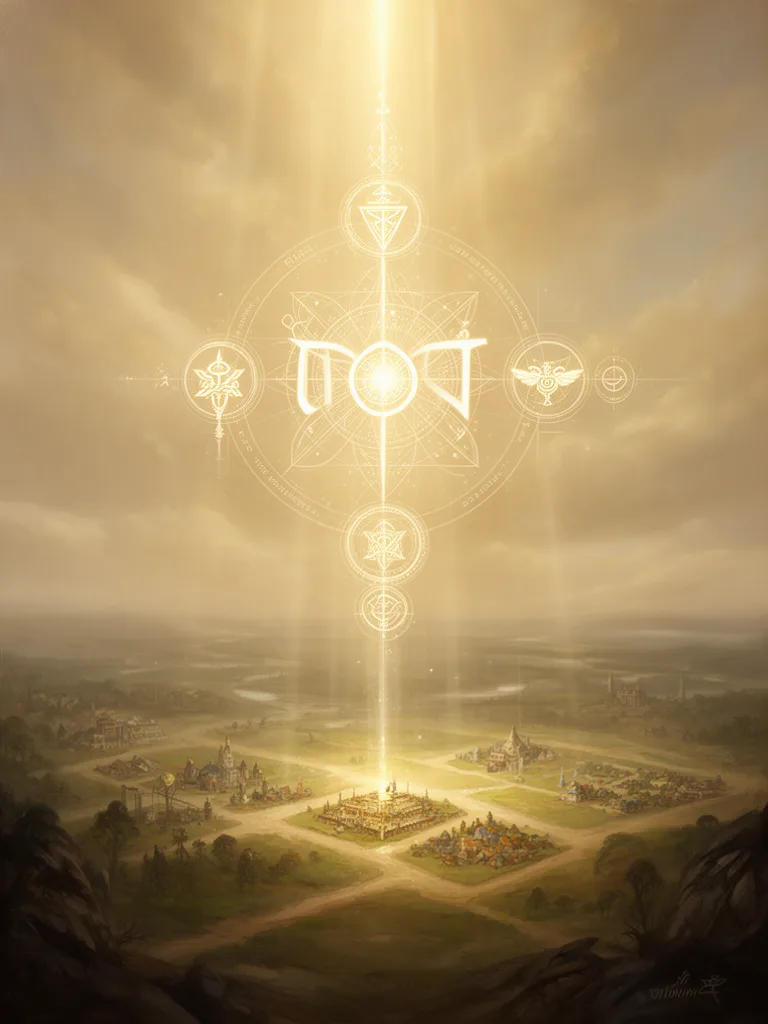
Civ, or *Civitas Dei*, is a Latin term meaning "City of God." It refers to a divine, perfect, and eternal spiritual realm contrasted with the earthly, temporal, and imperfect human world. The concept explores the ultimate destiny and true homeland of the faithful.
Where the word comes from
The term Civitas Dei is Latin, directly translating to "City of God." It originates from the title of Saint Augustine's seminal work, De Civitate Dei contra Paganos (The City of God against the Pagans), written in the early 5th century CE. The root civitas signifies a city, community, or state.
In depth
Dei. X., 9), just as Theosophy teaches. "Do not defile the divinity", he adds, "with the vain imaginings of men; you will not injure that which is for ever blessed (Buddhi-Manas) but you will blind yourself to the perception of the greatest and most vital truths". {Ad Marcellam, 18.) "If we would be free from the assaults of evil spirits, we must keep ourselves clear of those things over which evil spirits have power, for they attack not the pure soul whicli has no af^nity with them". {Dc Ahstin. ii., 43.) This is again our teaching. The Church Fathers held Porphyry as the bitterest enemy, the most irreconcilable to Christianity. Finally, and once more as in modern Theosophy, Porphyrj^ — as all the Neo-Platonists, according to St. Augustine — "praised Christ while they disparaged Christianity"; Jesus, they contended, as we contend, "said nothing himself against the pagan deities, but wrought wonders by their help". "Thej^ could not call him as his disciples did, God, but they honoured him as one of the best and wisest of men". (De Civ. Dei., xix., 23.) Yet, "even in the storm of controversy, scarcely a word seems to have been uttered against the private life of Porphyry. His system prescribed purity and ... he practised it". (See A Diet, of Christian Biography, Vol. IV., "Porphyry".)
How different paths see it
What it means today
Saint Augustine’s profound meditation on Civitas Dei offers a potent framework for understanding the human condition, a dichotomy that resonates deeply across spiritual traditions and continues to inform philosophical discourse. He posits two cities, two loves, and two destinies, a concept that, while rooted in Christian theology, echoes in the perennial search for a true home beyond the ephemeral. Mircea Eliade, in his explorations of the sacred and the profane, would recognize in this a fundamental human impulse to orient oneself toward a transcendent reality, a sacred geography that provides meaning and order to the chaos of lived experience.
The earthly city, driven by amor sui usque ad contemptum Dei (love of self even to the contempt of God), is characterized by its pursuit of temporal power, fleeting pleasures, and the construction of systems that ultimately crumble. It is a city built on sand, its foundations eroded by the ceaseless currents of change and human failing. In contrast, the Civitas Dei, founded on amor Dei usque ad contemptum sui (love of God even to the contempt of self), is a spiritual commonwealth, invisible yet profoundly real, whose citizens are those who have turned their hearts toward the divine. Their citizenship is not of this world; their true homeland is elsewhere, a place of eternal peace and perfect justice.
This spiritual geography is not merely an abstract theological construct. It suggests a practice of inner discernment, a constant turning away from the siren calls of worldly ambition and toward the quiet whisper of the divine within. It is akin to the Sufi concept of the fana (annihilation of the self) as a prelude to baqa (subsistence in God), where the illusory boundaries of the ego dissolve, revealing a deeper, more authentic mode of being. Theosophy, in its own way, speaks of planes of existence and the gradual ascent of the soul, a journey from the material to the spiritual, from the illusory to the real. The modern non-dual perspective might interpret the Civitas Dei as the recognition of the inherent oneness of all being, where the perceived separation between the earthly and the divine is ultimately an illusion of consciousness. The practice then becomes the realization of this inherent unity, the understanding that the "City of God" is not a destination to be reached but a state of being to be recognized.
The challenge for the modern seeker, as for Augustine, is to live authentically within the temporal realm while maintaining an unwavering orientation toward the eternal. It is to build one's life not on the shifting sands of worldly approval or material success, but on the bedrock of divine love and truth. This requires a profound act of will, a conscious choice to align one's desires and actions with a higher purpose, to be a citizen of the City of God even while sojourning in the imperfect landscapes of the earthly realm. It is a call to cultivate an inner citadel, a sanctuary of the spirit that remains inviolable amidst the storms of life.
RELATED_TERMS: Kingdom of God, Spiritual Realm, Eternal City, Heavenly Jerusalem, Gnosis, True Self, Inner Sanctuary, Divine Commonwealth
Related esoteric terms
Books on this concept








No reflections yet. Be the first.
Share your interpretation, experience, or question.
