Christian Kabbalah
Christian Kabbalah is a Renaissance-era movement where Christian scholars integrated Jewish Kabbalistic mysticism with Christian theology. They reinterpreted Kabbalistic concepts like the Sephirot to align with Christian doctrines, particularly the Trinity, seeking esoteric wisdom within scripture.
Where the word comes from
The term "Kabbalah" originates from the Hebrew word "qabbalah," meaning "reception" or "tradition." Christian Kabbalah emerged in the 15th and 16th centuries, a distinct branch that sought to synthesize Jewish mystical traditions with Christian dogma, often using the spelling "Cabala" to differentiate itself.
In depth
Christian Kabbalah arose during the Renaissance due to Christian scholars' interest in the mysticism of Jewish Kabbalah, which they interpreted according to Christian theology. Often spelled Cabala to distinguish it from the Jewish form and from Hermetic Qabalah, it sought to link Kabbalistic concepts with Christian doctrines, particularly the Trinity. Early proponents included Giovanni Pico della Mirandola and Johann Reuchlin, who adapted Kabbalistic ideas to Christian beliefs, sometimes using them...
How different paths see it
What it means today
The emergence of Christian Kabbalah during the Renaissance represents a fascinating intellectual and spiritual confluence, a moment when the boundaries between seemingly disparate traditions began to blur under the intense light of scholarly curiosity and a yearning for deeper spiritual understanding. Christian thinkers, drawn to the intricate symbolic language and cosmological frameworks of Jewish Kabbalah, saw not a foreign doctrine but a hidden key to unlocking the profound mysteries of their own faith. Figures like Giovanni Pico della Mirandola and Johann Reuchlin, steeped in Neoplatonism and Hermetic thought, approached Kabbalistic texts with a hermeneutic intent to discover Christian truths embedded within them.
They meticulously reinterpreted the ten Sephirot, the divine emanations on the Kabbalistic Tree of Life, mapping them onto concepts such as the Trinity, the nature of Christ, and the angelic hierarchy. This was not merely an act of syncretism but a profound attempt to find a universal grammar of the divine, a conviction that God's self-revelation, though expressed in diverse traditions, ultimately pointed to a singular, unified truth. Mircea Eliade, in his exploration of shamanism and the archaic cosmos, might see in this a recurring human impulse to bridge the earthly and the divine through symbolic mediation. Carl Jung's concept of the collective unconscious could also offer a framework for understanding how archetypal patterns, present in Kabbalistic imagery, resonated deeply within the Christian psyche, finding new expression.
The practice, for these scholars, involved rigorous study, comparative exegesis, and the creation of new symbolic systems that harmonized Kabbalistic diagrams with Christian iconography. It was an intellectual alchemy, transmuting ancient Hebrew mysticism into a form digestible and meaningful within a Christian theological context. The aim was often to prove the antiquity and universality of Christian revelation, suggesting that Kabbalah itself was a divinely inspired tradition that anticipated Christian doctrines. This intellectual endeavor, while distinct from its Jewish origins, highlights a persistent human desire to find echoes of the sacred across the diverse expressions of spiritual seeking. The pursuit of such esoteric knowledge, even when recontextualized, underscores a fundamental longing to perceive the divine architecture underlying all reality.
RELATED_TERMS: Hermeticism, Neoplatonism, Gnosticism, Christian Rosenkreuz, Theosophy, Mysticism, Esotericism, Symbolic Interpretation
Related esoteric terms
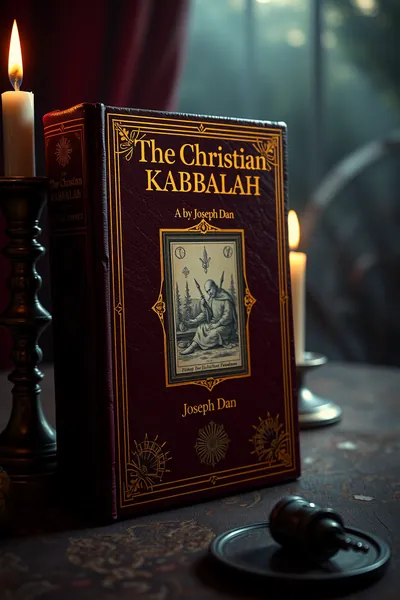
Books on this concept






No reflections yet. Be the first.
Share your interpretation, experience, or question.
