Bes
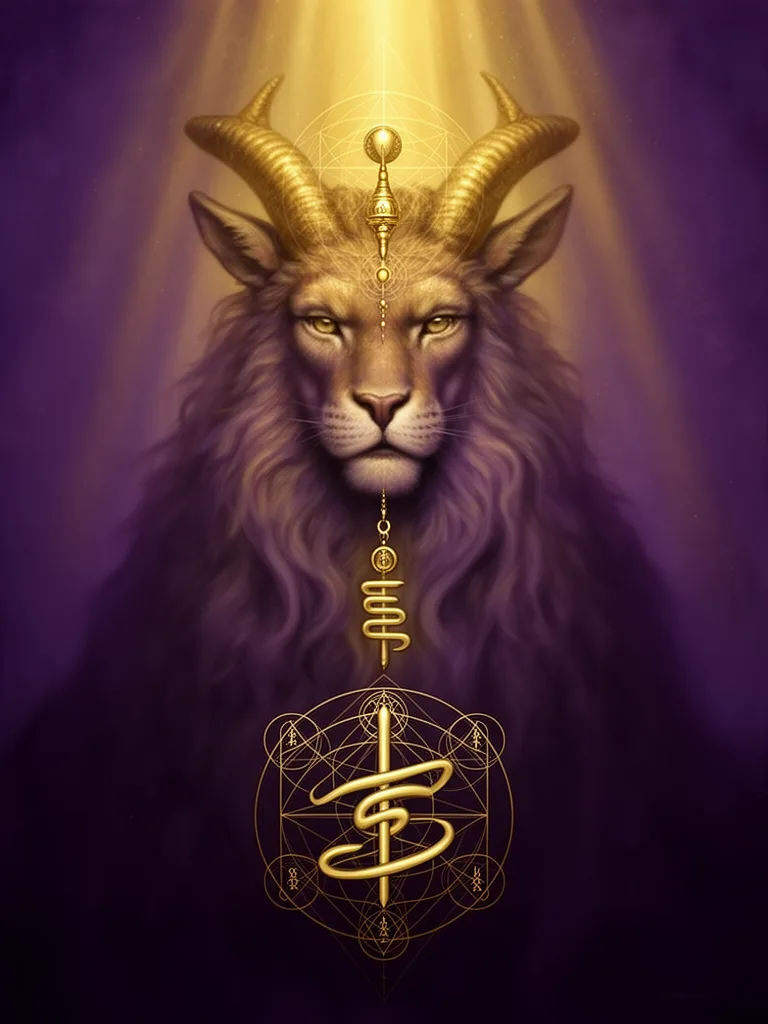
Bes is an ancient Egyptian deity, a household protector and bringer of joy and good fortune. Often depicted as a dwarf with leonine features, he wards off evil spirits and inspires music and dance, embodying a playful yet potent spiritual force.
Where the word comes from
The name "Bes" likely originates from the Egyptian word "bjs," meaning "to laugh" or "to sing," reflecting his association with joy and music. Its precise linguistic roots are debated, but it emerged in Egyptian iconography by the New Kingdom period, gaining widespread popularity.
In depth
A phallic god. the god of concupiscence and pleasure. He is represented standing on a lotus ready to devour his own progeny (Abydos). A rather modern deity of foreign origin. 52 THKOSdI'JIIAl. Bestla (Siiiinl.l. 'rindiUl^'litiT of the "Frost triaiits". till' sons of ^'IlliI•; inarrif(l to Huri, ;m<l the iiiotluT of Odiii and liis hrotlurs (tJilda). Beth ill'h.i. lloMs', (Iwflliiip:. Beth Elohim llih.). A Kab^alistic tj-i-atisc ti-fatin^r of the an}r»ls. souls of lucii. and dfUions. Tlu' nauic means "Iloiisf of the Gtids". Betyles (J'Ikih.). .Majrical stones. The ancient writers call them the "animated stones"; oracular stones, believed in iiiid used both In G(>ntih>s and Christians. (See S<ct. Dart. II. p. 342 i.
How different paths see it
What it means today
The image of Bes, the grinning dwarf god of ancient Egypt, offers a potent counterpoint to our often-solemn conceptions of the divine. Blavatsky's brief mention of him as a "phallic god" and "god of concupiscence and pleasure" hints at a primal, vital energy, but it is his pervasive role as a household protector, a guardian against nightmares and evil, that truly resonates. He was not confined to temples but adorned mirrors, beds, and cosmetic jars, a constant, intimate presence.
Mircea Eliade, in his explorations of shamanism and archaic religion, often highlighted the importance of liminal figures and protective spirits that straddle the boundaries between worlds. Bes, with his monstrous yet benevolent appearance, fits this archetype perfectly. He is a figure of the threshold, a jester who can also wield a sword against malevolent forces. His association with music and dance further connects him to ecstatic states, where the veil between the mundane and the sacred thins.
The Egyptians believed Bes could ward off snakes, scorpions, and other dangers, but also that he could bring good dreams and fertility. This dual capacity, to repel the negative and attract the positive, is a fundamental aspect of many spiritual traditions. In Sufism, for instance, the concept of baraka, divine blessing, can be invoked through various means, including ecstatic music and dance, which can disrupt stagnant energies and open channels for grace. Similarly, in Kabbalah, while the divine emanations are often approached with awe, there are also playful and accessible aspects of the divine, particularly in the lower sephiroth that interact with the material world.
Bes's enduring popularity, even as foreign deities rose and fell, speaks to a universal human need for a protector who is both formidable and approachable, who can confront darkness with a laugh rather than a frown. He embodies the idea that spiritual strength does not require grim austerity, and that joy itself can be a sacred act, a form of protection. His presence on everyday objects suggests that the sacred is not solely in the transcendent, but woven into the fabric of our daily lives, in the very air we breathe and the laughter we share. He invites us to consider the power of playfulness, the protective embrace of the absurd, and the divine in the everyday.
Related esoteric terms
Books on this concept





No reflections yet. Be the first.
Share your interpretation, experience, or question.
