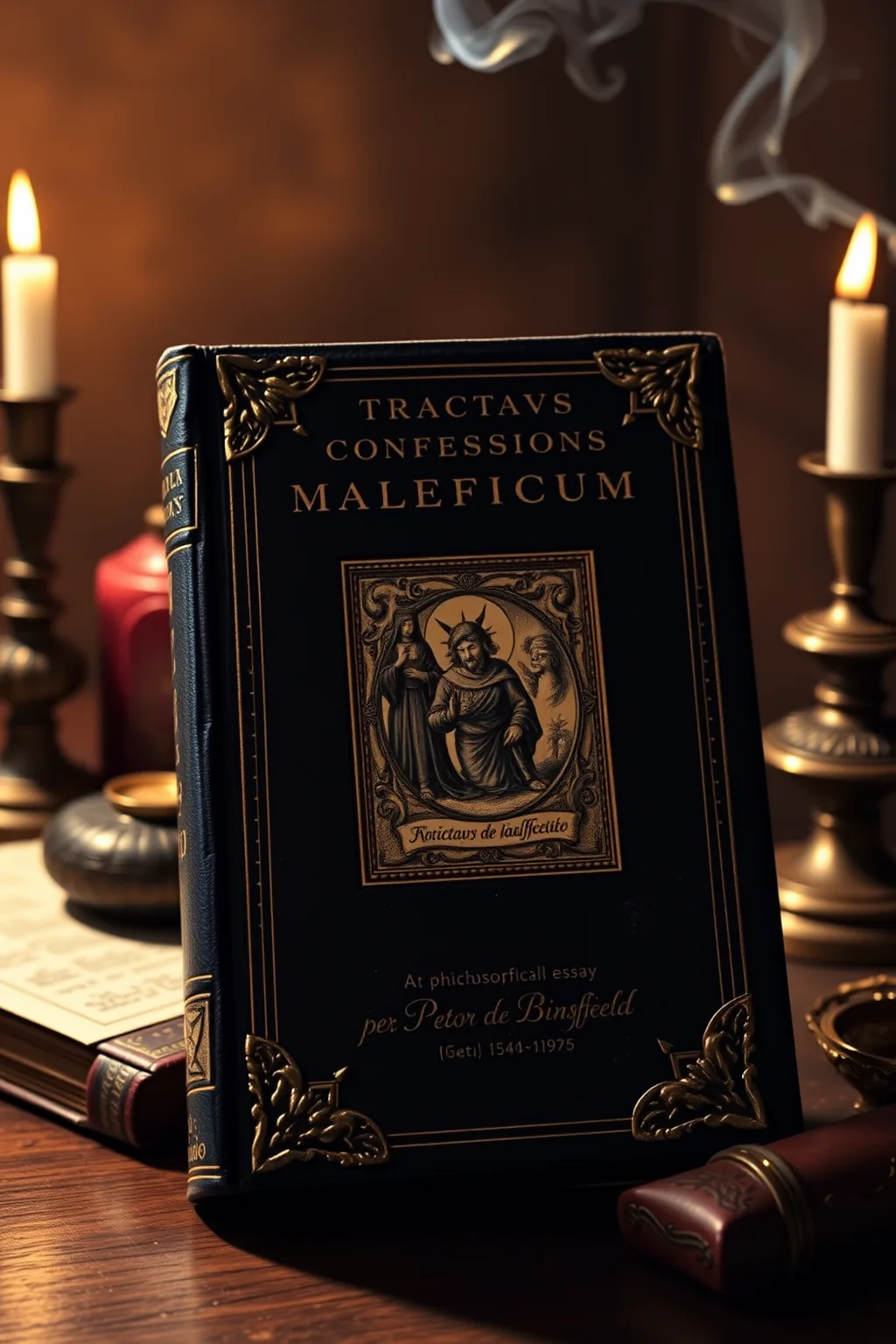
Tractavs de confessionibvs maleficorvm et sagarvm, secvndd recognitys & auctior redditus. An et quanta fides ijs adhibenda sit? Avctore Petro Binsfeldio ... 1605: Iss 116
 71
71

Tractavs de confessionibvs maleficorvm et sagarvm, secvndd recognitys & auctior redditus. An et quanta fides ijs adhibenda sit? Avctore Petro Binsfeldio ... 1605: Iss 116


Celeste Moreau (Divination & Symbolism Reviewer) — Pierre Binsfeld's *Tractatus de Confessionibus Maleficorum et Sagarum* stands as a cornerstone in the study of early modern witchcraft. This 1605 edition, meticulously digitized, provides unparalleled access to Binsfeld's rigorous analysis of witch confessions, probing their credibility with legalistic precision and theological discernment. Esoteric practitioners will find profound insights into the historical construction of demonic pacts and maleficium, while scholars will appreciate the nuanced exploration of evidence and belief. Binsfeld’s unflinching examination of the accused’s words, while rooted in his time, offers enduring lessons on the power of narrative and the societal mechanisms of persecution. A vital read for anyone seeking to understand the historical roots of demonology and the psychology of belief.
📝 Description
71
Pierre Binsfeld's 1605 treatise questions the credibility of witch confessions.
Pierre Binsfeld, a jurist and theologian, authored *Tractatus de Confessionibus Maleficorum et Sagarum* in 1605. The work critically examines confessions attributed to individuals accused of witchcraft and sorcery. Binsfeld investigates how much weight should be given to these testimonies, considering the psychological and societal factors influencing beliefs about witchcraft.
This book provides insight into the anxieties and spiritual beliefs of an era focused on the infernal and the arcane. Binsfeld's writing addresses the relationship between religious belief, fear, and the supernatural. It encourages contemplation on the nature of truth and confession when faced with accusations of demonic influence. The text is relevant for understanding early modern witch trials and the persistent interest in the darker aspects of the human mind.
Binsfeld's work sits within the tradition of early modern demonology and legal treatises concerned with supernatural accusations. It engages with theological interpretations of demonic influence and the practical application of law in cases of alleged witchcraft. The text reflects a period where theological doctrines and juridical processes intertwined to address perceived threats from malevolent forces.
💡 Why Read This Book?
Uncover the historical underpinnings of Western demonology and the legal and theological frameworks surrounding witchcraft accusations. This text is crucial for scholars of occult history, legal history, and religious studies, as well as for practitioners seeking to understand the roots of certain magical beliefs and practices. It offers a critical lens through which to examine the nature of confession, evidence, and societal fear in an age of intense spiritual upheaval.
⭐ Reader Reviews
Honest opinions from readers who have explored this book.
❓ Frequently Asked Questions
What is the primary focus of Binsfeld's *Tractatus de Confessionibus Maleficorum et Sagarum*?
The primary focus is the critical examination of confessions made by individuals accused of witchcraft and sorcery, questioning their authenticity and the degree of credence they should be afforded within legal and theological contexts.
Who was Pierre Binsfeld and what was his background?
Pierre Binsfeld (c. 1540-1598) was a jurist and theologian from Trier, Germany. His professional background lends significant weight to his rigorous, legalistic approach in analyzing witchcraft testimonies.
What historical period does this work illuminate?
This work primarily illuminates the late 16th and early 17th centuries, a period rife with witch trials and intense societal fear surrounding alleged maleficium and demonic influence.
Is this book suitable for modern witchcraft practitioners?
Yes, it provides essential historical context for understanding the origins of many beliefs and accusations surrounding witchcraft, offering valuable insights into historical perceptions of magical practices.
What is the 'recognitys & auctior redditus' part of the title referring to?
It signifies that this edition has been revised ('recognitys') and augmented or made more complete ('auctior redditus') compared to previous versions of the text.
🔮 Key Themes & Symbolism
The Scrutiny of Confession
Binsfeld's treatise studies the complex nature of confessions extracted from those accused of witchcraft. He rigorously dissects the circumstances under which these confessions were obtained, questioning the reliability of testimony often given under duress, torture, or psychological manipulation. This theme explores the fine line between genuine admission and coerced fabrication, highlighting the author's attempt to apply rational legal and theological principles to a phenomenon steeped in superstition and fear. The text encourages a critical assessment of evidence, urging readers to discern truth from delusion in the labyrinthine accounts of maleficium.
Demonic Influence and Human Agency
A central preoccupation of *Tractatus de Confessionibus Maleficorum et Sagarum* is the role of demonic influence versus human agency in the alleged acts of witchcraft. Binsfeld grapples with the extent to which individuals willingly entered into pacts with the Devil, or if they were merely deluded instruments of infernal forces. This exploration studies theological debates of the era concerning free will, predestination, and the pervasive fear of Satan's active presence in the world. The book examines how societal anxieties about the supernatural shaped the perception of individual culpability and the interpretation of extraordinary events.
The Epistemology of the Accused
Binsfeld's work implicitly engages with the epistemology of those accused of witchcraft. He analyzes the content of their confessions, seeking to understand the worldview that permitted such beliefs and claims. This includes examining their descriptions of sabbats, familiars, curses, and pacts, and attempting to reconcile these with established religious doctrine and natural law. The treatise serves as a historical document of how the 'knowledge' and experiences of the accused were perceived, judged, and ultimately used to condemn them, offering a unique perspective on the construction of heretical and magical belief systems during the early modern period.
💬 Memorable Quotes
Direct passages from the work, attributed to the author.
“An et quanta fides ijs adhibenda sit?”
— The central question posed: 'And how much faith should be given to them?' This captures the treatise's critical inquiry into the validity of witch confessions.
“Maleficium non nisi per daemonum opera patrari potest.”
— Meaning 'Maleficium can only be perpetrated through the works of demons.' This highlights the era's fundamental theological premise linking harmful magic directly to infernal intervention.
“Veritas est filia temporis.”
— Meaning 'Truth is the daughter of time.' This proverb suggests that true understanding of events, including witchcraft accusations, unfolds and becomes clearer with the passage of time.
“Fides suspecta, fides nulla.”
— Meaning 'Suspicious faith is no faith.' This legalistic maxim underscores the need for trustworthy evidence, implying that confessions tainted by suspicion hold no genuine value.
“Cum omnia demonum opera sint mendacia.”
— Meaning 'Since all works of demons are lies.' This reflects the inherent distrust of anything attributed to demonic influence, viewing it as inherently deceptive.
🌙 Esoteric Significance
Tradition
While Binsfeld's work is primarily a legal and theological treatise, its significance for esoteric traditions lies in its detailed cataloging and critical analysis of beliefs surrounding witchcraft and demonology. It provides a historical foundation for understanding the perceived mechanics of maleficium, demonic pacts, and the rituals associated with witchcraft as understood by contemporary authorities. For occultists, it offers insight into the historical construction of the adversary figure and the symbolic language used to describe forbidden knowledge and power, providing context for later grimoires and magical practices.
Symbolism
The text is replete with symbolic interpretations crucial to understanding early modern occultism. The 'confessions' themselves become symbolic artifacts, representing the perceived corruption of the soul, the inversion of divine order, and the tangible manifestation of infernal influence. Symbols like the witch's mark, the pact with the Devil, and the sabbat represent a rejection of societal norms and religious purity. Binsfeld's analytical approach, while aimed at discrediting, inadvertently preserves the symbolic language and imagery that informed both the persecution and the practice of witchcraft.
Modern Relevance
In the modern era, Binsfeld's *Tractatus* offers critical perspectives on the psychology of belief, mass hysteria, and the mechanisms of persecution. For practitioners of modern witchcraft and occultism, it provides invaluable historical context, informative the roots of many misconceptions and fears surrounding their path. It encourages a deeper understanding of how belief systems are constructed, challenged, and codified. Furthermore, its exploration of confession and evidence remains relevant in discussions about justice, truth, and the power of narrative in shaping societal understanding of the 'other'.
👥 Who Should Read This Book
This profound text is indispensable for several audiences. **Scholars of history, religion, and law** will find it a primary source for understanding the intellectual and judicial frameworks of early modern witch trials. **Occultists and practitioners of witchcraft** will gain crucial historical context, clarifying the origins of many accusations and perceived magical phenomena. **Seekers of esoteric knowledge** will appreciate its deep dive into historical demonology and the complex interplay of faith and fear. **Students of psychology and sociology** can analyze the societal dynamics and belief systems at play. Even the **general reader** curious about the darker chapters of human history will find Binsfeld's rigorous, albeit biased, examination compelling and informative.
📜 Historical Context
Published in 1605, Pierre Binsfeld's *Tractatus de Confessionibus Maleficorum et Sagarum* emerged during a peak period of witch hunts across Europe. This era was characterized by profound religious upheaval, societal anxieties fueled by plague and famine, and a burgeoning belief in the pervasive influence of the Devil. Legal systems, often influenced by theological doctrine, grappled with the question of how to identify, prosecute, and punish those believed to be in league with dark forces. Binsfeld, as a jurist, sought to bring a degree of legal and theological rigor to the chaotic proceedings of witch trials, examining the nature of evidence, particularly confessions, which were frequently obtained through torture. His work reflects the intellectual currents of the time, attempting to reconcile empirical observation with deeply held supernatural beliefs, and contributes significantly to our understanding of the legal and philosophical underpinnings of demonology.
📔 Journal Prompts
Reflect on the concept of 'evidence' as presented by Binsfeld in contrast to modern legal standards. How has our understanding of proof evolved?
Analyze the psychological states described or implied in the confessions. How might fear, delusion, or societal pressure influence an individual's testimony?
Consider the role of theological doctrine in shaping Binsfeld's interpretation of witchcraft. How do religious beliefs dictate the perception of the supernatural?
Imagine you are a jurist in 1605. Based on Binsfeld's arguments, what criteria would you use to evaluate a witch's confession?
How does Binsfeld's treatise contribute to our understanding of the 'othering' of marginalized groups throughout history?
🗂️ Glossary
Maleficorum
Latin for 'of the evildoers' or 'of the malefactors,' referring to those accused of performing harmful magic.
Sagarum
Latin for 'of the sorceresses' or 'of the witches,' specifically referring to female practitioners of alleged witchcraft.
Maleficium
Latin term referring to harmful magic or witchcraft, often believed to cause illness, death, or misfortune.
Tractatus
Latin for 'treatise' or 'discourse,' indicating a formal and systematic written work on a particular subject.
Fides
Latin for 'faith,' 'belief,' or 'credence.' In this context, it refers to the trustworthiness and acceptance of testimony or confessions.
This book appears in 2 collections
🔮 Readers Also Liked
Browse all →







More by BINSFELD, Pierre, ca. 1540-1598.
All books →
From the “Witchcraft” Collection
View all →



More Free Witchcraft & Paganism Books
View all →