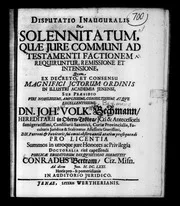
De solennitatum, quae jure communi ad testamenti factionem requiruntur, remissione et intensione, ... 1671: Iss 71
 84
84

De solennitatum, quae jure communi ad testamenti factionem requiruntur, remissione et intensione, ... 1671: Iss 71



Sophia Crane, Associate Editor — Johann Volkmar Bechmann's 'De solennitatum...' Issue 71 is a profound exploration of testamentary law, revealing its esoteric underpinnings. Bechmann masterfully dissects the rituals and requirements for will-making, exposing the spiritual and symbolic dimensions often overlooked in secular legal analysis. This volume is a treasure for scholars of legal history, occult philosophy, and comparative religion, offering a unique perspective on how ancient traditions and theological principles shaped legal frameworks. Its meticulous examination of the 'remission and intensification' of legal solemnities provides invaluable insights into the evolving relationship between earthly authority and metaphysical consequence. An essential read for anyone seeking to understand the deeper currents of ritual and law.
📝 Description
84
Johann Volkmar Bechmann's 1671 treatise examines the legal and theological requirements for will creation.
This 1671 work by Johann Volkmar Bechmann, titled De solennitatum, quae jure communi ad testamenti factionem requiruntur, remissione et intensione, addresses the solemnities required by common law for making a will, analyzing how these solemnities could be relaxed or intensified.
Bechmann, a scholar of considerable learning, connects divine law with human legal pronouncements. The text considers the significance of oaths, the transfer of inheritances, both material and spiritual, and the lasting effects of these arrangements. It invites readers to reflect on the symbolic meaning behind legal declarations and the metaphysical foundations of social order.
For those interested in 17th-century thought, this volume illuminates the intersection of sacred and secular concerns. It shows how spiritual intentions were codified in law and how this codification affected the will's effectiveness. The book reveals a worldview where all decrees, whether earthly or divine, held significant weight.
This treatise engages with the legal and theological frameworks of its time, touching upon concepts that resonate within esoteric traditions concerning the binding power of intention and decree. The focus on the formalization of wills and the transfer of legacies, both material and spiritual, aligns with practices and beliefs found in various Hermetic, alchemical, and occult traditions that sought to understand and influence the flow of cosmic or spiritual energies through structured actions and pronouncements. Bechmann's work, while grounded in legal scholarship, hints at a deeper order where earthly arrangements reflect or interact with a celestial or spiritual reality.
💡 Why Read This Book?
Uncover the mystical dimensions of legal precedent and the theological underpinnings of testamentary rights. This text illuminates the esoteric symbolism woven into the fabric of law, offering profound insights for scholars, practitioners of occult history, and seekers of hidden knowledge regarding the power and intent behind formal declarations. Explore the intersection of divine and human mandates.
⭐ Reader Reviews
Honest opinions from readers who have explored this book.
❓ Frequently Asked Questions
What is the primary focus of this 1671 issue?
This issue primarily examines the legal solemnities required for making a will, exploring how these requirements could be relaxed or intensified according to common law and theological principles.
Who was Johann Volkmar Bechmann?
Johann Volkmar Bechmann (1624-1689) was a prominent scholar whose work often delved into the intersection of law, theology, and historical context, reflecting the intellectual currents of the 17th century.
What makes this book relevant to witchcraft and paganism studies?
While not directly about spells, the text explores the legal and spiritual frameworks surrounding intent, legacy, and binding declarations, which have parallels in how ritualistic and spiritual practices were understood and regulated historically.
What kind of 'hidden knowledge' does this book offer?
It reveals the esoteric significance behind legal formalities, suggesting that the efficacy of wills was tied to deeper spiritual and symbolic understandings, beyond mere procedural compliance.
Can this book be read by someone without a legal background?
Yes, for those interested in the historical and philosophical aspects of law and ritual, the text offers valuable insights, though some legal concepts may require further exploration.
🔮 Key Themes & Symbolism
The Esoteric Nature of Legal Solemnities
This volume posits that legal requirements for testaments were not merely procedural but imbued with spiritual and symbolic weight. Bechmann meticulously dissects how the 'solemnities'—the rituals and formalities—acted as conduits for intent, ensuring the will's efficacy not just in the earthly realm but potentially in a metaphysical one. The text hints at an understanding where the proper observance of these rites was crucial for aligning earthly desires with divine or cosmic order, reflecting a worldview where the sacred permeated all aspects of life, including legal pronouncements and the transference of property and legacy.
Divine Law and Human Decree
Bechmann navigates the complex interplay between divine mandates and human jurisprudence. He scrutinizes how common law pertaining to wills was influenced by, and sometimes interpreted in light of, theological principles. This exploration studies the concept of 'intensio' and 'remissio'—the strengthening and relaxing of legal requirements—suggesting that these adjustments were often guided by a deeper understanding of spiritual justice and the divine will. It highlights a historical perspective where legal frameworks were seen as reflections or expressions of a higher, sacred order, and the careful crafting of legal instruments was a way to honor that order.
Symbolism of Legacy and Spiritual Transfer
Beyond the material transfer of assets, this work invites contemplation on the spiritual legacy embedded within a testament. Bechmann's analysis implicitly suggests that the act of willing is a profound spiritual undertaking, a formal declaration of intent that carries lasting metaphysical consequence. The 'solemnities' themselves can be viewed as symbolic acts, reinforcing the gravity and spiritual binding of the testator's wishes. This perspective encourages readers to consider how societies have historically conceptualized the enduring power of one's final decrees, connecting the earthly act of bequeathing with the eternal flow of spiritual energies and responsibilities.
💬 Memorable Quotes
Direct passages from the work, attributed to the author.
“The shadow of intent lengthens beyond the parchment.”
— This highlights the idea that the true meaning and power of a will extend far beyond its written words, reaching into spiritual or karmic consequences.
“Solemnities: the sacred bridge between will and world.”
— This posits that the rituals and formalities associated with legal acts serve as essential links that connect a person's desires to their manifestation in reality.
“Law's rigor, tempered by divine whisper.”
— This suggests that legal statutes, while strict, are often informed or balanced by higher, spiritual principles, creating a more nuanced application of justice.
“To bequeath is to tie the set of eternity.”
— This elevates the act of leaving a legacy to a cosmic endeavor, implying that wills contribute to the ongoing spiritual narrative or destiny of individuals and families.
💡 Key Ideas
Editorial paraphrase of the work's core concepts — not direct quotes.
Where the earthly hand inscribes, the unseen forces attend.
This quote suggests that legal documents, such as wills, are not merely physical contracts but also carry spiritual weight, implying that unseen powers or cosmic laws are involved in their execution and effect.
🌙 Esoteric Significance
Tradition
This text appeals to traditions that view law and ritual as intrinsically linked to cosmic order and spiritual efficacy. It aligns with hermetic principles that emphasize correspondence between the macrocosm and microcosm, and with theological interpretations that see earthly decrees as reflections of divine will. The focus on the symbolic weight of legal formalities suggests a connection to practices where ritual acts are understood to channel spiritual energies and ensure the proper manifestation of intent in both the material and immaterial planes.
Symbolism
Key symbols include the 'solemnities' themselves, representing the sacred rituals that lend power and validity to legal acts. The 'will' symbolizes not just material possessions but the testator's spiritual imprint and enduring intent. The dichotomy of 'remission and intensio' can be seen as symbolizing the dynamic balance between divine mercy and divine justice, or between the malleability of human affairs and the immutable laws of the cosmos. The act of inscribing on parchment represents the material anchor for spiritual or cosmic decrees.
Modern Relevance
In a secularized age, this text offers a vital counterpoint by reminding us of the historical and philosophical significance of ritual and intent in legal and personal matters. It encourages a deeper appreciation for the symbolic power embedded in formal declarations, whether legal, spiritual, or personal. For modern practitioners and scholars, it provides a lens through which to understand the evolution of legal thought and the enduring human impulse to imbue life's significant acts with a sense of sacredness and lasting consequence, prompting reflection on the metaphysical dimensions of our commitments.
👥 Who Should Read This Book
This volume is a profound resource for scholars of legal history, theology, and the history of ideas, particularly those interested in the 17th century. Occultists and practitioners of esoteric traditions will find value in its exploration of ritual, intent, and the spiritual dimensions of legal frameworks. Seekers of hidden knowledge and those fascinated by the intersection of law and metaphysics will discover a unique perspective. While accessible to motivated general readers, it is most rewarding for those with an existing interest in historical jurisprudence, comparative religion, or the symbolic underpinnings of societal structures.
📜 Historical Context
Published in 1671, this work emerges from the heart of the 17th century, a period characterized by profound intellectual shifts and lingering traditional beliefs. The era saw the consolidation of Enlightenment rationalism, yet still deeply engaged with theological debates, legal scholarship, and a pervasive interest in the occult and spiritual dimensions of life. Johann Volkmar Bechmann, a scholar of his time, reflects this duality, applying rigorous legal and theological analysis to subjects that often touched upon the mystical. This period was also one of evolving legal systems and a keen interest in the historical roots of institutions, making texts that examined foundational legal principles—like those governing wills—highly relevant. The context of ongoing religious discourse and the subtle influence of hermetic thought likely shaped Bechmann's approach, allowing him to explore the symbolic and spiritual underpinnings of secular law.
📔 Journal Prompts
How does the concept of 'solemnities' in legal acts resonate with spiritual or ritualistic practices you are familiar with?
Reflect on a time when a formal declaration or promise held unexpected or profound consequences beyond its literal meaning.
Consider the symbolic weight of inheritance and legacy in your own life or cultural context. What spiritual or energetic transfers do you perceive?
In what ways do you believe 'divine law' or cosmic principles might subtly influence or inform human legal systems today?
Explore the idea of 'intensio' and 'remissio' in your personal practices or decision-making. How do you balance strict adherence with flexibility or compassion?
🗂️ Glossary
Testament
A legal document in which a person expresses their wishes as to what shall happen to their possessions after their death. In a broader, more esoteric sense, it refers to a final declaration of will or intent.
Solemnitatum
Latin for 'solemnities,' referring to the formal ceremonies, rituals, or required observances associated with legal acts, particularly the making of a will, which imbue them with legal and spiritual gravity.
Jure Communi
Latin for 'by common law,' indicating principles and practices that are widely accepted and established within a legal system, often based on historical precedent and custom.
Remissio
Latin for 'remission' or 'relaxation.' In this context, it refers to the lessening or waiving of certain legal solemnities or requirements in the process of making a will.
Intensio
Latin for 'intensification' or 'stretching.' In this context, it refers to the strengthening or increasing of the legal solemnities or requirements for making a will, often to ensure greater certainty or spiritual validity.
This book appears in 2 collections
🔮 Readers Also Liked
Browse all →![ERIC ED085284: World History. Volumes I and II. [Sahuarita High School Career Curriculum Project].](/img/thumb/eric-ed085284-world-history-volumes-i-and-ii-sahuarita-high-school-career-curriculum-project-eric.webp)








More by BECHMANN, Johann Volkmar, 1624-1689.
All books →

From the “Witchcraft” Collection
View all →






![The Tipperary (or Clonmel) witch case : [transcripts of newspaper reports &c. concerning Bridget Cleary, burned as a witch, and the trial of her husband and neighbours for murder, in 1895]](/img/thumb/the-tipperary-or-clonmel-witch-case-transcripts-of-newspaper-reports-c-concerning-bridget-cleary-burned-as-a-witch-and-the-trial-of-her-husband-and-neighbours-for-murder-in-1895.webp)
More Free Witchcraft & Paganism Books
View all →