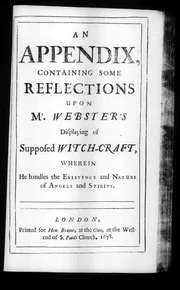
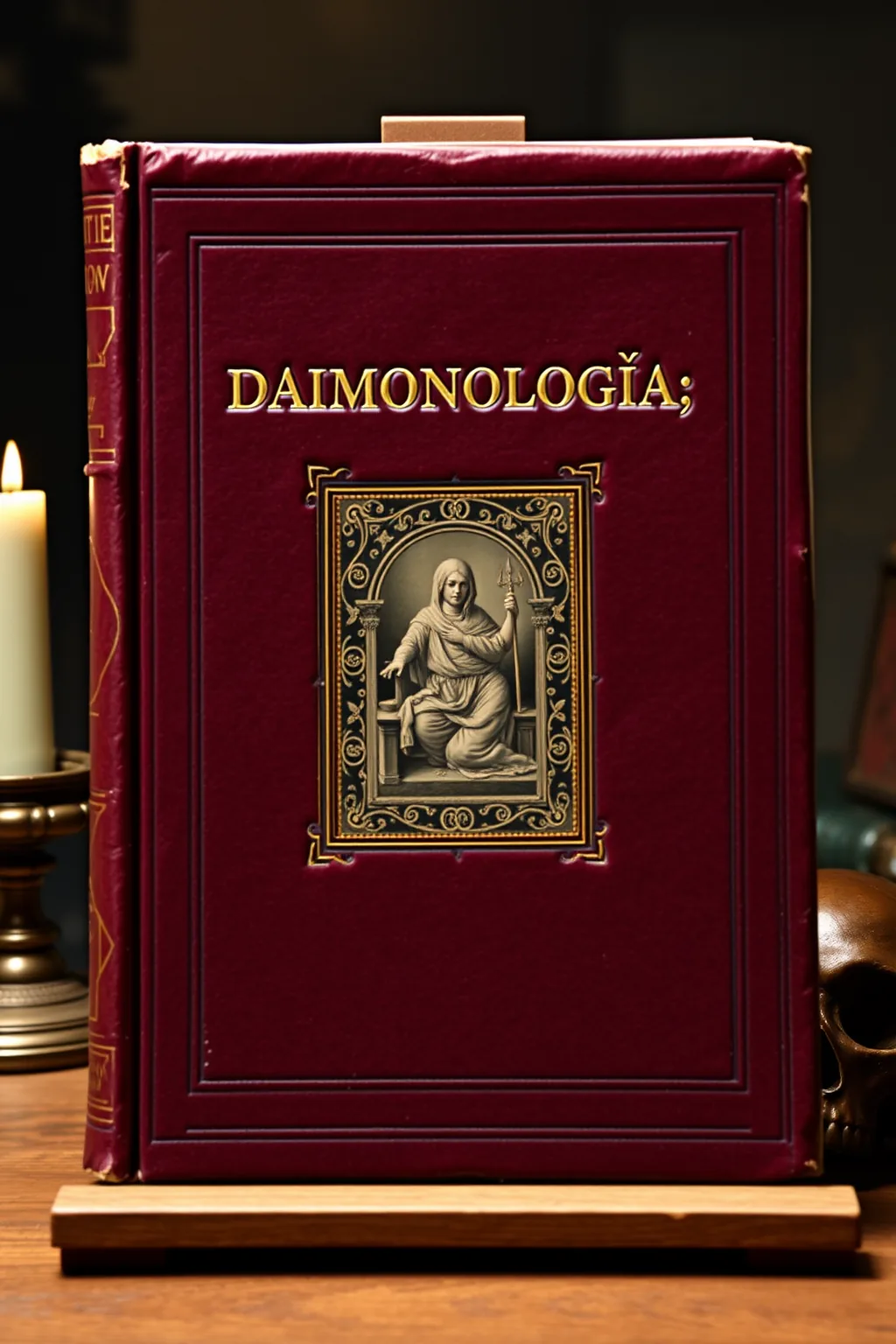
Daimonología; or, A treatise of spirits. Wherein several places of Scripture are expounded, against the vulgar errors concerning witchcraft, apparitions, &c. 1723: Iss 234
 83
83

Daimonología; or, A treatise of spirits. Wherein several places of Scripture are expounded, against the vulgar errors concerning witchcraft, apparitions, &c. 1723: Iss 234


Silas Hawthorne, Hermetic Studies Editor — Jacques Daillon's "Daimonología" stands as a beacon of rational inquiry amidst the tempest of early modern demonological fears. This meticulously argued treatise offers a refreshing exegesis of scripture, systematically dismantling popular fallacies concerning witchcraft and apparitions. Daillon's strength lies in his ability to weave theological precision with an understanding of the pervasive societal anxieties surrounding the supernatural. For the serious student of historical occultism and comparative religion, this work provides invaluable insights into the intellectual currents of its time, urging a more nuanced interpretation of spiritual phenomena beyond simplistic fear or credulity. It is a vital addition to any collection seeking to understand the historical discourse on the unseen.
📝 Description
83
Jacques Daillon's 1723 "Daimonología" examines scriptural passages concerning spirits and witchcraft.
Published in 1723, Jacques Daillon's "Daimonología; or, A Treatise of Spirits" scrutinizes biblical texts to address common misunderstandings about witchcraft and apparitions. Daillon sought to correct popular beliefs regarding supernatural phenomena, offering a reasoned approach grounded in scripture. He aimed to separate scriptural interpretation from widespread folklore and superstition prevalent in his time. The book discusses the nature of incorporeal beings and their relation to human experience. Daillon's work encourages a deeper scriptural understanding of spiritual matters. It attempts to demystify the unseen world by examining theological and philosophical aspects. The author presents a perspective intended to clarify the intersection of religious belief and popular notions about the occult.
This treatise challenges the prevailing ignorance and fear associated with the occult in the early modern period. Daillon's methodology involves a close reading of religious texts, which he uses to counter what he saw as vulgar errors. His intention was to provide clarity on the spiritual dimensions of existence. The work is for readers interested in a theological analysis of spiritual phenomena and historical views on witchcraft. It offers a framework for understanding the divine and the demonic as presented in scripture.
Daillon's "Daimonología" engages with the theological and philosophical debates surrounding spiritism and demonology common in the 17th and 18th centuries. It stands as a work of Christian demonology, seeking to interpret scriptural accounts of spiritual beings and their influence. Unlike purely folkloric accounts of witchcraft, Daillon's approach is rooted in scriptural exegesis, aiming to correct popular misconceptions through learned argument. His work is part of a broader tradition of scholarly inquiry into the supernatural, seeking to reconcile religious doctrine with observed or reported phenomena, distinguishing between divine, demonic, and human agency.
💡 Why Read This Book?
Uncover scriptural interpretations that challenge mainstream views on spirits and the occult. Explore the historical context of witchcraft beliefs and gain a deeper understanding of early modern spiritual discourse. This book is essential for scholars, practitioners of esoteric arts, and seekers of hidden knowledge who wish to engage with primary sources that offer a critical perspective on the supernatural.
⭐ Reader Reviews
Honest opinions from readers who have explored this book.
❓ Frequently Asked Questions
What is the primary focus of 'Daimonología'?
The book primarily focuses on interpreting scripture to debunk common misconceptions about witchcraft, apparitions, and the nature of spirits, offering a more theological and reasoned perspective than prevalent superstitions.
Who was Jacques Daillon?
Jacques Daillon (ca. 1634-1726) was a scholar and theologian whose work sought to provide a more accurate understanding of spiritual phenomena based on scriptural analysis, challenging the popular narratives of his time.
Is this book a practical guide to demonology?
No, 'Daimonología' is primarily an exegetical and theological treatise. It aims to clarify scriptural understanding regarding spirits rather than offering practical instructions for engaging with them.
What historical period does this book address?
The book was published in 1723 and addresses the prevailing beliefs and controversies surrounding witchcraft and spirits in early modern Europe.
What is the relationship between this book and witchcraft?
It directly addresses and refutes vulgar errors and superstitions concerning witchcraft, offering an alternative, scripturally-based perspective on the phenomenon.
🔮 Key Themes & Symbolism
Scriptural Exegesis and Spiritual Truth
Daillon meticulously examines biblical texts to unearth deeper meanings, challenging the superficial interpretations that fueled widespread fear of witchcraft and spectral entities. This theme highlights his commitment to revealing the 'true' spiritual understanding embedded within sacred writings, advocating for a reasoned discernment of the unseen forces rather than succumbing to irrational panic. It underscores the power of textual analysis in shaping perceptions of the divine and the demonic, offering a counter-argument to the prevailing witch-hunting hysteria of the era.
Debunking Vulgar Errors and Superstition
A central pillar of 'Daimonología' is its direct confrontation with common, often fear-driven, beliefs about witchcraft, apparitions, and demonic influence. Daillon systematically dismantles these 'vulgar errors,' presenting a more nuanced and intellectually rigorous perspective. This theme emphasizes the author's role as an intellectual emancipator, urging readers to question received wisdom and to seek verifiable truths grounded in theological reasoning and scriptural integrity. It speaks to the enduring human struggle against ignorance and the power of critical thought in reading through the mysteries of existence.
The Nature of Spirits and Apparitions
Beyond mere refutation, Daillon studies the philosophical and theological nature of spirits and the phenomena of apparitions. He seeks to categorize, understand, and contextualize these experiences within a divinely ordained order, distinguishing between genuine spiritual manifestations and human-induced or illusory events. This theme invites readers to contemplate the subtle areas of existence, the boundaries between the physical and the ethereal, and the potential for divine intervention or deception, fostering a more profound and less fearful engagement with the spiritual dimension.
💬 Memorable Quotes
Direct passages from the work, attributed to the author.
“The vulgar errors concerning witchcraft are but shadows of ignorance.”
— This highlights Daillon's view that widespread beliefs about witchcraft are not rooted in reality but are instead born from a lack of understanding and a fertile ground for misinformation.
“Scripture, rightly expounded, is the only true light against spectral fears.”
— This emphasizes the author's belief in the supreme authority of biblical texts, when interpreted correctly, as the ultimate tool for dispelling irrational anxieties about the supernatural.
“Apparitions are not always what they seem; discernment is key.”
— This points to the need for careful analysis and critical thinking when encountering purported spiritual visitations, suggesting that outward appearances can be deceiving.
“The true nature of spirits lies beyond the grasp of common superstition.”
— Daillon suggests that a deeper, more theological understanding is required to comprehend the essence of spiritual beings, moving beyond simplistic and often erroneous popular notions.
“Let reason guide your faith when confronting the unseen.”
— This encourages a balanced approach, where faith is informed and strengthened by intellectual inquiry and rational thought, rather than being solely driven by emotion or fear.
🌙 Esoteric Significance
Tradition
Daillon's work, while rooted in Christian theology, aligns with the broader esoteric tradition of seeking hidden knowledge and challenging orthodox interpretations. His method of scriptural exegesis to reveal deeper truths about the spiritual realm reflects the hermeneutic practices found in Kabbalah, Gnosticism, and Neoplatonism, which similarly look beyond the literal to uncover symbolic and mystical layers of meaning. He participates in the ongoing esoteric dialogue concerning the nature of unseen forces and their influence on the material world.
Symbolism
The 'spirits' and 'apparitions' discussed are not merely literal entities but can be interpreted as symbolic representations of psychological states, spiritual influences, or even archetypal forces. Daillon's attempts to 'expound' scripture suggest a symbolic reading of biblical narratives, where events and characters hold allegorical significance. His work implicitly invites contemplation of dualities—light and shadow, divine and demonic, truth and illusion—which are fundamental symbols within esoteric thought, prompting a deeper understanding of the human condition.
Modern Relevance
In an age still susceptible to misinformation and sensationalism, Daillon's emphasis on critical reasoning, scriptural discernment, and the debunking of 'vulgar errors' remains profoundly relevant. His work encourages a more nuanced and less fearful approach to phenomena that lie beyond immediate empirical understanding. For modern seekers of truth, it offers a historical perspective on how spiritual concepts have been debated and interpreted, providing a framework for engaging with contemporary discussions on consciousness, the paranormal, and the nature of reality with intellectual rigor and spiritual depth.
👥 Who Should Read This Book
This treatise is a treasure for the dedicated scholar of religious history, early modern demonology, and comparative occultism, offering primary source material that illuminates the intellectual debates of the 18th century. Seekers of spiritual truth who are drawn to critical theological inquiry will find Daillon's reasoned approach to scripture refreshing and insightful. Practitioners of esoteric arts interested in the historical evolution of beliefs about spirits and witchcraft will gain valuable context. Beginners curious about the historical interplay between religion, superstition, and the unseen will find a meticulously argued foundation, encouraging a move beyond simplistic notions towards a more profound understanding.
📜 Historical Context
Published in 1723, "Daimonología" emerges from a period of profound intellectual and societal transition in Europe. The Enlightenment was beginning to cast its rational light, yet deeply entrenched beliefs in witchcraft and the supernatural persisted. This era witnessed a clash between burgeoning scientific inquiry and centuries-old folk traditions and religious dogma. The Salem witch trials, though in the preceding century, had left a lingering scar, fueling both continued fear and a growing skepticism. Daillon's work is situated within this complex landscape, acting as a voice of theological reason attempting to read through the murky waters of superstition, demonology, and scriptural interpretation. It reflects a desire to bring order and clarity to a world still grappling with the perceived presence of malevolent spiritual forces, offering a counter-narrative to the sensationalism and fear that often dominated discourse on the occult.
📔 Journal Prompts
How has societal fear influenced interpretations of the supernatural throughout history, and how does Daillon's work challenge this?
Reflect on a personal experience or belief that might be considered a 'vulgar error' concerning the spiritual realm. How could scripture or reasoned inquiry offer a different perspective?
Daillon focuses on scriptural interpretation. How can diverse interpretations of sacred texts lead to different understandings of spirits and the occult?
Consider the symbolic potential of 'spirits' and 'apparitions' beyond literal entities. What psychological or archetypal meanings might they hold for you?
In what ways does Daillon's call for 'discernment' resonate with contemporary challenges of misinformation and 'fake news' in spiritual or occult contexts?
🗂️ Glossary
Daimonología
A treatise on spirits, demons, or the supernatural, derived from the Greek word 'daimon,' which can refer to a divine being, spirit, or demon.
Vulgar Errors
Commonly held, widespread misconceptions or mistaken beliefs that are prevalent among the general populace, often lacking factual or logical basis.
Apparitions
The appearance of a ghost, spirit, or phantom; a spectral manifestation, often believed to be supernatural in origin.
Exegesis
Critical explanation or interpretation of a text, especially of scripture, aiming to uncover its deeper meaning and intent.
Incorporeal Entities
Beings or existences that do not have a physical body or material form; spiritual or ethereal entities.
This book appears in 2 collections
🔮 Readers Also Liked
Browse all →








From the “Witchcraft” Collection
View all →

![D. [i. e., Doktor] Balthasar Bekkers reformierten Predigers in Amsterdam bezauberte Welt. ... 1781: Vol 3 Iss 81](/img/thumb/d-i-e-doktor-balthasar-bekkers-reformierten-predigers-in-amsterdam-bezauberte-welt-1781-vol-3-iss-81-bekker-balthasar-1634-1698.webp)




More Free Witchcraft & Paganism Books
View all →
![D. [i. e., Doktor] Balthasar Bekkers reformierten Predigers in Amsterdam bezauberte Welt. ... 1781: Vol 1 Iss 81](/img/thumb/d-i-e-doktor-balthasar-bekkers-reformierten-predigers-in-amsterdam-bezauberte-welt-1781-vol-1-iss-81-bekker-balthasar-1634-1698.webp)