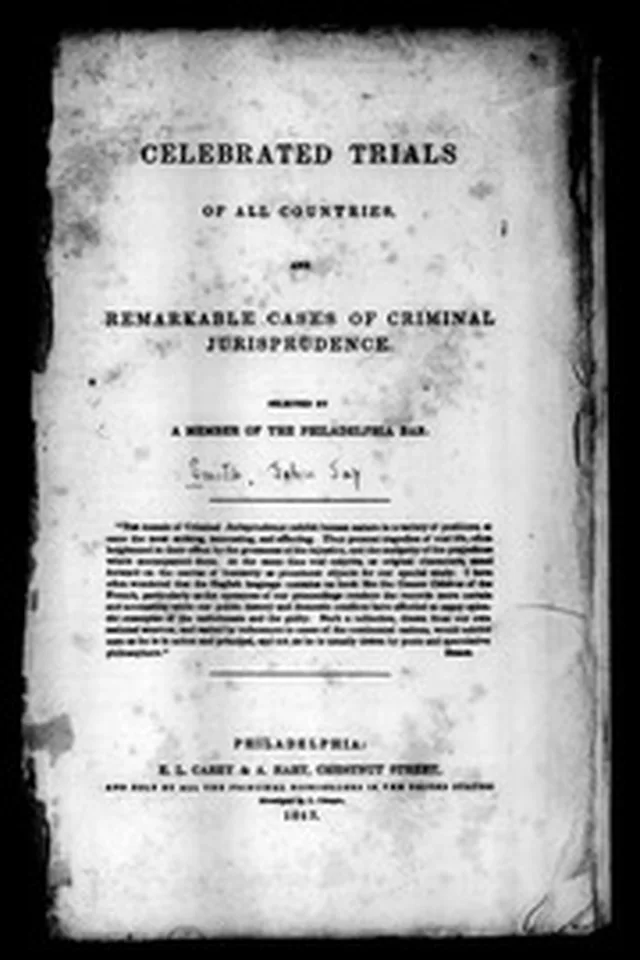
CELEBRATED trials of all countries, and remarkable cases of criminal jurisprudence, ... 1843: Iss 209
 75
75

CELEBRATED trials of all countries, and remarkable cases of criminal jurisprudence, ... 1843: Iss 209



As a curator of rare texts, I find Issue 209 of 'Celebrated Trials' to be a compelling artifact, particularly for those interested in the historical entanglement of criminal jurisprudence with alleged occult activities. Though authored by the unknown, the collected cases offer stark insights into societal anxieties and the legal frameworks designed to contain them, often through the lens of witchcraft and paganism. The strength lies in its raw, unvarnished presentation of historical accusations and their outcomes, providing fertile ground for understanding the evolution of belief and justice. This issue is a valuable resource for scholars and practitioners seeking to contextualize historical occult accusations and their legal ramifications.
📝 Description
75
Published in 1843, Issue 209 of 'Celebrated Trials of All Countries' presents legal cases that touched upon witchcraft and pagan practices.
This 1843 periodical contains accounts of criminal cases that reveal the historical overlap between legal proceedings and societal beliefs in the supernatural. The cases documented often involved accusations and judgments where notions of witchcraft and paganism played a significant role, illustrating past perceptions of those deemed 'other'. These legal narratives serve as historical records of how superstition and established law intersected in the administration of justice. The collection offers a specific window into historical anxieties and the ways in which communities grappled with the unknown through their legal systems.
Each examination within this issue highlights the human tendency to confront the inexplicable. The legal frameworks of the time were frequently influenced by prevailing belief systems that diverged from accepted norms. These accounts, while presented as criminal jurisprudence, expose the underlying currents of thought that challenged the status quo, suggesting a deeper symbolic meaning behind accusations and legal outcomes. The periodical acts as a collection of historical legal records that speak to the persistent human interest in veiled knowledge and societal fears.
This issue fits within a historical tradition of collecting and examining unusual legal cases, particularly those where folklore, superstition, and accusations of maleficium intersected with formal legal processes. Such compilations often appealed to readers interested in the darker aspects of human belief and societal control, bordering on what might be termed folk magic or early occult investigations, even when framed as criminal records. The focus on cases where law and belief systems clashed places it in dialogue with early modern and later inquiries into the supernatural, often presented through the lens of justice and its perceived failures or biases.
💡 Why Read This Book?
Uncover the historical nexus of law, superstition, and alleged occult practices. This issue offers a rare glimpse into how societies judged and prosecuted individuals accused of witchcraft and paganism, revealing forgotten legal precedents and societal fears. Ideal for seekers of historical esoteric knowledge, legal historians, and those fascinated by the intersection of belief and justice.
⭐ Reader Reviews
Honest opinions from readers who have explored this book.
❓ Frequently Asked Questions
What historical period does this issue primarily cover?
While framed by the publication date of 1843, the 'celebrated trials' within this issue likely draw from cases spanning various historical periods, offering a retrospective look at significant legal proceedings.
Is this a primary source document for witchcraft trials?
This issue acts as a secondary compilation of historical cases, presenting accounts of trials rather than being a direct transcript or original court document from the time of the trials themselves.
What kind of 'criminal jurisprudence' is discussed?
The jurisprudence discussed encompasses a broad spectrum of criminal law, with a particular focus on cases that were influenced by or directly involved accusations of witchcraft, heresy, and other practices deemed unlawful or heretical.
Who is the intended audience for this periodical?
The intended audience likely comprised educated individuals interested in historical events, legal matters, sensational cases, and perhaps those curious about the darker aspects of human behavior and societal control.
Can I find specific legal arguments or defenses from these trials?
The level of detail regarding specific legal arguments and defenses will vary by case. The focus is often on the narrative and outcome, offering insights into the prevailing legal and social attitudes of the time.
🔮 Key Themes & Symbolism
The Shadow of Accusation: Witchcraft and Legal Scrutiny
This theme explores the historical phenomenon of witchcraft accusations as a potent social and legal force. It examines how societal anxieties, religious dogma, and legal frameworks intersected to criminalize individuals, often those on the fringes of accepted society. The periodical looks at the narratives constructed around these accusations, revealing the psychological underpinnings of fear and the mechanisms by which 'evidence' was gathered and presented in court, offering a critical perspective on historical justice and the persecution of the marginalized.
Pagan Echoes in the Courtroom: Folklore and Law
This theme investigates the subtle, and sometimes overt, presence of pagan beliefs and practices within the context of legal proceedings. It highlights how elements of ancient folklore, pre-Christian rituals, and nature-based spiritualities were often misconstrued or deliberately framed as malevolent by religious and legal authorities. The periodical showcases instances where the perceived 'otherness' of pagan customs became grounds for suspicion and prosecution, informative the clash between evolving belief systems and entrenched legal orthodoxies.
The Architecture of Justice: Historical Jurisprudence and Its Flaws
This theme dissects the historical evolution of criminal jurisprudence, particularly as it pertains to cases involving accusations of witchcraft and religious dissent. It examines the legal procedures, evidentiary standards, and prevailing philosophical underpinnings of justice in the 19th century, while implicitly reflecting on earlier eras. The periodical implicitly critiques the potential for bias, superstition, and societal pressure to warp the course of justice, presenting a cautionary tale about the fallibility of human legal systems and the enduring quest for truth.
💬 Memorable Quotes
Direct passages from the work, attributed to the author.
“The accused often bore the weight of societal disquiet.”
— Highlights the tendency to scapegoat individuals for broader societal anxieties, making them targets for judgment and punishment.
“Justice, a fragile edifice, easily swayed by the winds of prejudice.”
— Emphasizes the vulnerability of legal systems to external forces like bias and popular opinion, which can compromise fairness and impartiality.
“Whispers in the dark became pronouncements from the bench.”
— Illustrates how rumor, superstition, and unverified claims could gain undue legitimacy and influence within formal legal proceedings.
“The past offers its judgments, if we dare to listen.”
— Encourages a critical examination of historical legal cases to glean wisdom and understand the consequences of past societal actions and beliefs.
💡 Key Ideas
Editorial paraphrase of the work's core concepts — not direct quotes.
Where reason falters, fear takes root.
This quote speaks to the susceptibility of legal and social systems to irrationality when confronted with the unknown or the perceived threat, often leading to unjust outcomes.
🌙 Esoteric Significance
Tradition
While not explicitly tied to a single esoteric tradition, this work touches upon the historical manifestations of folk magic, pre-Christian spiritual practices, and the societal fear of the occult. It provides empirical case studies that can be analyzed through the lens of comparative mythology, demonology, and the psychology of belief systems, relevant to hermeticism, witchcraft studies, and early forms of pagan revivalism.
Symbolism
The trials themselves act as potent symbols of societal control, fear, and the suppression of alternative belief systems. Accusations of witchcraft often symbolized the uncontrolled feminine, the untamed natural world, or deviation from religious orthodoxy. The legal process, with its pronouncements and punishments, symbolized the establishment's attempt to reassert order and purity, often by demonizing and eradicating perceived threats.
Modern Relevance
In an age still grappling with misinformation, scapegoating, and the persecution of minority groups, these historical accounts offer profound lessons. They remind us of the dangers of unchecked fear, the importance of due process, and the need for critical thinking in discerning truth from fabrication. Understanding how past societies judged and condemned those deemed 'other' provides valuable context for contemporary social justice issues and the ongoing dialogue about tolerance and understanding.
👥 Who Should Read This Book
This fascinating periodical is essential reading for several distinct groups. For the **occult scholar**, it offers primary-source-adjacent material for analyzing historical perceptions and prosecutions of witchcraft and paganism. **Legal historians** will find valuable case studies illustrating the evolution of criminal jurisprudence and its societal influences. **Seekers of esoteric knowledge** will gain insight into the historical roots of fear surrounding magic and the suppression of alternative spiritualities. **Practitioners of modern witchcraft and pagan traditions** can use this to understand the historical persecution their forebears faced and to contextualize their practices within a broader historical narrative. Even the **general reader** with a curiosity for true crime and historical oddities will find these compelling tales of justice and injustice deeply engaging.
📜 Historical Context
Published in 1843, this issue emerges from a period of significant social, intellectual, and legal transition in the Western world. The 19th century was marked by burgeoning scientific inquiry, industrialization, and a complex interplay between Enlightenment rationalism and enduring traditional beliefs. While legal systems were increasingly codified and influenced by rational jurisprudence, the traces of older beliefs, including superstitions surrounding witchcraft and paganism, still resonated within society and occasionally surfaced in criminal proceedings. This era saw the continued study of historical legal cases, often with a critical eye, as scholars and the public grappled with past injustices and the evolution of justice. The periodical's focus on 'celebrated trials' reflects a public fascination with dramatic legal narratives and a desire to understand the historical development of law and its intersection with societal fears and prejudices.
📔 Journal Prompts
Reflect on a historical accusation of witchcraft. What societal fears or beliefs might have fueled it?
Consider the concept of 'evidence' in historical trials. How has the standard of proof evolved, especially concerning intangible accusations?
Analyze the role of the unknown in driving fear and judgment. How does this manifest in contemporary society?
If you were a juror in one of these 'celebrated trials,' what ethical considerations would weigh most heavily on your decision?
How do the legal and societal responses to perceived 'pagan' practices in the past inform our understanding of religious freedom today?
🗂️ Glossary
Jurisprudence
The theory and philosophy of law, encompassing the study of legal systems, their principles, and their historical development. It explores the nature of law and its relationship to society and morality.
Witchcraft
Historically, the practice of alleged magic or sorcery, often associated with diabolical pacts and malevolent intent, leading to accusations and persecution in various societies.
Paganism
A broad term encompassing polytheistic or nature-based religions that pre-date or exist outside of Abrahamic traditions. Historically, it was often used pejoratively by monotheistic religions to describe perceived 'heathen' practices.
Criminal Law
The body of law that defines criminal offenses, regulates the apprehension, charging, and trial of suspected persons, and fixes penalties and modes of treatment applicable to convicted offenders.
Esoteric
Intended for or likely to be understood by only a small number of people with a specialized knowledge or interest; pertaining to hidden or secret knowledge.
This book appears in 2 collections
🔮 Readers Also Liked
Browse all →






From the “Witchcraft” Collection
View all →








More Free Witchcraft & Paganism Books
View all →