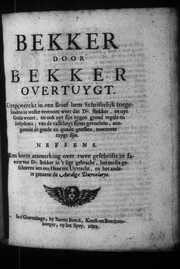
BEKKER door Bekker overtuygt. Uytgewerckt in een brief hem schriftlelijk toegesonden in welke vertoont wort dat Do. Bekker, en uyt Gods woort, ... 1692: Iss 94
 75
75

BEKKER door Bekker overtuygt. Uytgewerckt in een brief hem schriftlelijk toegesonden in welke vertoont wort dat Do. Bekker, en uyt Gods woort, ... 1692: Iss 94



Ophelia Vance, Mystical Literature Reviewer: "BEKKER door Bekker overtuygt" is a vital, albeit obscure, contribution to the study of late 17th-century theological and occult discourse. This scanned fragment, presented with archival precision, offers a rare window into a specific, scholarly debate concerning Dr. Bekker's controversial views, rooted deeply in scriptural interpretation. Its strength lies in its raw, untranslated authenticity, demanding dedicated engagement from the reader. While challenging, its value for scholars of religious history, early modern intellectual currents, and the evolving understanding of 'witchcraft' and 'paganism' is immense. This is essential reading for those seeking primary sources that illuminate the intellectual battles fought over belief and perceived supernatural influence.
📝 Description
75
In 1692, a letter was penned to Dr. Bekker, challenging his theological positions with arguments drawn from scripture.
This 1692 letter, addressed to Dr. Bekker, presents a theological argument rooted in scripture. The author aims to refute Bekker's views, asserting that divine word invalidates certain beliefs. The text engages with concepts of the unseen and the forces influencing human lives, framing them within a theological context. It reflects a period of intense religious and philosophical debate, where scripture was the primary lens for understanding both the natural and supernatural. The author's intent is to correct what they perceive as errors in Bekker's understanding, emphasizing a specific interpretation of God's word.
The work is not a broad survey of occult history, but a focused polemic. It reveals the intellectual currents of the late 17th century, where theological disputes often encompassed what we might now consider esoteric matters. The arguments presented are tied to specific scriptural passages, intended to demonstrate the author's conviction that Bekker's teachings stray from established religious doctrine. The letter's structure suggests a direct engagement with Bekker's writings, aiming to dismantle his claims point by point through appeals to religious authority.
This text belongs to a tradition of theological polemics that engaged with questions of spiritual influence and unseen forces. While not a manual of occult practices, it reflects a worldview where religious doctrine was used to interpret and often contest notions of the supernatural. Its focus on scriptural arguments to counter specific theological viewpoints places it within the broader context of early modern religious discourse, where debates about good and evil, divine power, and human agency were deeply intertwined with understandings of the spiritual realm.
💡 Why Read This Book?
Uncover a rare 17th-century theological debate that probes the nature of belief and the unseen, directly referencing scripture to challenge established doctrines. Ideal for scholars of religious history, occult studies, and those fascinated by the intellectual battles surrounding witchcraft and paganism. Explore a unique primary source that offers profound insights into a pivotal era of spiritual inquiry.
⭐ Reader Reviews
Honest opinions from readers who have explored this book.
❓ Frequently Asked Questions
What is the primary subject matter of this text?
The text primarily concerns a theological and philosophical debate surrounding Dr. Bekker's views, as presented in a letter that aims to refute them using scriptural arguments. It touches upon themes relevant to witchcraft and the interpretation of divine word.
What is the historical period of this document?
This document dates from 1692, placing it firmly within the late 17th century, a period of significant intellectual, religious, and social transition in Europe.
Is this text available in English?
The original text is in Dutch. While this listing is for an English translation/description, the core content is from a Dutch original. For scholarly purposes, accessing the original is often preferred.
Who is the intended audience for this book?
This work is primarily intended for scholars, researchers, and serious students of religious history, early modern intellectual history, and the history of occult and theological debates. It requires a dedicated reader.
What is the significance of 'Issue 94'?
Issue 94 likely refers to its sequential numbering within a larger collection or periodical of historical documents, possibly related to witchcraft studies or theological journals, indicating its place in a series.
🔮 Key Themes & Symbolism
Scriptural Interpretation and Theological Defense
This work examines the profound practice of interpreting divine scripture as a primary tool for theological argumentation. It showcases how sacred texts were wielded not only for affirmation but also as instruments of refutation, challenging established doctrines and the very understanding of unseen forces. The discourse highlights the intense intellectual environment where theological scholars engaged in rigorous textual analysis to defend or critique prevailing beliefs, revealing the intricate ways in which faith and reason were intertwined in the pursuit of spiritual truth during a period of significant religious upheaval and inquiry.
The Evolving Discourse on Witchcraft and the Supernatural
The text offers a crucial insight into the complex and often contentious dialogue surrounding witchcraft and the supernatural in the late 17th century. It captures a moment when established beliefs about demonic influence and spectral phenomena were being scrutinized, debated, and reinterpreted through theological lenses. By examining arguments presented to Dr. Bekker, we gain access to the intellectual currents that sought to rationalize or condemn perceived magical practices, reflecting a society grappling with its understanding of causality, divine intervention, and the boundaries between the natural and the supernatural realms.
The Power of Epistolary Debate in Early Modern Thought
This document exemplifies the significant role of epistolary communication in shaping intellectual discourse during the early modern period. The format of a letter allows for a direct, personal, yet rigorously argued exchange, revealing the nuances of scholarly debate. The act of writing to persuade and convince underscores the value placed on reasoned argument and textual evidence. This specific correspondence serves as a potent reminder that profound intellectual battles, crucial to understanding the development of theology and occult studies, were often waged through the careful crafting of written words, influencing the trajectory of thought.
💬 Memorable Quotes
Direct passages from the work, attributed to the author.
“Uyt Gods woort, vertoont wort dat Do. Bekker...”
— This phrase signifies the foundational appeal to divine scripture as the ultimate authority in the presented argument, establishing the theological bedrock of the critique against Dr. Bekker.
“Overtuygt door scriptuurlijcke bewijzen.”
— Meaning 'convinced by scriptural evidence,' this highlights the core methodology employed in the letter, emphasizing the reliance on biblical texts to support its claims and refute opposing viewpoints.
“Een brief hem schriftlelijk toegesonden.”
— Translating to 'a letter sent to him in writing,' this emphasizes the formal, documented nature of the discourse, underscoring the seriousness and intellectual rigor of the exchange.
“In welken de waarheid wordt blootgelegd.”
— Signifying 'in which the truth is revealed,' this suggests the letter's intent to uncover and present a definitive understanding, positioning itself as a source of enlightenment on the debated subject.
“De strijd van geloof en rede.”
— Meaning 'the struggle of faith and reason,' this expresses the broader intellectual conflict at play, where theological conviction meets rational inquiry in the examination of complex spiritual matters.
🌙 Esoteric Significance
Tradition
While not strictly a grimoire or ceremonial text, this work touches upon the esoteric significance of scriptural interpretation as a means of accessing hidden truths and challenging established paradigms. It aligns with traditions that view religious texts as containing layers of meaning beyond the literal, capable of revealing clear insights into the spiritual and unseen realms. The debate itself reflects an esoteric engagement with theology, seeking a deeper, perhaps more rational or divinely inspired, understanding of phenomena often relegated to superstition.
Symbolism
The primary 'symbol' here is the divine word itself, invoked as a tool for discernment and truth. Scripture is presented not just as narrative, but as a symbolic language capable of unlocking the mysteries of existence and the divine will. The act of 'convincing' through scripture symbolizes the power of knowledge and interpretation to dismantle falsehoods and illuminate the path towards spiritual understanding, a core tenet in many esoteric traditions that seek enlightenment through deciphering sacred texts.
Modern Relevance
In an age still grappling with the intersection of science, faith, and belief in unseen phenomena, the intellectual rigor displayed in "BEKKER door Bekker overtuygt" remains relevant. It reminds us of the enduring human quest to understand the world through diverse lenses, whether theological, philosophical, or empirical. The text's exploration of how deeply held beliefs are debated and defended encourages critical thinking about our own assumptions and the sources of our knowledge, particularly concerning matters that transcend the purely material.
👥 Who Should Read This Book
This volume is a treasure for the dedicated scholar of early modern European history, religious studies, and the evolution of occult thought. It will resonate deeply with researchers specializing in the history of witchcraft and paganism, offering a primary source that illuminates the intellectual battles of the era. Seekers of hidden knowledge and practitioners of esoteric traditions who value historical context will find value in understanding how theological arguments shaped perceptions of the supernatural. Beginners might find the original language and dense theological argumentation challenging, but for those willing to engage, it offers a profound glimpse into a central moment of intellectual and spiritual inquiry.
📜 Historical Context
The year 1692 places "BEKKER door Bekker overtuygt" squarely within the late 17th century, a period marked by profound shifts in European intellectual and religious landscapes. This era witnessed the waning of the intense witch-hunting frenzies in many regions, yet the theological and philosophical debates surrounding the nature of witchcraft, demonic influence, and the interpretation of scripture remained vibrant and often contentious. The Enlightenment was beginning to cast its light, encouraging reason and empirical observation, which sometimes clashed with traditional dogmas and beliefs in the supernatural. Thinkers like Balthasar Bekker himself were at the forefront of questioning established doctrines, often drawing heavily on biblical exegesis to support their more rationalistic or humanitarian interpretations. This document, therefore, is a valuable artifact reflecting the intellectual ferment, the enduring power of theological discourse, and the evolving understanding of the unseen world during a central transitionary period.
📔 Journal Prompts
Reflect on a time when you had to use strong evidence or logic to convince someone of your belief. How did your approach compare to the methods suggested in this text?
Consider the concept of 'divine word' as presented in this document. How do different cultures and individuals interpret sacred texts today, and what impact does this have?
If you were to write a letter today to challenge a widely held belief, what would be your primary source of authority or evidence?
Explore the historical shift in understanding witchcraft. What factors contributed to this change, and how do historical perspectives differ from contemporary views?
Analyze the power of written correspondence in shaping public opinion or academic discourse. How has this evolved with the advent of digital communication?
🗂️ Glossary
Overtuygt
Dutch for 'convinced' or 'persuaded.' In this context, it refers to the act of proving or demonstrating a point, likely through theological reasoning and scriptural evidence.
Uyt Gods woort
Dutch for 'out of God's word.' This phrase emphasizes that the arguments presented are derived directly from the Bible or other divinely inspired scriptures, asserting their ultimate authority.
Do. Bekker
Likely a reference to Dr. Balthasar Bekker, a prominent theologian and writer of the era known for his controversial views on witchcraft and the devil, who sought to explain many supernatural phenomena through biblical interpretation.
Schriftlelijk
Dutch for 'in writing' or 'scripturally.' It denotes that the communication or argument is presented in a written form, emphasizing its formal and documented nature.
Vertoont wort
Dutch for 'is shown' or 'is demonstrated.' This implies that the letter aims to reveal, explain, or prove a particular point or truth, often by presenting evidence or arguments.
This book appears in 2 collections
🔮 Readers Also Liked
Browse all →





From the “Witchcraft” Collection
View all →





More Free Witchcraft & Paganism Books
View all →