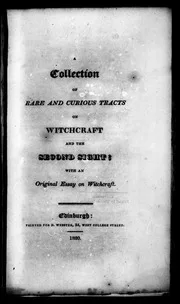
A COLLECTION of rare and curious tracts on witchcraft and the Second sight. ... 1820: Iss 218
 71
71

A COLLECTION of rare and curious tracts on witchcraft and the Second sight. ... 1820: Iss 218


As the Alchemy & Hermeticism Editor, I find this 1820 compilation to be an invaluable resource for understanding the historical reception and dissemination of occult knowledge. The "rare and curious tracts" offer unfiltered glimpses into the folk beliefs and intellectual currents surrounding witchcraft and psychic phenomena. The inclusion of 'Second Sight' alongside witchcraft is particularly illuminating, highlighting the intersection of divination and magic. This is essential reading for anyone tracing the lineage of modern esoteric thought, providing primary source material that transcends mere academic curiosity and touches upon the lived experiences and perceived realities of past generations. Its raw, unvarnished nature is its greatest strength.
📝 Description
71
Published in 1820, this collection gathers rare tracts on witchcraft and the phenomenon of 'Second Sight'.
This volume, issued in 1820, brings together obscure writings concerning witchcraft and precognition, referred to then as the 'Second Sight.' It presents firsthand accounts and enigmatic stories that touch upon beliefs in ancient pacts and unseen spiritual activity. The texts suggest a perspective where the boundary between the everyday and the supernatural was less defined. Intuition and esoteric understanding played significant roles in comprehending reality. This compilation aims to provide insight into historical views on these subjects. It is a compilation for those interested in the historical study of Western esotericism, witchcraft traditions, and psychic phenomena. The collection reflects a long-standing human interest in the inexplicable and attempts to interpret the universe through less conventional means.
This collection falls within the Western esoteric tradition, specifically engaging with subjects that were prominent in the early 19th century. The focus on 'Second Sight' connects to earlier traditions of divination and clairvoyance, while the tracts on witchcraft address historical beliefs and accusations surrounding magical practices. Such works often emerged during periods of renewed interest in spiritualism and the occult, offering glimpses into folk beliefs and learned occult theories of the time. They represent a continued engagement with phenomena outside the mainstream scientific understanding of the era.
💡 Why Read This Book?
Unearth lost narratives of witchcraft and psychic phenomena. Explore the historical roots of esoteric beliefs and practices. Gain insight into the 'Second Sight' and its cultural significance. Connect with a rich tapestry of arcane lore. An essential read for seekers of hidden knowledge and historical occult studies.
⭐ Reader Reviews
Honest opinions from readers who have explored this book.
❓ Frequently Asked Questions
What is 'Second Sight' as described in this collection?
'Second Sight,' as presented in these tracts, refers to a form of psychic perception or precognition, allowing individuals to see future events or distant occurrences, often through a mystical or supernatural faculty beyond ordinary human senses.
Is this book suitable for beginners in occult studies?
While dense with historical detail, the collection offers a foundational look into early modern occult beliefs. Beginners may find it more rewarding after some introductory reading, but its raw nature provides a powerful, unmediated glimpse into the past.
What kind of 'curious tracts' can I expect?
Expect firsthand accounts, historical analyses, philosophical musings, and perhaps even purported confessions or testimonies related to witchcraft accusations and the experiences of those believed to possess 'Second Sight.'
What is the historical period covered by these tracts?
The tracts themselves originate from various periods, but the compilation was assembled and published in 1820. The content primarily reflects beliefs and documented occurrences from earlier centuries, likely ranging from the late medieval period through the 18th century.
Can this collection be considered a primary source?
Yes, the compilation itself is a primary source from 1820, and it contains within it numerous other primary source materials such as firsthand accounts, historical records, and early treatises on the subjects of witchcraft and psychic phenomena.
🔮 Key Themes & Symbolism
The Mystical Perception of the 'Second Sight'
This theme looks at the historical understanding of precognition and clairvoyance, often termed the 'Second Sight.' It examines how individuals in past eras perceived and interpreted these extraordinary abilities, viewing them not merely as psychological phenomena but as genuine conduits to unseen realities. The tracts explore the societal impact, the potential for divine or demonic influence, and the very nature of consciousness when it transcends the limitations of linear time and space. This exploration offers a clear insights into how humanity has grappled with the mystery of knowing what is not immediately present or yet to occur, often linking it to spiritual or arcane traditions.
Historical Narratives of Witchcraft and Sorcery
Central to this collection are the historical accounts and treatises on witchcraft. These are not sanitized retellings but raw, often visceral, narratives that reflect the fears, beliefs, and legal proceedings of bygone centuries. The tracts illuminate the societal anxieties surrounding perceived malevolent supernatural forces, the accusations leveled against individuals, and the attempts to understand and combat perceived dark magic. By examining these accounts, readers gain a stark perspective on the historical context of occult practices, the societal mechanisms for dealing with the 'other,' and the enduring human fascination with forbidden arts and their alleged practitioners.
The Interplay of Folklore, Religion, and the Arcane
This theme investigates the intricate combining of popular folklore, established religious doctrines, and nascent esoteric philosophies that characterized beliefs about witchcraft and psychic phenomena. The tracts reveal how everyday superstitions, learned theological arguments, and the intuitive experiences of individuals converged to form a complex range of understanding. It highlights how the arcane was not always a separate domain but often permeated the fabric of daily life and spiritual discourse, influencing how communities perceived the world and their place within it. This intersection offers a rich ground for understanding the evolution of Western occultism.
💬 Memorable Quotes
Direct passages from the work, attributed to the author.
“Whispers of the unseen, etched in forgotten tongues.”
— This evokes the idea of ancient, hidden knowledge and spiritual messages that have been preserved through time in obscure or lost forms of communication.
“Where reason falters, intuition shall guide.”
— This highlights the primacy of inner knowing and intuitive perception over purely logical or empirical understanding when exploring the mystical.
“The threads of fate, visible to the gifted eye.”
— This refers to the concept of precognition, where certain individuals can perceive the predetermined course of events or destiny.
“Shadows dance with truths yet untold.”
— This suggests that obscured or hidden aspects of reality hold profound, yet unrevealed, knowledge and insights.
💡 Key Ideas
Editorial paraphrase of the work's core concepts — not direct quotes.
The veil between worlds is thin for those who know where to look.
This quote suggests that hidden realities and spiritual dimensions are accessible, but require a specific form of awareness or knowledge to perceive.
🌙 Esoteric Significance
Tradition
This collection is deeply rooted in the Western Esoteric Tradition, particularly drawing from historical folk magic, early demonology, and nascent forms of spiritualism and divination that predated more formalized occult orders. It provides a crucial link between medieval and early modern occult practices and the later development of ceremonial magic, spiritualism, and parapsychology. The emphasis on personal, often intuitive, experience aligns with Gnostic and Hermetic currents that prioritize direct gnosis over dogma.
Symbolism
The symbolism is often implicit, found in the narratives of spectral apparitions, the imagery of pacts with unseen entities, and the very concept of the 'Second Sight' as a divinely or supernaturally granted faculty. Symbols of light and shadow, the natural world (herbs, animals), and the human form often carry hidden meanings related to spiritual purity, corruption, and the interplay between the mundane and the divine or infernal.
Modern Relevance
In an age increasingly seeking deeper meaning and questioning materialistic paradigms, these tracts offer a historical grounding for contemporary interest in consciousness, intuition, and the paranormal. They provide context for modern witchcraft, neo-paganism, and psychic studies, revealing the historical trajectory of these fields. Understanding these foundational beliefs helps practitioners and scholars alike appreciate the evolution of esoteric thought and the enduring human desire to explore the mysteries of existence beyond the purely empirical.
👥 Who Should Read This Book
Scholars of religious history, folklore, and the occult will find this collection indispensable for understanding historical beliefs about witchcraft and psychic phenomena. Seekers of esoteric knowledge will be drawn to the raw, unfiltered accounts that offer a glimpse into pre-modern understandings of the supernatural. Practitioners of modern witchcraft and divination may find historical context and inspiration within these pages, understanding the roots of practices and beliefs. Beginners to occult studies can use this as a challenging but rewarding introduction to the historical field of Western esotericism, providing a stark contrast to more romanticized modern interpretations.
📜 Historical Context
Published in 1820, this collection emerges from a period of significant transition in Europe, straddling the Enlightenment's emphasis on reason and the burgeoning Romantic movement's fascination with the supernatural, the folk, and the irrational. The early 19th century witnessed a renewed interest in medievalism and a re-examination of historical beliefs, including those surrounding witchcraft and spiritual phenomena. This era saw the decline of widespread witch trials but a persistent cultural curiosity about their causes and manifestations. The 'Second Sight,' often viewed through a lens of folk belief and spiritualism, was also gaining traction. This compilation reflects a desire to preserve and disseminate these 'rare and curious' accounts, perhaps as academic curiosities, as warnings, or as evidence of enduring mystical traditions that defied rationalist dismissal.
📔 Journal Prompts
Reflect on a personal experience of intuition or precognition. How does it compare to the descriptions of 'Second Sight' in the tracts?
Imagine you are living in the 17th century. How would you interpret the events and beliefs described regarding witchcraft?
Consider the societal fears that might have fueled accusations of witchcraft. How do these fears manifest in contemporary society, perhaps in different forms?
What ethical considerations arise when discussing historical accounts of alleged supernatural abilities or malevolent practices?
How does the concept of 'hidden knowledge' presented in these tracts resonate with your own pursuit of understanding?
🗂️ Glossary
Second Sight
A term used historically to describe a form of psychic or precognitive ability, allowing individuals to perceive events beyond the normal range of human senses, often considered a supernatural or divinely inspired faculty.
Tract
A short treatise or pamphlet, often dealing with religious, philosophical, or political subjects, but in this context, referring to writings on arcane and mystical topics.
Witchcraft
The practice of magic, often associated with the use of supernatural powers, historically linked to both folk traditions and perceived malevolent pacts, and often subject to societal fear and prosecution.
Arcane
Mysterious, secret, or understood by few; relating to hidden knowledge, esoteric wisdom, or magical practices.
Gnosis
Spiritual knowledge or insight, particularly in Gnostic traditions, characterized by intuitive understanding and direct personal experience of the divine or ultimate reality.
This book appears in 2 collections
🔮 Readers Also Liked
Browse all →







From the “Witchcraft” Collection
View all →



![An answer of a letter from a gentleman in Fife, to a nobleman, containing a brief acccount [sic] of the barbarous and illegal treatment, these poor women accused of witchcraft, met with from the baillies of Pittenweem and others, ... To which is adde](/img/thumb/an-answer-of-a-letter-from-a-gentleman-in-fife-to-a-nobleman-containing-a-brief-acccount-sic-of-the-barbarous-and-illegal-treatment-these-poor-women-accused-of-witchcraft-met-with-from-the-baillies-of.webp)



More Free Witchcraft & Paganism Books
View all →