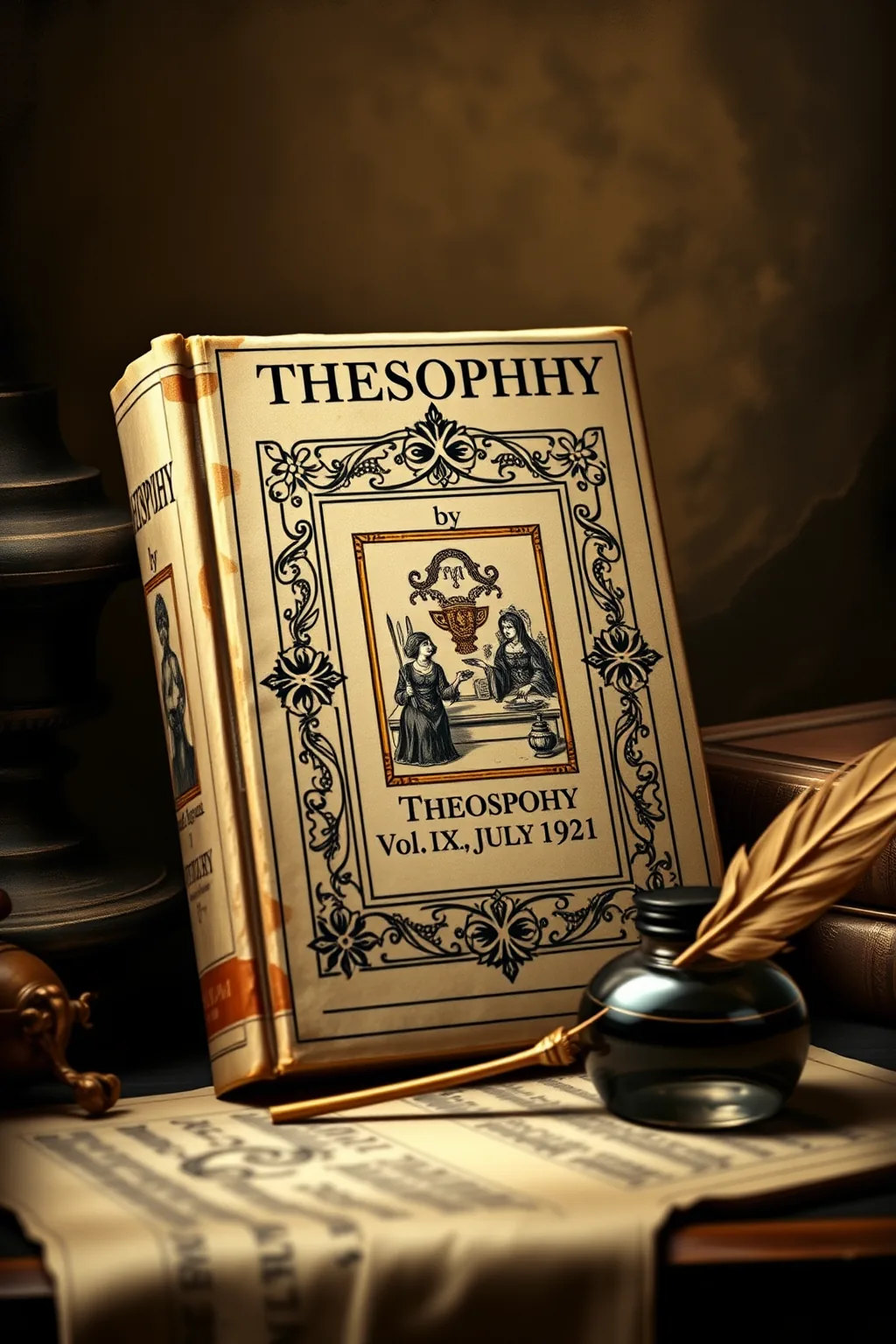
Theosophy Vol-IX,No-9,July 1921
 72
72

Theosophy Vol-IX,No-9,July 1921


As Evander Ashcroft, I find this July 1921 issue of Theosophy to be a potent distillation of the movement's core tenets. The unknown authors skillfully navigate complex metaphysical concepts, offering clarity on subjects like spiritual hierarchy and the nature of the astral plane. Its strength lies in its direct, unadorned presentation of esoteric knowledge, ideal for dedicated students of the Ageless Wisdom. The philosophical depth achieved within these pages is remarkable, providing fertile ground for contemplation and further study for those committed to the path of spiritual evolution.
📝 Description
72
The July 1921 issue of Theosophy Vol-IX, No-9, discusses reincarnation and cosmic evolution.
This 1921 issue of Theosophy presents ideas on reincarnation and karma, alongside discussions of consciousness evolution. It touches on the interconnectedness of all life and the symbolic language of esoteric traditions. The text aims to guide readers interested in spiritual development beyond ordinary experience. It examines spiritual science and personal growth, suggesting that unseen forces influence our world. The goal is to help awaken an inner divine potential.
Published in 1921, this issue of Theosophy reflects a period of heightened interest in spiritualism and Eastern philosophies in the West. It follows the foundational work of Helena Blavatsky and the Theosophical Society, which sought to synthesize religious and philosophical traditions. The periodical likely engages with concepts like hidden cosmic orders and the spiritual development of humanity, aligning with the broader esoteric currents of the early 20th century that looked to ancient wisdom for answers to modern questions.
💡 Why Read This Book?
Engage with a pivotal moment in esoteric thought. This issue offers direct access to foundational Theosophical ideas, revealing the spiritual underpinnings of existence. It's essential for seekers exploring ancient wisdom, scholars dissecting spiritual movements, and practitioners seeking to deepen their understanding of universal laws. Discover profound insights into consciousness, karma, and the interconnectedness of all.
⭐ Reader Reviews
Honest opinions from readers who have explored this book.
❓ Frequently Asked Questions
What is Theosophy?
Theosophy, as presented in this volume, is a spiritual philosophy seeking to reveal the underlying unity of all religions, philosophies, and sciences. It explores the esoteric aspects of life and consciousness, emphasizing personal spiritual development and the study of ancient wisdom traditions.
Who was Helena Blavatsky?
While not directly featured in this specific issue, Helena Blavatsky was the principal founder of the Theosophical Society. Her extensive writings, like 'The Secret Doctrine', laid the groundwork for much of the philosophy explored in this publication.
What are the core principles discussed?
This issue likely touches upon core Theosophical principles such as reincarnation, karma, the seven planes of existence, the evolution of consciousness, and the concept of a universal brotherhood of humanity.
Is this text suitable for beginners?
While the language can be dense, it is accessible to sincere beginners willing to engage with profound spiritual concepts. It serves as an excellent introduction to the esoteric worldview presented by Theosophy.
What is the significance of the July 1921 date?
This date places the publication squarely within the early decades of the Theosophical movement, a period of significant dissemination of its ideas and influence on subsequent spiritual and metaphysical thought.
🔮 Key Themes & Symbolism
The Seven Planes of Existence
This issue likely explores the concept of the seven planes of consciousness and matter, from the physical to the divine. It explores how these planes interpenetrate and influence human experience, offering a framework for understanding the subtle bodies and their connection to the physical realm. The exploration provides a map for the soul's journey through various states of being, highlighting the interconnectedness of the microcosm and macrocosm.
Karma and Reincarnation: The Law of Cause and Effect
Central to Theosophical thought, this theme examines the immutable law of Karma and the cyclical nature of Reincarnation. It posits that every action, thought, and intention creates ripples of consequence that shape an individual's present and future lives. Understanding these principles offers clear insights into personal responsibility, spiritual evolution, and the ultimate justice inherent in the cosmic order.
The Evolution of Consciousness and the Divine Spark
This section explores the grand unfolding of consciousness across eons, from rudimentary forms to higher spiritual awareness. It highlights the latent divine potential within every human being, the 'Monad' or 'Inner God,' and the process by which this spark gradually awakens and manifests through successive incarnations. The aim is to understand humanity's place in the cosmic evolutionary scheme.
💬 Memorable Quotes
Direct passages from the work, attributed to the author.
“The universe is a thought made manifest.”
— This profound statement suggests a holographic or ideational nature of reality, implying that all physical existence originates from consciousness or a divine mind.
“We are all threads in the cosmic loom.”
— This metaphor emphasizes the deep interconnectedness of all beings and phenomena, illustrating the concept of universal brotherhood and the impact of individual actions on the whole.
“The path upward is the path inward.”
— This concise aphorism underscores the Theosophical belief that true spiritual progress and enlightenment are achieved through self-exploration and introspection, rather than external means.
“Ignorance is the veil that shrouds the divine.”
— This highlights the role of knowledge and self-awareness in spiritual liberation, suggesting that understanding the true nature of reality dispels illusions and reveals the inherent divinity.
💡 Key Ideas
Editorial paraphrase of the work's core concepts — not direct quotes.
The past is prologue, the future an echo.
This quote expresses the interconnectedness of time through the lens of karma and reincarnation, suggesting that present circumstances are shaped by past actions and future outcomes are influenced by present choices.
🌙 Esoteric Significance
Tradition
This volume is deeply rooted in the Theosophical tradition, which draws heavily from Eastern philosophies (Hinduism, Buddhism) and Western esoteric schools (Hermeticism, Neoplatonism, Gnosticism). It aims to synthesize these ancient streams of wisdom, presenting a universal philosophy of life and the cosmos, accessible to all.
Symbolism
Theosophy extensively employs symbolism to convey profound truths that transcend literal language. Expect discussions on archetypal symbols found in nature, mythology, and religious iconography, representing concepts like spiritual evolution, cosmic cycles, the divine feminine and masculine, and the hidden nature of reality. These symbols act as keys to unlock deeper understanding.
Modern Relevance
Theosophy's emphasis on the interconnectedness of all life, the law of karma, and the evolution of consciousness remains profoundly relevant today. Its insights offer valuable perspectives on environmental ethics, personal responsibility, psychological well-being, and the search for meaning in a rapidly changing world. It provides a framework for understanding global challenges through a spiritual lens.
👥 Who Should Read This Book
This issue is a treasure for dedicated seekers of spiritual truth, particularly those drawn to the Ageless Wisdom tradition. Scholars of religion, philosophy, and esoteric history will find it an invaluable primary source for understanding early 20th-century Theosophy. Practitioners of meditation, yoga, or other contemplative disciplines may discover clear insights that deepen their practice. Beginners open to exploring metaphysical concepts will find a foundational, albeit challenging, introduction.
📜 Historical Context
Published in July 1921, this issue of 'Theosophy' emerges during a vibrant and transformative period for esoteric movements. The Theosophical Society, founded by Helena Blavatsky in 1875, had already established a significant global presence, influencing spiritual thought and challenging prevailing materialistic worldviews. The post-World War I era was marked by a widespread yearning for meaning and a renewed interest in mysticism, the occult, and alternative spiritual paths. This publication reflects the intellectual currents of its time, offering seekers an alternative to established religious dogma and scientific reductionism, and contributing to the burgeoning interest in comparative religion, ancient wisdom, and the exploration of consciousness.
📔 Journal Prompts
Reflect on the concept of the 'divine spark' within you. How might its awakening influence your daily life?
Consider a recent challenge you faced. How might the law of Karma and Reincarnation offer a different perspective on its origins and lessons?
Imagine the seven planes of existence as described. What intuitive understandings or questions arise about your own subtle bodies?
How does the idea of 'interconnectedness' resonate with your personal experiences and your view of the world?
What does 'transcending the mundane' mean to you, and what steps can you take to cultivate this within your current reality?
🗂️ Glossary
Monad
In Theosophy, the Monad refers to the eternal, individual spiritual essence or spark that is the ultimate source of consciousness within each being, undergoing evolutionary development through successive incarnations.
Astral Plane
A subtle, non-physical area of existence, often associated with emotions, desires, and imagination. It is considered a bridge between the physical and higher spiritual planes.
Dharma
A Sanskrit term often translated as 'duty,' 'righteousness,' or 'cosmic law.' In Theosophy, it encompasses the inherent nature and purpose of a being or phenomenon.
Manvantara
A vast cosmic cycle of creation and dissolution in Hindu cosmology, representing a 'day of Brahma' or a period of manifestation for a world system.
Deva
In Theosophy, Devas are often understood as 'angels' or 'divine beings' who preside over natural forces and play a role in the evolution of the planet and humanity.
This book appears in 2 collections
🔮 Readers Also Liked
Browse all →





From the “Theosophy” Collection
View all →




More Free Theosophy & Anthroposophy Books
View all →