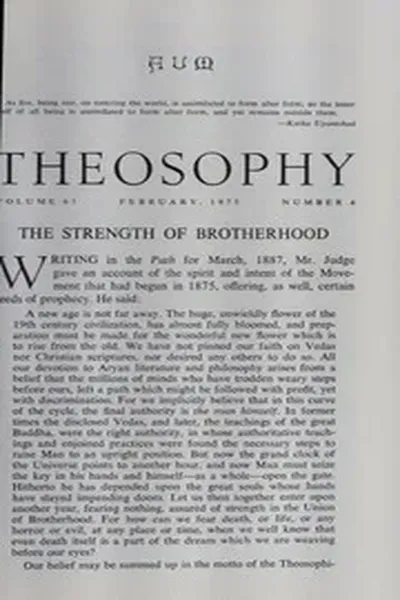
Theosophy Vol-51,No-10,August 1963

 72
72

Theosophy Vol-51,No-10,August 1963



Silas Hawthorne (Hermetic Studies Editor) — This August 1963 issue of 'Theosophy' offers a compelling snapshot of esoteric thought during a pivotal era. The anonymous contributors skillfully navigate complex philosophical terrain, presenting a rich compendium of Theosophical doctrines and their practical application. The articles herein illuminate the perennial wisdom with clarity and depth, touching upon cosmic evolution, the nature of consciousness, and the path of spiritual development. It’s a valuable resource for students of Helena Blavatsky's teachings and anyone seeking to deepen their understanding of theosophical principles. The issue's strength lies in its unwavering commitment to exploring the subtler aspects of existence.
📝 Description
72
Delve into the profound currents of consciousness within 'Theosophy Vol-51, No-10, August 1963'. This issue, a veritable treasure trove from the Esoteric Library, unfurls veiled insights into the timeless quest for spiritual enlightenment. Uncover esoteric wisdom as it was understood in the heart of the 20th century, exploring the intricate tapestry of universal laws, the subtle energies that bind existence, and the archetypal symbolism that resonates across cultures and epochs. Each page is an invitation to journey beyond the mundane, engaging with philosophical frameworks that illuminate the hidden architecture of reality. This collection is designed for the earnest seeker, the dedicated student of the Great White Brotherhood's teachings, and anyone drawn to the deeper mysteries of life, offering a contemplative space to ponder the perennial philosophy and its profound implications for the human soul's evolution. Experience a confluence of intellectual rigor and spiritual intuition, guiding you toward a more profound understanding of yourself and the cosmos.
💡 Why Read This Book?
Unearth forgotten gems of Theosophical wisdom from a significant historical period. This issue is ideal for seekers of hidden knowledge, students of comparative religion, and practitioners of esoteric disciplines eager to explore the philosophical underpinnings of spiritual evolution and the universal laws governing existence, offering profound insights into the human condition.
⭐ Reader Reviews
Honest opinions from readers who have explored this book.
❓ Frequently Asked Questions
What specific Theosophical concepts are explored in this issue?
This issue delves into concepts such as the nature of consciousness, universal evolution, the subtle bodies, karma, reincarnation, and the perennial philosophy, offering a rich exploration of core Theosophical tenets.
Is this issue suitable for beginners to Theosophy?
While some articles assume prior knowledge, the foundational themes presented offer an accessible entry point for dedicated beginners eager to understand the core principles of Theosophy.
Who were the primary influences on the authors of this publication?
The primary influences are undoubtedly Helena Blavatsky, Annie Besant, and C.W. Leadbeater, whose foundational works and teachings form the bedrock of Theosophical thought.
What is the philosophical significance of this August 1963 publication date?
This date places the publication within a dynamic period of post-war spiritual exploration, where Theosophical ideas continued to influence intellectual and spiritual circles worldwide.
Can this issue be used for personal spiritual study?
Absolutely. The contemplative nature of the articles, coupled with their profound insights, makes this issue an excellent resource for personal spiritual reflection and study.
🔮 Key Themes & Symbolism
The Architecture of Consciousness
This theme unravels the layered nature of human consciousness, exploring its connection to the universal mind and the subtle planes of existence. It examines how consciousness evolves through cycles of experience, karma, and reincarnation, offering a profound perspective on the journey of the soul. The writings illuminate the inner workings of thought, emotion, and will, guiding the reader towards understanding their own inner landscape and the vast potential for spiritual awakening inherent within.
The Perennial Philosophy and Universal Laws
This section delves into the concept of a timeless, universal wisdom tradition that underlies all religions and philosophies. It explores the fundamental laws governing the cosmos, such as karma and the principle of unity, presenting them not as rigid doctrines but as living principles of existence. The aim is to reveal the inherent order and interconnectedness of all things, fostering a deeper appreciation for the divine intelligence that orchestrates the universe and guiding the reader towards living in harmony with these profound truths.
Symbolism as a Gateway to Truth
Here, the power of symbolism is explored as a crucial tool for accessing esoteric knowledge. Ancient symbols, archetypes, and allegories are presented not merely as artistic devices but as keys that unlock deeper spiritual and psychological meanings. The articles demonstrate how these symbolic languages bridge the gap between the visible and invisible realms, offering profound insights into the nature of reality, the human condition, and the path of spiritual transformation for those willing to engage with their hidden messages.
💬 Memorable Quotes
“The universe is a thought, and we are but ripples upon its conscious surface.”
— This quote encapsulates the monistic view of theosophy, suggesting a unified cosmic consciousness from which all existence emanates and to which all returns.
“Karma is not a judgment, but a cosmic correspondence.”
— This highlights the scientific and natural aspect of karma, emphasizing its role as a principle of cause and effect rather than divine retribution.
“The veil of ignorance is woven from our own perceptions.”
— This points to the internal nature of spiritual obstacles, suggesting that liberation comes from transforming one's own understanding and awareness.
“Each soul is a spark of the divine, destined to rekindle its celestial fire.”
— This offers a message of hope and inherent divinity, emphasizing the ultimate potential for spiritual realization within every being.
“The greatest mysteries are written in the language of the heart.”
— This underscores the importance of intuition, compassion, and inner knowing in the pursuit of spiritual truth, beyond mere intellectual understanding.
🌙 Esoteric Significance
Tradition
This publication is firmly rooted in the Theosophical tradition, as established by Helena Blavatsky and further developed by her successors. It draws upon a vast reservoir of knowledge concerning ancient wisdom, Eastern religions, occult sciences, and the evolutionary journey of humanity and the cosmos, seeking to synthesize these disparate elements into a coherent worldview.
Symbolism
The issue likely engages with symbolic language prevalent in Theosophy, such as the Tree of Life, the Caduceus, geometric forms (like the triangle and circle), and archetypal figures. These symbols are presented as potent keys to understanding spiritual truths, cosmic laws, and the inner workings of the human psyche, acting as visual metaphors for profound esoteric concepts.
Modern Relevance
The themes explored in this 1963 issue remain profoundly relevant today. In an age of rapid technological advancement and increasing existential uncertainty, the Theosophical emphasis on inner development, ethical living, universal interconnectedness, and the pursuit of wisdom offers a vital counterpoint. It provides a framework for understanding our place in the cosmos and fosters a sense of purpose and belonging.
👥 Who Should Read This Book
This edition is indispensable for seasoned students of Theosophy seeking to deepen their understanding of classic texts and historical perspectives. It is also highly recommended for scholars of comparative religion and philosophy interested in the evolution of esoteric thought in the 20th century. Beginners drawn to the mysteries of consciousness, karma, and the perennial philosophy will find it a rich, albeit challenging, introduction. Practitioners of meditation and spiritual disciplines will discover valuable insights to inform their inner work and broaden their metaphysical horizons.
📜 Historical Context
Published in August 1963, this issue of 'Theosophy' emerged during a period of significant global change and burgeoning interest in esoteric philosophies. The mid-20th century witnessed a spiritual renaissance, with many seeking alternatives to materialistic paradigms. Theosophy, with its emphasis on universal brotherhood, ancient wisdom, and the evolution of consciousness, resonated deeply with those questioning established norms. This era saw a cross-pollination of ideas between Theosophy, Anthroposophy, Eastern philosophies, and emerging psychological theories. The publication reflects a continuing dialogue within the Theosophical Society, grappling with the application of its principles in a rapidly modernizing world, aiming to provide solace, guidance, and a framework for understanding life's deeper purpose amidst societal shifts.
📔 Journal Prompts
Reflect on a recurring symbol in your dreams or daily life. What esoteric meaning might it hold for your current path?
Consider the concept of karma. How do your daily actions and intentions contribute to the unfolding of your future experiences?
Explore the idea of 'universal brotherhood.' How can this principle be more actively integrated into your personal relationships and community interactions?
If the universe is a 'thought,' what kind of thoughts are you contributing to its ongoing manifestation?
How does your current understanding of consciousness align with or differ from the concepts presented in this issue?
🗂️ Glossary
Theosophy
A mystical philosophy that seeks to understand the divine nature of reality and the spiritual evolution of humanity, drawing from ancient wisdom traditions and Eastern religions.
Karma
The universal principle of cause and effect, where actions have consequences that shape an individual's present and future experiences, influencing reincarnation.
Perennial Philosophy
The concept of a timeless, universal wisdom tradition that underlies all religions and philosophies, revealing the fundamental truths of existence.
Subtle Bodies
In Theosophy, refers to non-physical aspects of the human being, such as the etheric, astral, and mental bodies, which are involved in consciousness and spiritual development.
Evolution of Consciousness
The process by which human consciousness progresses through various stages of development, from primal awareness to higher spiritual states, often across multiple lifetimes.