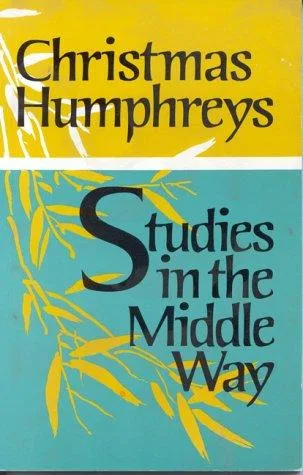
Studies in the middle way
 78
78

Studies in the middle way
Christmas Humphreys’s *Studies in the Middle Way* offers a commendably clear exposition of Buddhist principles, particularly for those new to the subject. Humphreys’s strength lies in his ability to distill complex ideas into accessible language, a skill honed by his extensive experience in popularizing Eastern thought for a Western audience. He consistently steers clear of overly academic or sectarian language, making the core tenets of the Middle Way understandable. A notable section details the practical application of the Noble Eightfold Path, illustrating how ethical conduct, mental discipline, and wisdom interrelate. However, the book occasionally feels dated in its approach, sometimes presenting Buddhist concepts through a rather 1950s British lens, which might lack the nuance some contemporary readers expect. Despite this, *Studies in the Middle Way* remains a solid, foundational text for understanding Buddhist balance.
📝 Description
78
Christmas Humphreys published Studies in the Middle Way in 1984, clarifying Buddhist philosophy for Westerners.
Studies in the Middle Way presents a structured look at Buddhist philosophy, specifically the path that avoids extremes. Christmas Humphreys, a key figure in introducing Buddhist thought to the West, explains core principles without using specialized terms. The book aims to show how Buddhist teachings can be applied practically by individuals today, stressing balance and mindful action.
This book is for anyone wanting a clear and straightforward introduction to Buddhist ideas, especially Westerners not familiar with its complexities. It will appeal to readers interested in ethical systems, contemplative methods, and philosophical thought that values personal experience over rigid doctrine. Those seeking inner peace and mental clarity will find its approach useful.
Humphreys, a barrister and judge, was a leading advocate for Buddhism in Britain. He co-founded the Buddhist Society in London in 1924. His work presented Buddhist concepts in a way Western audiences could grasp, often comparing them to Western philosophy and psychology. This approach set it apart from purely academic or Asian interpretations.
Within the context of Western mysticism and contemplation, Humphreys' work offers a bridge between Eastern Buddhist philosophy and a Western audience. It emerged during a time of growing interest in Eastern traditions, presenting Buddhist ideas not as foreign dogma but as a practical path to personal development. By connecting these concepts to Western philosophical and psychological frameworks, the book provided an accessible entry point to contemplative practices and ethical frameworks rooted in personal experience rather than institutional authority.
💡 Why Read This Book?
• Gain a clear understanding of the Buddhist concept of the 'Middle Way,' learning how to balance opposing extremes in thought and action, as explored in the early chapters. • Discover practical applications of the Noble Eightfold Path for daily living, moving beyond theoretical knowledge to embodied practice, a focus emphasized throughout the text. • Appreciate the historical effort to present Buddhist philosophy to a Western audience, understanding the context provided by Humphreys’s own background as a key figure in the Buddhist Society.
⭐ Reader Reviews
Honest opinions from readers who have explored this book.
❓ Frequently Asked Questions
What is the 'Middle Way' as described by Christmas Humphreys?
The 'Middle Way' in Buddhist philosophy, as presented by Humphreys, is a path that avoids extremes of self-indulgence and severe asceticism. It emphasizes balance in all aspects of life, leading to wisdom and liberation.
When was Studies in the Middle Way first published?
Studies in the Middle Way was first published in 1984. This places its origins within a period of growing Western interest in Eastern spiritual traditions.
Who was Christmas Humphreys and what was his role in Buddhism?
Christmas Humphreys (1901-1983) was an English lawyer, judge, and author who played a significant role in introducing Buddhist philosophy to the West. He co-founded the Buddhist Society in London in 1924.
Does the book discuss the Noble Eightfold Path?
Yes, the book dedicates significant attention to the Noble Eightfold Path, outlining its components as a practical guide for living the Middle Way. It is presented as a method for cultivating ethical conduct, mental discipline, and wisdom.
Is this book suitable for beginners to Buddhism?
Absolutely. Humphreys's writing style is accessible and aims to clarify Buddhist concepts for those unfamiliar with them. It serves as an excellent introductory text for Western readers.
What kind of Buddhist tradition does Humphreys primarily draw from?
While Humphreys aimed for a broad, non-sectarian presentation, his work often reflects Theravada and Mahayana influences, filtered through his Western philosophical and legal perspective. He focused on the universal ethical and philosophical aspects.
🔮 Key Themes & Symbolism
The Middle Way Concept
The central tenet explored is the 'Middle Way,' a path of moderation that eschews the extremes of excessive asceticism and unrestrained sensual indulgence. Humphreys posits this balanced approach as the most effective route to spiritual understanding and inner peace. This concept is not merely theoretical but is presented as a practical guide for navigating life's challenges, encouraging mindful decision-making and a rejection of rigid dogmatism or nihilism.
Noble Eightfold Path
Humphreys details the Noble Eightfold Path (Right Understanding, Right Thought, Right Speech, Right Action, Right Livelihood, Right Effort, Right Mindfulness, Right Concentration) as the practical embodiment of the Middle Way. The book breaks down each element, illustrating how they form an interconnected framework for ethical living, mental cultivation, and the development of wisdom. It emphasizes that these are not sequential steps but concurrent practices.
Impermanence and Non-Self
The work touches upon fundamental Buddhist doctrines such as anicca (impermanence) and anatta (non-self). Humphreys explains how recognizing the transient nature of all phenomena and the lack of a fixed, independent self leads to detachment from suffering and a clearer perception of reality. This understanding is crucial for breaking free from attachment and illusion.
Wisdom and Compassion
Central to the Middle Way is the cultivation of prajna (wisdom) and karuna (compassion). The book suggests that true wisdom arises from understanding the nature of reality as presented through the Middle Way, while compassion is its natural outflow, extending understanding and kindness to all beings. These two qualities are presented as inseparable aspects of enlightenment.
💬 Memorable Quotes
Direct passages from the work, attributed to the author.
“All conditioned things are impermanent.”
— This statement captures the Buddhist doctrine of anicca. It serves as a reminder that everything subject to causes and conditions, including our own experiences and the external world, is in a constant state of flux.
“Right understanding is the first step towards the Middle Way.”
— This emphasizes the foundational role of correct perception and insight. Without a clear grasp of Buddhist principles, particularly the Middle Way, one cannot effectively follow the path.
“The path is not a goal to be reached, but a way of living.”
— This interpretation stresses the practical, ongoing nature of the Buddhist path. It's about the continuous cultivation of wisdom and compassion in daily life, rather than a destination.
“Suffering arises from attachment.”
— This reflects the Buddhist understanding of dukkha (suffering) and its cause. Attachment to impermanent things and concepts creates the conditions for dissatisfaction and pain.
💡 Key Ideas
Editorial paraphrase of the work's core concepts — not direct quotes.
The Middle Way is the way of balance, of moderation, of seeing things as they are.
This paraphrased concept highlights the core message of the book: that true understanding and peace are found not in extremes, but in a balanced perspective that reflects reality without distortion.
🌙 Esoteric Significance
Tradition
While not strictly esoteric in the sense of hidden rituals, Humphreys's work draws heavily from the philosophical and ethical dimensions of Buddhism, which are foundational to many esoteric traditions. It aligns with the Western Hermetic and Theosophical interest in Eastern thought, seeking universal truths applicable across cultures. His focus on the 'Middle Way' can be seen as a method for balancing the inner and outer worlds, a common theme in esoteric systems.
Symbolism
The primary symbolic representation is the 'Middle Way' itself, often depicted as a path avoiding two extremes, signifying balance, moderation, and the avoidance of duality. The Noble Eightfold Path, with its eight spokes, can be seen as a wheel, symbolizing the Dharma Chakra (Wheel of Dharma), representing the Buddha's teachings and the cyclical nature of existence. The book also implicitly uses the symbol of the lotus flower, representing purity and enlightenment emerging from muddy waters.
Modern Relevance
Humphreys's work continues to be relevant for contemporary mindfulness practitioners and those interested in secular Buddhism or Buddhist-inspired ethics. Thinkers and authors focusing on cognitive behavioral therapy (CBT) and acceptance and commitment therapy (ACT) often echo the principles of mindful awareness and non-attachment discussed in his writings. His accessible style makes it a gateway for individuals exploring contemplative practices without necessarily adhering to religious dogma.
👥 Who Should Read This Book
['• Students of comparative religion seeking a clear exposition of core Buddhist principles, particularly the concept of the Middle Way and its philosophical underpinnings.', "• Individuals interested in Western interpretations of Eastern philosophy, who appreciate a rational and ethical approach to spiritual inquiry, as exemplified by Humphreys's background.", "• Seekers of practical wisdom and mental balance, looking for accessible guidance on navigating life's dualities and cultivating inner peace through mindful conduct."]
📜 Historical Context
Published in 1984, *Studies in the Middle Way* arrived in a Western intellectual landscape increasingly receptive to Eastern thought. Christmas Humphreys, a prominent figure since the 1920s through his involvement with the Buddhist Society, aimed to bridge the gap between Buddhist philosophy and Western rationalism. His background as a judge lent an air of authority and clarity to his explanations. The era saw continued engagement with figures like D.T. Suzuki, who popularized Zen, and the increasing availability of translations from various Buddhist traditions. Humphreys's work, however, often focused on the ethical and philosophical underpinnings, drawing parallels with Western secular ethics and psychology, differentiating it from more devotional or monastic interpretations prevalent in some quarters. His approach sought to present Buddhism as a viable, practical philosophy for modern life, distinct from the more mystical or esoteric interpretations gaining traction elsewhere.
📔 Journal Prompts
The Middle Way as a principle for decision-making in challenging situations.
Reflections on recognizing impermanence in daily life.
Applying the concept of 'Right Effort' to personal goals.
Exploring the balance between self-care and altruism.
The role of 'Right Understanding' in resolving conflict.
🗂️ Glossary
Middle Way
The central Buddhist concept of avoiding extremes, such as asceticism and sensual indulgence, in favor of a balanced path leading to wisdom and liberation.
Noble Eightfold Path
The eight practices leading to the cessation of suffering: Right Understanding, Right Thought, Right Speech, Right Action, Right Livelihood, Right Effort, Right Mindfulness, and Right Concentration.
Anicca
The Buddhist doctrine of impermanence, stating that all conditioned phenomena are in a constant state of flux and change.
Anatta
The doctrine of non-self, asserting that there is no permanent, unchanging, independent self or soul.
Dukkha
Often translated as suffering, dissatisfaction, or stress, arising from attachment and ignorance.
Prajna
Wisdom or insight, particularly the profound understanding of the nature of reality as taught in Buddhism.
Karuna
Compassion, the altruistic wish for all beings to be free from suffering.
🔮 Readers Also Liked
Browse all →



More by Christmas Humphreys
All books →





More Free Theosophy & Anthroposophy Books
View all →