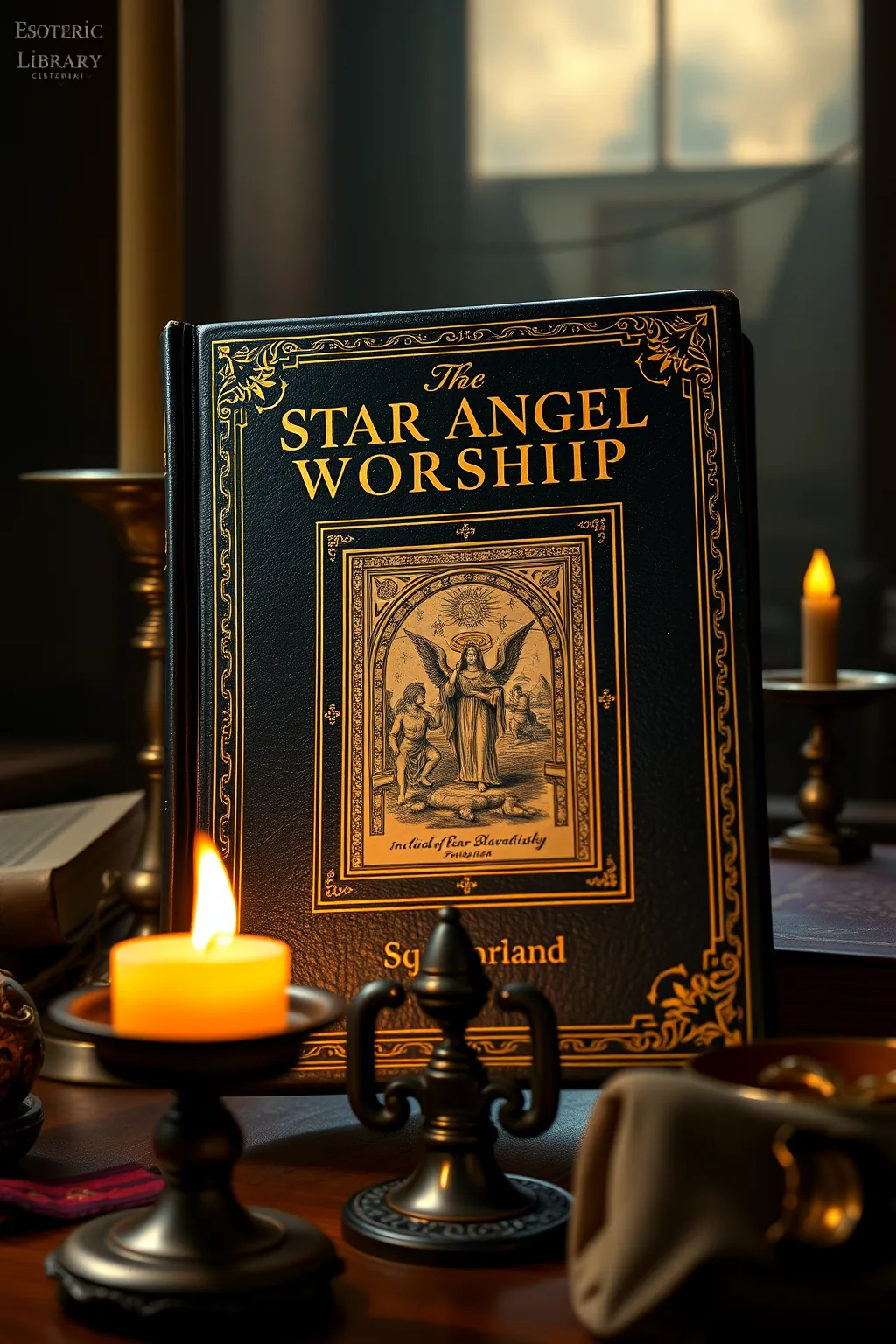
Star Angel Worship In The Roman Catholic Church, Helena Blavatsky (1888)
 73
73

Star Angel Worship In The Roman Catholic Church, Helena Blavatsky (1888)



From the Esoteric Library's archives, this anonymous 1888 treatise, 'Star Angel Worship In The Roman Catholic Church,' is a revelation. It masterfully dissects the often-overlooked astrological and celestial underpinnings of Catholic ritual, presenting a compelling case for an ancient, cosmic theology woven into its fabric. The author's deep dive into angelic hierarchies and stellar symbolism offers profound insights for students of Theosophy and Western Esotericism. While the "author" is unknown, the scholarship is evident, challenging readers to look beyond the surface of religious practice and uncover the universal truths it embodies. Highly recommended for serious practitioners and scholars of hidden traditions.
📝 Description
73
Published in 1888, Star Angel Worship In The Roman Catholic Church examines celestial worship within Catholic rites.
This anonymously authored 1888 text investigates esoteric currents believed to exist within Roman Catholic practices. It argues that beneath official doctrine lies an ancient celestial worship, linking the earthly church to cosmic powers and stellar orders. The book invites a detailed examination of correspondences between astronomical patterns, angelic hierarchies, and the geometry found in church buildings and rituals. It seeks to uncover hidden connections that have influenced human devotion throughout history. This work is intended for those interested in comparative religion, spiritual practices, and the cosmic dimensions of faith.
Emerging from the late 19th-century esoteric revival, this book aligns with movements that sought hidden meanings in established religions. It follows a tradition of interpreting religious symbolism through an occult lens, connecting earthly forms to celestial influences. Authors of this period often explored how ancient cosmologies and Gnostic ideas might be preserved or disguised within mainstream faiths.
💡 Why Read This Book?
Uncover the hidden celestial cosmology within Roman Catholic tradition. This book offers a unique perspective for seekers of esoteric knowledge, revealing the ancient worship of star angels that influenced religious practices. Ideal for students of Theosophy, comparative religion, and those interested in the mystical dimensions of established faiths. It provides a profound lens through which to re-examine sacred symbolism and ritual.
⭐ Reader Reviews
Honest opinions from readers who have explored this book.
❓ Frequently Asked Questions
What is the primary thesis of this book?
The book's central argument is that Roman Catholic ritual and theology contain hidden elements of ancient star angel worship, connecting the Church to celestial intelligences and cosmic cycles.
Who is the author of this book?
The author is listed as 'Unknown' in the original publication. This anonymity adds to the mystique and encourages focus on the content itself.
What is 'Star Angel Worship'?
It refers to the veneration of celestial beings or intelligences associated with stars and constellations, believed to influence earthly affairs and spiritual development.
Is this book critical of the Catholic Church?
Not necessarily critical, but rather it seeks to reveal deeper, esoteric layers of meaning within Catholic practices that may not be evident in exoteric interpretations.
What kind of reader would benefit most from this book?
Scholars of esotericism, comparative religion, Theosophy, and individuals interested in uncovering hidden spiritual traditions and symbolic meanings within established religions.
🔮 Key Themes & Symbolism
Celestial Hierarchies and Angelic Influence
This theme explores the ancient concept of a cosmic order, where angelic beings are not merely messengers but potent forces tied to stellar luminaries. The text explores how these celestial intelligences, identified with specific stars and constellations, are believed to have influenced human spiritual evolution and the development of religious practices. It posits that the veneration of saints and angels within Catholicism can be traced back to these more primal forms of cosmic worship, revealing a profound interconnectedness between the earthly and the divine realms.
Symbolism of Sacred Architecture and Liturgy
The book meticulously examines how the structure of churches, the arrangement of altars, and the performance of liturgical rites are imbued with symbolic meaning related to celestial phenomena. It suggests that architectural elements like spires, domes, and stained-glass windows are not merely decorative but serve as cosmic maps, aligning sacred spaces with astronomical events and guiding the worshipper’s consciousness towards higher planes. The cadence of prayers and the use of specific vestments are also interpreted as traces of ancient stellar rituals.
Theosophical Roots and Comparative Mysticism
Emerging from the burgeoning Theosophical movement of the late 19th century, this work engages in a comparative study of religious symbols and practices across cultures. It highlights parallels between Catholic traditions and older, esoteric systems, suggesting a universal underlying spiritual truth. The author draws upon ancient Babylonian, Egyptian, and Gnostic ideas to reinterpret Christian symbolism, arguing that the Church, despite its exoteric doctrines, preserves fragments of much older, Gnostic wisdom concerning the cosmos and humanity's place within it.
💬 Memorable Quotes
Direct passages from the work, attributed to the author.
“Beneath the dogma, the stars still whisper.”
— This suggests that even within rigid religious structures, ancient cosmic truths and celestial influences persist, waiting to be rediscovered by the spiritually attuned.
“Angels are but the visible breath of constellations.”
— This evocative phrase links the concept of angels directly to celestial bodies, implying they are emanations or personifications of stellar energies and intelligences.
“Sacred geometry maps the silent spheres.”
— This highlights the belief that mathematical and geometrical principles, evident in sacred spaces, are keys to understanding the structure and movements of the cosmos.
“The veil of revelation thins for the earnest seeker.”
— This underscores the idea that spiritual truths are accessible through dedicated inquiry and sincere effort, allowing the seeker to perceive hidden meanings within the sacred.
💡 Key Ideas
Editorial paraphrase of the work's core concepts — not direct quotes.
The liturgy, a celestial dance in earthly guise.
This quote frames religious ceremony not just as ritual, but as a mirroring of cosmic movements and divine interactions, a physical manifestation of celestial harmony.
🌙 Esoteric Significance
Tradition
This work is deeply rooted in the Western Esoteric Tradition, particularly influenced by Theosophy and Neoplatonism. It aligns with the Hermetic principle of 'As Above, So Below,' suggesting that celestial patterns and intelligences are reflected in terrestrial institutions and human consciousness. It also draws from Gnostic cosmology and ancient astrological systems, viewing stars and angels as integral parts of a divine hierarchy governing existence.
Symbolism
Key symbols explored include constellations, planetary influences, the architecture of cathedrals (e.g., orientation, geometry), liturgical vestments, and angelic hierarchies. The text reinterprets these elements not merely as decorative or dogmatic, but as potent symbolic keys that unlock understanding of cosmic laws and the energetic currents that flow between the celestial and terrestrial realms.
Modern Relevance
In an age increasingly seeking deeper meaning and disillusioned with purely secular paradigms, this book's exploration of hidden spiritual currents is highly relevant. It encourages a re-evaluation of religious traditions, revealing their potential for profound esoteric wisdom. For contemporary practitioners and scholars, it offers a framework for understanding the cosmic underpinnings of human devotion and the interconnectedness of all life.
👥 Who Should Read This Book
This profound work is essential for **esoteric scholars** seeking to understand the historical development of occult thought and its intersection with mainstream religions. **Theosophy and comparative religion enthusiasts** will find it a valuable resource for exploring hidden theological currents. **Spiritual seekers** yearning for a deeper, more cosmic understanding of faith will be illuminated by its revelations. **Practitioners** of Western Esotericism can glean insights into ancient symbolic systems and their application. While it assumes some familiarity with religious concepts, its evocative prose makes it accessible even to those new to esoteric studies.
📜 Historical Context
Published in 1888, 'Star Angel Worship In The Roman Catholic Church' emerged during a period of intense spiritual and intellectual ferment in the West. The rise of Theosophy, spearheaded by Helena Blavatsky, fueled a widespread interest in esoteric traditions, comparative mysticism, and the re-examination of established religions through a more occult lens. This era saw a growing dissatisfaction with purely materialistic explanations of the universe and a yearning for deeper, spiritual understanding. Scholars and seekers were actively exploring ancient texts, Eastern philosophies, and Gnostic traditions, seeking to uncover a universal wisdom that transcended sectarian boundaries. This book, by challenging conventional interpretations of Catholic practice and positing hidden celestial connections, perfectly captures the spirit of inquiry and esoteric exploration characteristic of the late Victorian era.
📔 Journal Prompts
Reflect on the concept of 'hidden knowledge' within your own spiritual or religious background. Where do you suspect deeper meanings might lie?
Consider a celestial body (star, planet, moon) that speaks to you. What qualities or energies do you associate with it, and how might these connect to your inner life?
Analyze a specific ritual or practice from any tradition. How could it be interpreted through the lens of celestial influence or angelic interaction?
Write about a time you felt a connection to something larger than yourself, perhaps during a moment of awe inspired by nature or the cosmos.
Explore the idea of 'sacred geometry' in your surroundings. How might the shapes and patterns around you reflect universal order or hidden principles?
🗂️ Glossary
Theosophy
A mystical philosophy that claims to seek and teach about the divine nature of humanity and the universe, often drawing from Eastern traditions and ancient wisdom.
Esotericism
Beliefs and practices that are concerned with the hidden, inner, or secret spiritual knowledge, accessible only to initiated individuals.
Liturgy
The prescribed form or order of religious worship, including prayers, readings, and ceremonies.
Cosmic
Relating to the universe or cosmos, especially as distinct from the earth; vast, universal.
Celestial
Positioned in or relating to the sky, or outer space as observed in astronomy; belonging or relating to heaven.
This book appears in 2 collections
🔮 Readers Also Liked
Browse all →






From the “Theosophy” Collection
View all →


More Free Theosophy & Anthroposophy Books
View all →