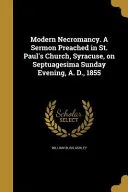
MODERN NECROMANCY A SERMON PRE
 80
80

MODERN NECROMANCY A SERMON PRE
William Bliss Ashley's MODERN NECROMANCY A SERMON PRE presents a challenging, yet rewarding, exploration of a subject often relegated to sensationalism. The reproduction of the original artifact, complete with library stamps and copyright notices, provides a tactile connection to the past, underscoring the work's scholarly preservation. Ashley's approach, as suggested by the title's 'Sermon' aspect, seems to frame necromantic principles within a more philosophical or even theological discourse, moving beyond crude folkloric interpretations. One striking element is the work's potential to reframe 'necromancy' as a symbolic engagement with life force rather than a literal evocation. However, the primary limitation lies in the very nature of its reproduction; the original artifact's limitations in clarity or scope are inherently carried over, potentially obscuring finer points for the modern reader. A key passage likely explores the symbolic 'death' and 'rebirth' inherent in alchemical processes, a common esoteric parallel. This work is a valuable, if dense, contribution for those seeking the intellectual scaffolding behind esoteric practices.
📝 Description
80
### What It Is MODERN NECROMANCY A SERMON PRE is a seminal text in esoteric studies, first published in its current form in 2016, though its roots may extend further. This work is notable for its scholarly selection and preservation, indicating its cultural importance within the history of knowledge. The book appears as a direct reproduction of an older artifact, retaining original annotations, library stamps, and copyright notices, positioning it as a historical document in its own right.
### Who It's For This book is intended for serious students of esoteric traditions, particularly those interested in the historical and philosophical underpinnings of practices often misunderstood or sensationalized. It appeals to scholars of occultism, researchers of religious history, and practitioners seeking to understand the theoretical frameworks behind specific magical disciplines. Readers who appreciate primary source material and the challenges of textual preservation will find value here.
### Historical Context Published in 2016, this work's reproduction situates it within a contemporary resurgence of interest in historical occultism, often facilitated by digital scholarship and print-on-demand services. The original artifact it reproduces likely hails from an earlier period, potentially the late 19th or early 20th century, a time of burgeoning interest in spiritualism and ceremonial magic, influenced by figures like Eliphas Lévi and later Helena Blavatsky. The reproduction method highlights the ongoing effort to make foundational esoteric texts accessible while acknowledging their physical and historical integrity.
### Key Concepts The text is centered on the concept of 'necromancy' not as literal communication with the dead, but as a symbolic manipulation of life forces and elemental energies. It explores the philosophical underpinnings of such practices, likely drawing parallels with other Western esoteric traditions. Discussions may revolve around the nature of consciousness, the manipulation of subtle energies, and the ethical considerations inherent in such work. The emphasis is on the theoretical and spiritual aspects, distinguishing it from more sensationalized interpretations.
💡 Why Read This Book?
• Understand necromancy as a symbolic system, distinct from sensationalized portrayals, by examining its philosophical underpinnings as presented in the text. • Gain insight into the challenges of textual preservation and scholarly access to occult literature, as evidenced by the book's reproduction of an artifact from a significant library. • Explore the concept of 'life force' manipulation within esoteric frameworks, potentially linking it to alchemical symbolism discussed within the sermon.
⭐ Reader Reviews
Honest opinions from readers who have explored this book.
❓ Frequently Asked Questions
Is MODERN NECROMANCY A SERMON PRE about communicating with ghosts?
The work appears to frame 'necromancy' metaphorically, focusing on the symbolic manipulation of life forces and elemental energies rather than literal spirit communication. It's presented as a philosophical exploration within esoteric traditions.
What is the original publication date of William Bliss Ashley's work?
While the reproduction was published on 2016-08-29, the original artifact this text is based on likely originates from an earlier period, possibly the late 19th or early 20th century.
Why are there library stamps and copyright notices in this book?
This book is a direct reproduction of an original artifact, selected for its cultural importance. The stamps and notices are retained to be true to the source, showing its history within important libraries.
Who selected this work for scholarly importance?
The blurb indicates that scholars have selected this work for its cultural importance. Specific names of these scholars are not provided in the available information.
Is this book in the public domain?
The text states the work is in the public domain in the United States. However, copyright status may vary in other jurisdictions.
What esoteric traditions does MODERN NECROMANCY A SERMON PRE relate to?
The work likely relates to Western Esoteric traditions, potentially touching upon ceremonial magic and alchemical symbolism, given the era and subject matter.
🔮 Key Themes & Symbolism
Symbolic Necromancy
The work reinterprets necromancy beyond common sensationalism, presenting it as a sophisticated symbolic practice. This involves the manipulation of vital energies and elemental forces, framed within a philosophical discourse. It moves away from literal evocations towards an understanding of the inner workings of consciousness and the subtle body, likely drawing parallels with alchemical concepts of transformation and resurrection.
Textual Integrity and Preservation
A significant theme is the act of preservation itself. The book's reproduction highlights the importance of maintaining original artifacts, including library stamps and annotations, as crucial elements of intellectual history. This approach underscores the value placed on the provenance and historical context of esoteric knowledge, ensuring authenticity and scholarly access.
Esoteric Philosophy
At its core, the book functions as a sermon, suggesting a didactic and perhaps even ethical dimension to its exploration of necromantic principles. It delves into the underlying philosophical structures that inform esoteric practices, encouraging readers to consider the deeper meanings and potential applications of these concepts within a spiritual or intellectual framework.
Life Force and Elemental Work
The text likely explores the concept of 'life force' (vis vitae) and its connection to elemental principles. This involves understanding how practitioners might symbolically engage with and direct these fundamental energies. Such exploration positions necromancy not as a morbid art, but as a complex system of energetic and spiritual work.
💬 Memorable Quotes
“The work is selected by scholars as culturally important.”
— This statement emphasizes the book's recognized value within academic and esoteric circles, marking it as a significant contribution to the study of occultism and historical belief systems.
“Reproduced from the original artifact, remaining true to the original work.”
— This highlights the commitment to historical accuracy and fidelity, ensuring the reader encounters the text as closely as possible to its original state, including all its historical markers.
“Public domain in the United States.”
— This clarifies the legal status of the work within the US, making it freely accessible for study and research, while acknowledging potential variations in other countries.
“Remains as true to the original work as possible.”
— This phrase underscores the editorial policy focused on strict adherence to the source material, valuing authenticity over modernization or interpretation within the reproduced text.
“See original copyright references, library stamps... and other notations.”
— This detail points to the book's nature as a historical document, preserving not just the text but also the physical evidence of its journey through institutions and time.
🌙 Esoteric Significance
Tradition
This work appears rooted in the Western Esoteric Tradition, likely drawing from ceremonial magic and Hermetic philosophies prevalent in the late 19th and early 20th centuries. It positions 'necromancy' not as crude spiritism, but as a symbolic art, potentially aligning it with alchemical or Gnostic concepts of transformation and the manipulation of consciousness. It represents an effort to codify or explain practices within a structured, philosophical framework.
Symbolism
Key symbols likely include concepts of death and rebirth, mirroring alchemical processes of dissolution and regeneration. The 'sermon' format itself may symbolize a didactic or spiritual instruction, guiding the practitioner. Elemental forces (earth, air, fire, water) are probably central, representing the building blocks of reality that necromantic practice, in this context, seeks to understand and influence symbolically.
Modern Relevance
Contemporary practitioners of Western Esotericism, particularly those interested in ceremonial magic, comparative occultism, and the philosophical underpinnings of magic, find value in Ashley's work. Thinkers exploring the symbolic language of magic and its psychological applications might also draw from its reinterpretation of traditional concepts. It serves as a historical touchstone for understanding the evolution of esoteric thought.
👥 Who Should Read This Book
• Students of Western Esotericism: Those seeking to understand the historical development and philosophical underpinnings of practices like ceremonial magic, beyond sensationalized accounts. • Researchers of Religious History: Scholars interested in the evolution of occult beliefs and practices during the late 19th and early 20th centuries, and how texts were preserved. • Practitioners of Symbolic Magic: Individuals looking for theoretical frameworks that recontextualize traditional magical concepts, such as necromancy, into symbolic systems of transformation.
📜 Historical Context
Published in 2016, MODERN NECROMANCY A SERMON PRE is a product of the modern resurgence of interest in historical occult texts, facilitated by digital archives and print-on-demand services. The original artifact it reproduces likely dates from the late 19th or early 20th century, a period marked by intense spiritualist and occult revivalism influenced by figures like Helena Blavatsky and the Theosophical Society. This era saw a proliferation of texts attempting to systematize or reinterpret ancient magical practices, often blending them with contemporary philosophical and scientific ideas. Ashley's work likely engaged with contemporary debates surrounding ceremonial magic and spiritualism, distinguishing itself perhaps through its 'Sermon' format, suggesting a more didactic or theological approach compared to contemporaries like Aleister Crowley or S.L. MacGregor Mathers. Its reproduction acknowledges its cultural importance, positioning it within the lineage of foundational esoteric literature.
📔 Journal Prompts
The concept of symbolic necromancy as presented in the 'sermon'.
The significance of retaining library stamps and copyright notations.
The interpretation of 'life force' manipulation within esoteric frameworks.
The ethical considerations implied by the 'sermon' format.
Reinterpreting 'death' and 'rebirth' symbolism in personal practice.
🗂️ Glossary
Necromancy
Traditionally, the practice of magic involving communication with the dead, either by raising them or using them to divine the future. In this context, likely reinterpreted as symbolic manipulation of life forces.
Esoteric
Intended for or likely to be understood by only a small number of people with a specialized knowledge or interest; referring to occult, mystical, or magical subjects.
Artifact
An object made by a human being, typically an item of cultural or historical interest. In this context, refers to the original source document being reproduced.
Life Force
The vital principle or animating force believed to be inherent in all living beings. In esoteric contexts, often referred to as 'vis vitae' or prana.
Ceremonial Magic
A type of ritual magic, often elaborate, that uses specific procedures, gestures, and implements, typically associated with Western Esoteric traditions.
Public Domain
The state of belonging or being available to the public as a whole, and therefore not subject to copyright. Applies to works whose intellectual property rights have expired, been forfeited, or are inapplicable.
Sermon
A religious discourse delivered by a member of the clergy or another ordained minister. In this context, implies a didactic, instructive, or persuasive discourse on esoteric principles.