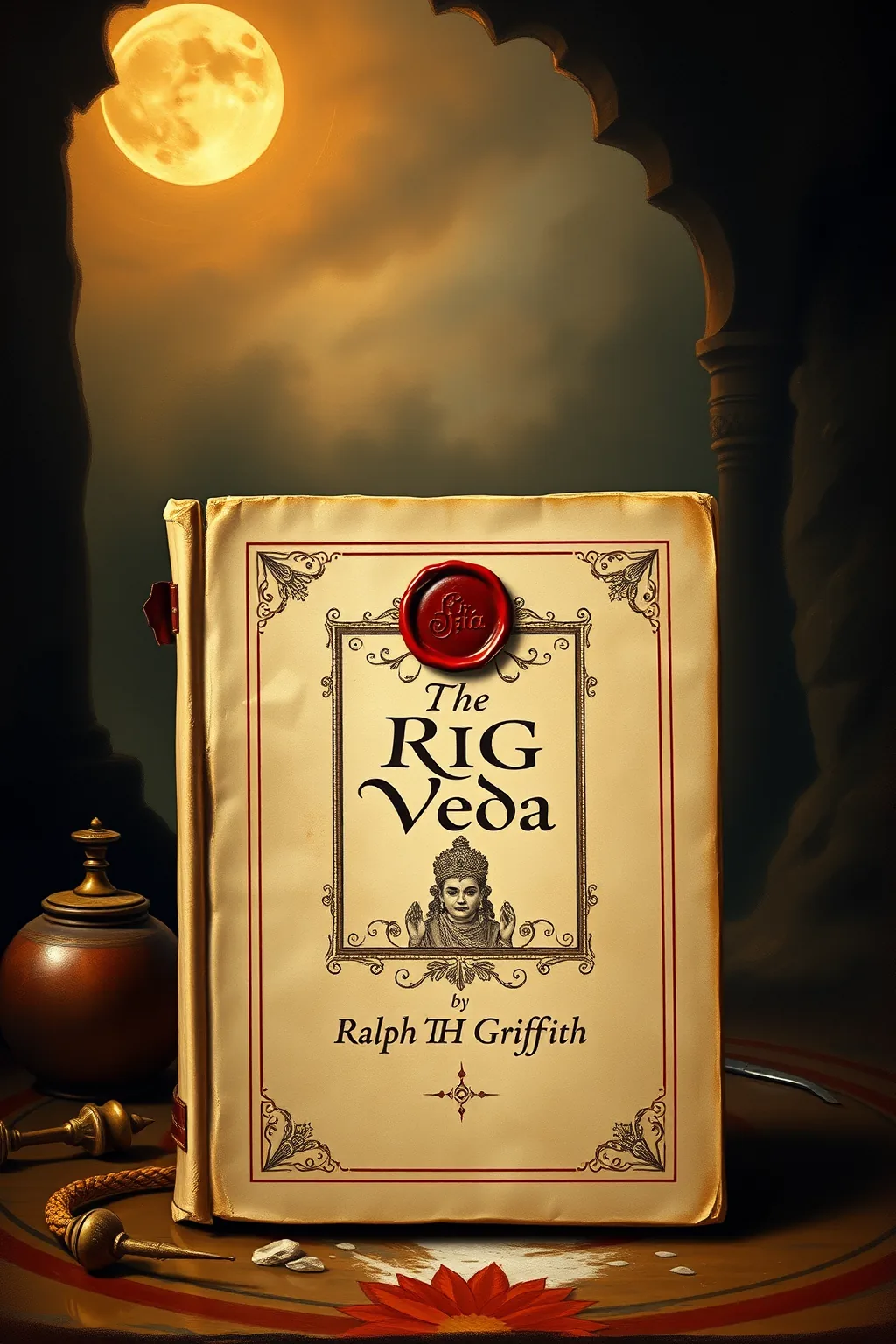
The Rig Veda
 74
74

The Rig Veda



Silas Hawthorne (Hermetic Studies Editor) — Griffith's Rig Veda remains an unparalleled gateway into the primordial consciousness of the Vedic seers. His meticulous translation, a labor of devotion, unveils not mere poetry, but profound gnosis. The hymns thrum with esoteric power, revealing early cosmological blueprints and the intricate symbolism of elemental deities that form the bedrock of many mystical traditions. This is essential reading for anyone seeking to grasp the foundational currents of Eastern spirituality, occult philosophy, and the very origins of meditative disciplines. A treasure for dedicated scholars and earnest spiritual seekers alike.
📝 Description
74
Ralph T. H. Griffith's 1896 translation of the Rig Veda provides access to Sanskrit hymns composed over 3,000 years ago.
This English translation makes available the Rig Veda, the oldest collection of Vedic hymns. Composed in Sanskrit millennia ago, these verses contain early Indo-Aryan cosmology and invocations to deities such as Agni (fire god), Indra (storm god), and Soma (ritual drink). Griffith's translation aims to retain the original rhythm and symbolism of the ancient text. It serves as more than a historical artifact; it is a resource for understanding early conceptions of the divine and the universe. The work is relevant for those interested in ultimate truths, early yogic practices, or the origins of Eastern mysticism. It offers insights into spiritual development that echo through time.
The Rig Veda is a foundational text within the Vedic tradition, which forms the basis for much of Hinduism and its esoteric branches. Its hymns are not merely prayers but are considered sonic structures that can influence consciousness and the cosmos. Within esoteric traditions, the Veda is studied for its Mantras, the subtle energies they contain, and the philosophical insights into the nature of reality, self, and the divine. Griffith's translation allows readers to engage with these ancient sonic and philosophical systems, connecting to a lineage of spiritual practice and understanding that predates many later developments in Indian spirituality.
✍️ Author
Ralph T H Griffith
Ralph T. H. Griffith was an English orientalist and translator of Sanskrit texts.
💡 Why Read This Book?
Unlock ancient wisdom that shaped global spiritual traditions. The Rig Veda offers profound insights into early cosmology, divine archetypes, and meditative practices. Ideal for seekers of esoteric knowledge, scholars of comparative religion, and practitioners of Eastern mysticism aiming to connect with the roots of spiritual inquiry.
⭐ Reader Reviews
Honest opinions from readers who have explored this book.
❓ Frequently Asked Questions
What is the Rig Veda?
The Rig Veda is the oldest and most sacred collection of Vedic hymns, composed in ancient Sanskrit around 1500 BCE or earlier. It contains over a thousand hymns dedicated to various deities and explores early spiritual and cosmological ideas.
Who was Ralph T. H. Griffith?
Ralph T. H. Griffith was a scholar and translator renowned for his English rendering of the Rig Veda, first published in 1896. His work is considered a foundational text for understanding Vedic literature in the Western world.
What are the main deities invoked in the Rig Veda?
Key deities include Agni (fire, messenger of the gods), Indra (king of the gods, god of thunder and war), Soma (a ritual drink and associated deity), Surya (the sun god), and Varuna (god of cosmic order).
What is the historical significance of the Rig Veda?
It is one of the oldest extant texts of the Indo-Aryan civilization and a primary source for understanding the religion, philosophy, and social structure of ancient India, influencing later Hindu scriptures and thought.
Is this translation suitable for beginners?
While the Rig Veda is complex, Griffith's translation provides accessible language. However, for deeper understanding, it is often recommended to study alongside scholarly commentaries or introductions to Vedic philosophy.
🔮 Key Themes & Symbolism
Cosmic Order and Divine Manifestation
The Rig Veda meticulously details the creation of the cosmos, the establishment of Rta (cosmic order), and the diverse manifestations of the divine through anthropomorphic deities. It explores the intricate interplay between primordial forces and the emergence of life, offering useful insights into the ancient Indo-Aryan understanding of existence. The hymns act as powerful invocations, seeking to align human consciousness with these cosmic principles, fostering a sense of unity with the universal flux and the sacred architecture of reality.
Ritual, Sacrifice, and the Path to Enlightenment
Central to the Rig Veda is the concept of Yajna (sacrifice or ritual), understood not merely as offerings but as a transformative process that sustains the cosmos and purifies the practitioner. The hymns detail specific rituals, the properties of sacred substances like Soma, and the role of priests in mediating divine energies. This theme highlights the practical application of spiritual knowledge, presenting ritual as a potent tool for achieving spiritual merit, liberation, and a deeper connection with the divine realms.
The Nature of Brahman and the Self
While not explicitly formulated as in later Upanishads, the Rig Veda contains nascent explorations of the ultimate reality, Brahman, and its relationship to the individual self (Atman). The hymns hint at an underlying unity pervading all existence, a singular consciousness from which all diversity arises. This theme lays the groundwork for Advaita Vedanta and other monistic philosophies, inviting contemplation on the true nature of consciousness and the ultimate identity of the individual soul with the Universal Soul.
💬 Memorable Quotes
Direct passages from the work, attributed to the author.
“Let me sing the praise of the bright, who hath the golden eye...”
— This invocation likely refers to Surya, the sun god, a primary source of light and life, symbolizing divine illumination and cosmic energy.
“Agni, the priest, the most glorious, the most divine...”
— Agni, the fire god, is central as the intermediary between humans and gods, representing purification, transformation, and the sacred flame of consciousness.
“Indra, in his might, hurled his bolt...”
— This speaks to Indra's role as a powerful deity who overcomes obstacles and chaos, symbolizing strength, protection, and the forces that maintain cosmic order.
“The wise in spirit, have fashioned with their thoughts...”
— This highlights the role of seers and enlightened minds in understanding and shaping spiritual truths, emphasizing the power of consciousness and wisdom.
“Where there is light, there is joy...”
— A simple yet profound statement connecting divine illumination and positive spiritual states, suggesting that true happiness arises from inner enlightenment.
🌙 Esoteric Significance
Tradition
The Rig Veda is the foundational text of the Vedic tradition, which is the earliest layer of what would evolve into Hinduism and significantly influenced subsequent esoteric schools like Yoga, Vedanta, and Tantra. It represents the primal expressions of yogic consciousness, divine archetypes, and early cosmological models that are interpreted esoterically as keys to unlocking universal truths and inner potential.
Symbolism
The hymns are rich in symbolism: Agni represents the divine spark within, the altar of transformation; Indra embodies the active, dynamic force of consciousness that overcomes ignorance; Soma is the ecstatic divine nectar that grants spiritual insight and union. The cosmic deities symbolize fundamental forces of existence, and the rituals are allegorical pathways to spiritual realization, making the text a profound guide to inner alchemy.
Modern Relevance
In an age often marked by spiritual seeking and a disconnection from ancient wisdom, the Rig Veda offers timeless insights into the nature of reality, consciousness, and the human condition. Its exploration of archetypal forces, the power of intention, and the pursuit of cosmic order resonates deeply with contemporary seekers of meaning, mindfulness practitioners, and those interested in the roots of meditation and spiritual discipline.
👥 Who Should Read This Book
This translation is useful for serious students of comparative religion, comparative mythology, and ancient philosophy. Spiritual seekers yearning to connect with the primal sources of Eastern mysticism will find profound inspiration. Practitioners of yoga and meditation may discover the ancient roots of their disciplines. Scholars will appreciate its linguistic and historical depth, while anyone drawn to the profound mysteries of human consciousness and the cosmos will find this a compelling and transformative read.
📜 Historical Context
The Rig Veda emerged from the Vedic period (c. 1500–500 BCE) in the Punjab region of the Indian subcontinent. This era saw the development of a sophisticated oral tradition, culminating in the compilation of these hymns by priestly families. The society was largely pastoral and agrarian, with a hierarchical structure. The hymns reflect a worldview deeply intertwined with nature, personified by powerful deities who controlled cosmic forces. This period is crucial as it laid the foundational philosophical and religious concepts that would evolve into classical Hinduism, influencing subsequent Indian thought, spirituality, and culture for millennia. Griffith's translation in the late 19th century brought these ancient texts to a wider Western audience, sparking academic and spiritual interest.
📔 Journal Prompts
Reflect on the concept of Rta (cosmic order) and how it might manifest or be disrupted in your daily life.
Consider the archetype of Agni (fire). How can you cultivate the 'sacred fire' of transformation and purification within yourself?
Which deity's attributes most resonate with your current life challenges or aspirations, and why?
Explore the idea of Yajna (sacrifice/ritual). What 'sacrifices' are you willing to make for your spiritual growth?
Meditate on the idea of interconnectedness implied in the hymns. How does this perspective shift your understanding of your place in the universe?
🗂️ Glossary
Veda
A large body of Sanskrit scriptures, considered the oldest and most authoritative texts of Hinduism. The Rig Veda is the oldest of the four Vedas.
Hymn
A religious song or poem, typically of praise to a deity. In the Rig Veda, these are invocations and meditations addressed to various gods and cosmic principles.
Sanskrit
An ancient Indo-Aryan language in which the Vedas and many other classical Indian texts were composed. It is considered a sacred language.
Deity
A god or goddess. The Rig Veda invokes numerous deities representing natural forces, cosmic principles, and aspects of the divine.
Cosmology
The study of the origin, evolution, and structure of the universe. The Rig Veda presents early Indo-Aryan cosmological views.
This book appears in 1 collection
🔮 Readers Also Liked
Browse all →







![The History of Spiritualism. [With Plates, Including Portraits.]](/img/thumb/the-history-of-spiritualism-with-plates-including-portraits-arthur-conan-doyle-008182.webp)
More by Ralph T H Griffith
All books →


From the “Transcendental Meditation” Collection
View all →







More Free Spiritual Development Books
View all →