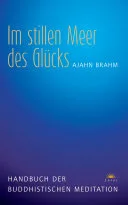
Im stillen Meer des Glücks
 80
80

Im stillen Meer des Glücks
Ajahn Brahm's "Im stillen Meer des Glücks" provides a refreshingly unvarnished presentation of the Buddha's meditative instructions. The book excels in its fidelity to the Pali Canon, offering a clear, step-by-step guide that bypasses the often-confusing layers of modern interpretation. Its strength lies in this directness; readers seeking the unadulterated method will find much to appreciate. However, this same adherence to classical form might present a barrier for absolute beginners unfamiliar with Buddhist terminology, even with Brahm's typically accessible prose. A particularly illustrative section details the development of concentration through the jhanas, explaining each stage with clarity that is rare in contemporary literature on the subject. While it might lack the broad appeal of more secularized mindfulness guides, for those committed to the historical Buddhist path, it is an indispensable resource.
This book serves as a reliable anchor to the original teachings.
📝 Description
80
Ajahn Brahm's 2009 book revisits the Buddha's meditation methods directly from the Pali Canon.
"Im stillen Meer des Glücks" (In the Still Sea of Happiness) presents the Buddha's meditation practices as recorded in the original Pali Canon. Ajahn Brahm avoids modern adaptations, instead constructing a clear framework for understanding and applying classical Buddhist contemplative techniques. The book functions as a guide, outlining the essential steps and principles for effective meditation without unnecessary additions. It is written for individuals who wish to learn meditation directly from the Buddha's recorded teachings and who prioritize authenticity in engaging with the historical Buddhist approach to mental cultivation. Readers seeking a straightforward manual on the core practices of mindfulness and concentration, supported by scriptural references, will find this work suitable.
This book appeared in 2009 during a period of increased global interest in Buddhist meditation. Unlike many contemporary books that adapt these practices for secular use or integrate them with psychology, Ajahn Brahm's method focuses on the original teachings. This dedication to authenticity positions the book as a contrast to more generalized or therapeutic applications, grounding it firmly in the Theravada Buddhist lineage.
This work is situated within the Theravada Buddhist tradition, emphasizing the direct transmission of the Buddha's teachings from the Pali Canon. It stands apart from contemporary interpretations that often secularize or psychologize meditation. Ajahn Brahm's approach prioritizes the original scriptural basis, aligning with a lineage that seeks to preserve the purity of the Dhamma. The book grounds meditative practice in ethical conduct, presenting a systematic path to inner peace and wisdom consistent with early Buddhist doctrine.
💡 Why Read This Book?
• Gain a direct understanding of the Buddha's meditation methods, as detailed in the Pali Canon, offering a distinct advantage over generalized mindfulness techniques. • Learn the foundational principles of concentration (samadhi) and insight (vipassana) directly from Ajahn Brahm's authentic teachings, first published in 2009. • Cultivate mindfulness (sati) through practices rooted in classical Buddhist ethics (sila), providing a structured path for mental discipline not found in secular adaptations.
⭐ Reader Reviews
Honest opinions from readers who have explored this book.
❓ Frequently Asked Questions
What makes Ajahn Brahm's meditation approach in "Im stillen Meer des Glücks" different?
This book emphasizes meditation as taught directly by the Buddha, using the Pali Canon as its primary source. It focuses on authentic classical Buddhist practice rather than modern secular adaptations or psychological interpretations.
Is "Im stillen Meer des Glücks" suitable for complete beginners to meditation?
Yes, the book provides a comprehensive introduction to classical Buddhist meditation. While it prioritizes authenticity, Ajahn Brahm's explanations are generally clear for those willing to engage with the foundational teachings.
What are the core concepts covered in Ajahn Brahm's book on meditation?
The book covers key Buddhist concepts such as mindfulness (sati), concentration (samadhi), and insight (vipassana), explaining their development according to the Buddha's original instructions.
When was "Im stillen Meer des Glücks" first published?
The book "Im stillen Meer des Glücks" by Ajahn Brahm was first published on March 11, 2009.
Does the book discuss ethical conduct in relation to meditation?
Yes, the work highlights the importance of ethical conduct (sila) as a fundamental basis for developing deeper states of meditation and insight, aligning with the Noble Eightfold Path.
Where can I find more resources on the Pali Canon mentioned in the book?
The Pali Canon is the standard collection of scriptures in the Theravada Buddhist tradition. Further study can be pursued through academic resources or established Buddhist study centers focusing on early Buddhist texts.
🔮 Key Themes & Symbolism
Authentic Buddhist Meditation
The core of "Im stillen Meer des Glücks" lies in its commitment to presenting meditation precisely as the Buddha outlined it, drawing directly from the Pali Canon. This approach prioritizes the historical transmission of these practices, offering readers an unadulterated method for mental cultivation. It contrasts with contemporary, often secularized, interpretations by focusing on the original purpose and structure of Buddhist contemplative exercises, ensuring practitioners engage with the teachings in their most direct form.
Mindfulness and Concentration
Central to the book are the twin pillars of mindfulness (sati) and concentration (samadhi). Ajahn Brahm meticulously explains how to cultivate these states, moving from basic awareness to deeper levels of mental absorption. The text details the progression through various meditative states, emphasizing the systematic development of mental focus as a prerequisite for gaining insight. This structured approach provides a clear roadmap for practitioners aiming to achieve stability and clarity of mind.
The Role of Sila
Ethical conduct (sila) is presented not merely as a preliminary step but as an integral foundation for effective meditation. The book explains how adherence to ethical principles creates a conducive mental environment, reducing hindrances and supporting the development of concentration and wisdom. This interconnectedness highlights the holistic nature of the Buddhist path, where moral discipline and meditative practice are mutually reinforcing elements leading towards liberation.
Insight (Vipassana)
The ultimate aim of the practices described is the development of insight (vipassana), leading to a direct understanding of reality. "Im stillen Meer des Glücks" guides readers toward recognizing the impermanent, unsatisfactory, and selfless nature of phenomena. This insight is cultivated through sustained mindfulness and concentration, enabling the practitioner to see beyond conditioned perceptions and attain profound wisdom, aligning with the ultimate goals of Buddhist practice.
💬 Memorable Quotes
Direct passages from the work, attributed to the author.
“Meditation as taught by the Buddha.”
— This phrase expresses the book's central thesis: a direct and unmediated presentation of the Buddha's original instructions for mental training, prioritizing historical accuracy over contemporary adaptations.
“The need for classical Buddhist practice.”
— This highlights the book's focus on the traditional methods of Buddhist meditation, suggesting that adhering to these classical forms is essential for achieving the intended spiritual results.
“Understanding mindfulness (sati) and concentration (samadhi).”
— This points to the fundamental concepts explained in detail, serving as the building blocks for the reader's meditation practice as presented in the book.
“Ethical conduct (sila) as a foundation.”
— This emphasizes the book's integration of ethics into the meditative path, underscoring that right living is inseparable from right practice for spiritual development.
“Developing insight (vipassana) for wisdom.”
— This signifies the ultimate goal of the meditative journey described, where direct understanding of reality leads to profound wisdom and liberation.
🌙 Esoteric Significance
Tradition
This work firmly belongs to the Theravada Buddhist tradition, one of the oldest extant branches of Buddhism. While not typically categorized under Western esoteric traditions like Hermeticism or Kabbalah, its focus on direct experience, mental transformation, and liberation aligns with the broader esoteric quest for inner knowledge and spiritual realization common across many mystical lineages.
Symbolism
The book extensively employs the symbolism inherent in Buddhist cosmology and practice. Key symbols include the 'still sea' itself, representing a state of profound mental tranquility and peace attainable through meditation. The path described, mirroring the Noble Eightfold Path, functions as a symbolic map for spiritual progression, guiding the practitioner through stages of ethical conduct, mental discipline, and wisdom.
Modern Relevance
Contemporary Buddhist teachers and practitioners who emphasize adherence to the original teachings of the Buddha often draw upon works like this. It serves as a crucial reference point for those seeking to deepen their understanding of classical meditation techniques amidst a proliferation of simplified or adapted methods, maintaining the integrity of the ancient practice.
👥 Who Should Read This Book
• Aspiring Buddhist practitioners seeking to learn meditation directly from the Buddha's earliest recorded teachings, prioritizing authenticity over modern adaptations. • Experienced meditators looking to refine their practice by grounding it in the classical methods described in the Pali Canon, as presented by Ajahn Brahm. • Scholars of comparative religion and Buddhist studies interested in understanding the foundational contemplative techniques of Theravada Buddhism in their traditional context.
📜 Historical Context
Published in 2009, "Im stillen Meer des Glücks" arrived during a period of intense global interest in Buddhist meditation, largely fueled by the burgeoning secular mindfulness movement. While many authors adapted these practices for therapeutic or stress-reduction purposes, Ajahn Brahm's work intentionally returned to the source, specifically the Pali Canon, the earliest recorded teachings of the Buddha. This commitment to authenticity positioned his book as a vital resource for practitioners seeking the unadulterated classical Buddhist path, distinct from contemporary interpretations that might diverge significantly. In the intellectual field of 2009, where works by figures like Jon Kabat-Zinn were popularizing mindfulness in clinical settings, Brahm's book offered a more traditional, scripturally grounded perspective rooted in the Theravada tradition.
📔 Journal Prompts
The cultivation of mindfulness (sati) through daily activities.
Developing concentration (samadhi) using the methods described.
Reflecting on the role of ethical conduct (sila) in meditation.
Exploring the nature of insight (vipassana) as presented.
The Buddha's teachings on the path to happiness.
🗂️ Glossary
Pali Canon
The standard collection of scriptures in the Theravada Buddhist tradition, believed by adherents to contain the teachings of the Buddha (Siddhartha Gautama) and his immediate disciples.
Sati
A Pali term often translated as mindfulness, awareness, or attention. It refers to the faculty of remembering or paying attention to the present moment without judgment.
Samadhi
A Sanskrit and Pali term signifying meditative consciousness or profound concentration. It denotes a state of mental unification achieved through sustained meditative practice.
Vipassana
Meaning 'insight' or 'clear-seeing' in Pali. It refers to a specific type of Buddhist meditation focused on developing insight into the true nature of reality.
Sila
A Pali term encompassing virtue, morality, or ethical conduct. It is considered a fundamental prerequisite for the development of concentration and wisdom in Buddhism.
Noble Eightfold Path
The path to the cessation of suffering (dukkha) as taught by the Buddha, comprising eight interconnected elements: Right View, Right Intention, Right Speech, Right Action, Right Livelihood, Right Effort, Right Mindfulness, and Right Concentration.
Jhana
Meditative absorptions or states of profound concentration and bliss described in Buddhist teachings, attainable through deep meditative practice.