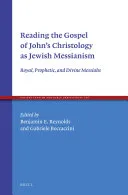
Reading the Gospel of John’s Christology as Jewish Messianism
 74
74

Reading the Gospel of John’s Christology as Jewish Messianism
Reynolds and Boccaccini's collection offers a necessary corrective to the frequent divorce of the Fourth Gospel from its Jewish roots. The strength lies in its persistent focus on Second Temple messianic expectations as the interpretive key. By foregrounding figures like the Royal and Prophetic Messiahs, the authors illuminate how John's Jesus might have been understood by his original audience. A limitation, however, is the sheer density of scholarly argument, which may prove challenging for casual readers. The exploration of John's claim of oneness with the Father (John 10:30) as a manifestation of divine messianic status, rather than a Hellenistic import, is particularly compelling. This work significantly advances the conversation about John's Jewishness.
📝 Description
74
Published in 2018, this collection argues John's Gospel reflects Jewish messianic expectations, not detachment from them.
This 2018 collection, edited by Benjamin Reynolds and Gabriele Boccaccini, re-examines the Gospel of John. It challenges the common view of John's Jesus as separate from his Jewish origins. The essays propose that John's unique portrayal of Christ aligns more closely with diverse Second Temple Jewish messianic expectations than is usually acknowledged.
The essays confront the scholarly tendency to view the Fourth Gospel in isolation from its immediate Jewish context. For decades, many scholars interpreted John's Jesus through a Hellenistic lens, neglecting the active messianic discourse of Second Temple Judaism. This volume places John's Christology within the range of ideas circulating around 70 CE and shortly after.
This work situates the Gospel of John within the broader spectrum of Second Temple Jewish thought, a period rich with diverse messianic speculation. By connecting John's Christology to these Jewish currents, it moves away from later Gnostic or purely Hellenistic interpretations. The book emphasizes how specific Jewish messianic archetypes, such as the Royal or Prophetic Messiah, illuminate John's depiction of Jesus. This approach highlights the esoteric dimensions inherent in understanding Jesus' identity through the lens of contemporary Jewish messianic hopes, rather than through anachronistic external frameworks.
💡 Why Read This Book?
• Understand the specific nature of Second Temple Jewish messianic expectations, moving beyond generalized notions of messianism. • Analyze the Johannine Jesus's divine claims (e.g., John 10:30) not as foreign imports, but as expressions of Jewish messianic concepts. • Re-evaluate the Gospel of John's relationship to its historical milieu, appreciating its place within a vibrant Jewish intellectual landscape.
⭐ Reader Reviews
Honest opinions from readers who have explored this book.
❓ Frequently Asked Questions
What is the primary argument of 'Reading the Gospel of John’s Christology as Jewish Messianism'?
The book argues that the Fourth Gospel's portrayal of Jesus aligns with diverse Second Temple Jewish messianic expectations, challenging the view that John's Christology is separate from its Jewish context.
When was this book first published?
The initial publication date for 'Reading the Gospel of John’s Christology as Jewish Messianism' was July 17, 2018.
Who are the editors of this collection?
The collection is edited by Benjamin Reynolds and Gabriele Boccaccini, scholars specializing in early Judaism and New Testament studies.
What specific types of Jewish messianism are explored?
The essays examine concepts such as the Royal Messiah, the Prophetic Messiah, and ideas of a divinely appointed or divine Messiah within Second Temple Judaism.
How does this book differ from traditional interpretations of John's Gospel?
It shifts the interpretive framework away from Hellenistic influences towards understanding John's Jesus through the lens of contemporary Jewish messianic hopes and categories.
What does 'Second Temple Judaism' refer to in this context?
It refers to the period of Jewish history and religious thought from the rebuilding of the Second Temple in Jerusalem (c. 516 BCE) until its destruction by the Romans in 70 CE.
🔮 Key Themes & Symbolism
Messianic Expectations
This collection scrutinizes how the Gospel of John reflects various expectations for a messianic figure prevalent in Second Temple Judaism. It moves beyond a singular, monolithic view of messianism, exploring distinct currents such as the anticipation of a Davidic king (Royal Messiah), a prophetic redeemer, and figures imbued with divine authority or status.
Johannine Christology Recontextualized
A central theme is the re-evaluation of John's unique Christology—Jesus's heavenly descent, his "I Am" sayings, and his oneness with the Father. Instead of viewing these as Hellenistic philosophical concepts, the essays propose their roots lie within Jewish messianic discourse and theological speculation of the period.
The Fourth Gospel and Early Judaism
The work challenges the historiographical tendency to separate the Fourth Gospel from the broader landscape of first-century Judaism. It argues for a more integrated understanding, positing that John's theological innovations are best understood as responses to, and developments within, ongoing Jewish debates about God's anointed.
Divine and Human Messiahs
The essays explore the spectrum of messianic conceptions, including those that attributed a significant degree of divine nature or heavenly origin to the messianic figure. This provides a framework for understanding John's high Christology not as an anomaly, but as part of a broader conversation about divine-human interaction.
💬 Memorable Quotes
“John’s Jesus is no stranger to the world of Second Temple Jewish messianic expectations.”
— This statement encapsulates the book's core thesis: that understanding the Fourth Gospel requires placing Jesus firmly within the Jewish messianic discourse of his time, rather than isolating him.
“The Fourth Gospel is rarely considered part of the world of early Judaism.”
— This highlights the scholarly problem the book seeks to address – the historical tendency to detach John's Gospel from its Jewish origins and context, often viewing it through a later, more Hellenistic lens.
“Interpreting John’s Jesus as part of Second Temple Jewish messianic expectations.”
— This phrase directly states the interpretive goal of the collected essays, focusing on the diverse messianic hopes that existed in Judaism before 70 CE as the key to understanding John's portrait of Christ.
“The Johannine Jesus, who descends from heaven, is declared the Word made flesh...”
— This points to specific high-Christological claims in John's Gospel that are often seen as problematic for Jewish interpretation, but which the book aims to explain through existing Jewish messianic frameworks.
“...and claims oneness with the Father, is no stranger to Jewish messianism.”
— This emphasizes that even the most seemingly 'divine' claims about Jesus in John can be re-examined and understood as resonating with, rather than contradicting, certain streams of Jewish messianic thought.
🌙 Esoteric Significance
Tradition
While not strictly an esoteric text itself, this work is crucial for esoteric traditions that engage with Christian origins, particularly Gnostic and Hermetic streams. It provides a scholarly framework for understanding how concepts of divine mediation, the Word (Logos), and heavenly descent, often central in esoteric thought, might have pre-existing roots within Jewish mysticism and messianic speculation, rather than being solely later philosophical imports.
Symbolism
The collection implicitly engages with symbols of divine authority and mediation. The concept of the 'Word' (Logos), central to John, is examined not just philosophically but as a potential messianic attribute within Jewish thought. The 'descent from heaven' symbolizes a divine origin and authoritative presence, interpreted here through the lens of Jewish expectations for divinely empowered figures.
Modern Relevance
Contemporary esoteric thinkers and practitioners seeking a deeper, historically grounded understanding of Christology find value here. It offers a scholarly counterpoint to purely symbolic or allegorical readings by rooting high Christological claims in specific historical Jewish messianic currents, enriching esoteric interpretations of Jesus's divine nature and role.
👥 Who Should Read This Book
• Scholars of New Testament studies and Second Temple Judaism seeking to refine their understanding of the Fourth Gospel's historical and theological context. • Students of comparative religion interested in the diverse messianic movements and expectations within ancient Judaism. • Theologians and spiritual seekers who wish to explore the Jewish roots of Christian Christology beyond conventional interpretations.
📜 Historical Context
Published in 2018, this collection emerged within a scholarly environment still grappling with the precise relationship between the Fourth Gospel and its first-century Jewish context. For much of the 20th century, scholars like Rudolf Bultmann influenced interpretations that emphasized Hellenistic Gnosticism over Jewish messianism as John’s primary background. However, the work of scholars such as E.P. Sanders and later Geza Vermes had already begun to reassert the Jewishness of Jesus and the early church. This volume builds upon that foundation, directly challenging the isolationist approach to John’s Gospel. It positions itself against interpretations that view John's Christology as an outlier, arguing instead for its deep immersion in the diverse messianic expectations circulating within Judaism during the Second Temple period, particularly in the decades leading up to and following 70 CE.
📔 Journal Prompts
The concept of the Royal Messiah within Second Temple Judaism and its potential echoes in John.
Reflecting on John's claims of 'oneness with the Father' through the lens of Jewish messianic paradigms.
Examining the Johannine 'descent from heaven' in light of Jewish cosmological and messianic beliefs.
The implications of interpreting the 'Word made flesh' as a messianic title within its Jewish milieu.
How does understanding John's Jesus as a Jewish messiah alter perceptions of his teachings?
🗂️ Glossary
Second Temple Judaism
The period of Jewish history from the construction of the Second Temple in Jerusalem (c. 516 BCE) to its destruction by the Romans (70 CE), characterized by diverse religious movements and messianic expectations.
Johannine
Pertaining to the Gospel of John or the theological traditions associated with it.
Christology
The theological study of the nature, person, and role of Jesus Christ.
Messianism
Belief in a messiah, a divinely appointed savior or liberator, often involving specific expectations about their identity, role, and actions.
Royal Messiah
A concept within Jewish messianism envisioning a messianic figure primarily as a king, often a descendant of David, who would restore Israel's political and religious fortunes.
Prophetic Messiah
A messianic concept focusing on a figure endowed with prophetic authority, perhaps recalling figures like Moses or Elijah, who would herald a new era or divine revelation.
Logos
Greek for 'word,' 'reason,' or 'discourse.' In John's Gospel, it refers to the divine intermediary through whom God created the world and who became incarnate as Jesus.