Esoteric Christianity Made Simple
 76
76

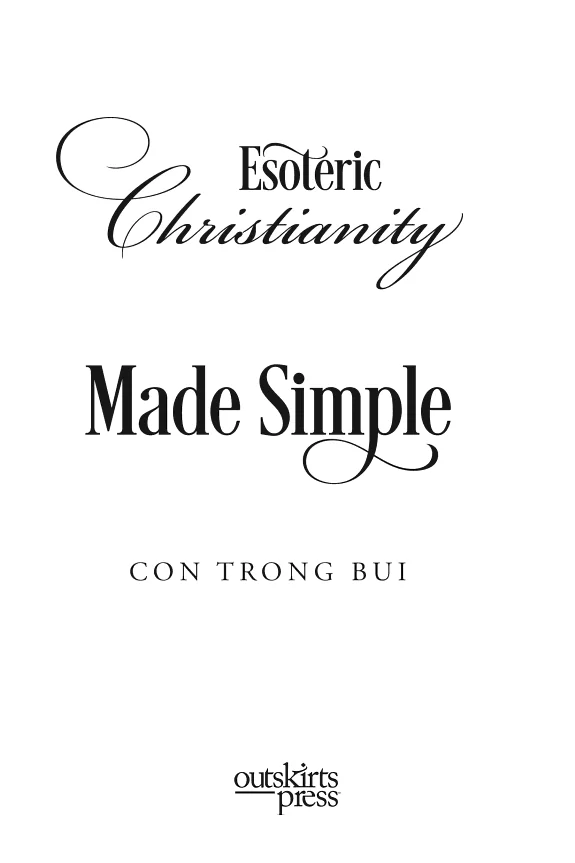
Esoteric Christianity Made Simple
Con Trong Bui’s "Esoteric Christianity Made Simple" attempts a significant feat: to reframe the familiar narrative of Christianity through a lens of hidden meaning. The book shines when it dissects specific parables, suggesting allegorical interpretations that connect to psychological or spiritual development. For instance, the interpretation of the Creation story as an allegory for the awakening of consciousness offers a fresh perspective. However, the work occasionally struggles with accessibility; while aiming for simplicity, some conceptual leaps might leave readers unfamiliar with esoteric terminology feeling adrift. A notable passage reinterpreting the Last Supper as a symbolic meal of spiritual nourishment, rather than a purely historical event, exemplifies the book's core ambition. The author’s effort to present these ideas clearly is commendable, though the depth of esoteric tradition means some concepts remain inherently complex. The book succeeds in opening doors to new ways of thinking about Christian scripture, even if it doesn't unlock them for every reader.
📝 Description
76
### What It Is Esoteric Christianity Made Simple presents an allegorical and symbolic reading of the Christian Bible, moving beyond literal interpretations to explore deeper spiritual meanings. It recontextualizes familiar narratives and teachings, offering a framework for understanding Christian scripture through an occult or mystical lens. The work posits that much of Christian theology, as commonly understood, obscures a more profound, inner path to spiritual realization, a path accessible through the study of its hidden doctrines.
### Who It's For This book is intended for individuals who approach religious texts with an open mind, seeking to uncover layers of meaning not typically presented in mainstream religious education. It will appeal to those curious about comparative religion, mystical traditions, and the potential for spiritual growth within a Christian framework, but from an unconventional perspective. Readers familiar with Gnosticism or Hermeticism may find particular resonance with its approach.
### Historical Context Published in 2020, Con Trong Bui's work emerges in an era where interest in esoteric interpretations of world religions has seen a resurgence, particularly online. It follows a long tradition of mystical exegesis, echoing movements like the Gnostics who sought secret knowledge, or the Renaissance Hermeticists who saw biblical figures as initiates. The book engages with a contemporary desire to reconcile faith with personal spiritual experience, often challenging the dogmatic stances prevalent in many established Christian denominations.
### Key Concepts The central thesis revolves around the idea that the Bible is a coded text, its surface narrative concealing esoteric truths about human consciousness and divine potential. Concepts such as the nature of Christ are re-examined not just as historical events but as archetypal representations of spiritual attainment. The work emphasizes an inner transformation, aligning the human spirit with the divine, as the true meaning behind Christian doctrines and rituals.
💡 Why Read This Book?
• Gain a new interpretive framework for understanding Christian scripture, moving beyond literal dogma to symbolic meanings, particularly concerning the reinterpretation of the Creation narrative as presented in Chapter 2. • Discover how familiar biblical figures and events, such as the concept of 'the Christ' as an archetype, are reframed to represent inner spiritual development rather than solely historical occurrences. • Explore the potential for personal spiritual transformation by aligning with esoteric principles, as discussed in the sections on the inner Christ and the Kingdom of Heaven.
⭐ Reader Reviews
Honest opinions from readers who have explored this book.
❓ Frequently Asked Questions
What is the primary goal of Esoteric Christianity Made Simple?
The book aims to present a symbolic and allegorical interpretation of the Christian Bible, revealing deeper spiritual meanings often obscured by literal readings. It seeks to provide context and ideas not typically found in mainstream Christian teachings.
Who is Con Trong Bui and when was this book first published?
Con Trong Bui is the author of Esoteric Christianity Made Simple. The book was first published on March 31, 2020, reflecting contemporary interest in alternative spiritual interpretations.
Does the book challenge traditional Christian beliefs?
Yes, it challenges long-held beliefs by offering alternative explanations for key Christian concepts, from the Creation of Man to the Last Supper, focusing on their esoteric significance.
What kind of reader would benefit most from this book?
Open-minded readers interested in exploring the mystical, occult, or metaphysical aspects of Christianity, particularly those seeking a symbolic rather than literal understanding of scripture.
What are some key topics explored in Esoteric Christianity Made Simple?
The book explores topics such as the allegorical meaning of Creation, the symbolic significance of the Last Supper, and the nature of Christ as an inner spiritual attainment, moving beyond historical accounts.
Is this book suitable for beginners in esoteric studies?
The author intends for the explanations and insights to be understandable and appreciable by any reader, suggesting an effort towards clarity for those new to esoteric concepts.
🔮 Key Themes & Symbolism
Biblical Allegory
The work posits that the Christian Bible is not merely a historical record but a complex allegory containing profound spiritual truths. It suggests that events and figures like the Creation or Jesus's miracles are symbolic representations of inner states of consciousness and spiritual laws. This perspective invites readers to look beyond the literal narrative to understand the deeper, hidden messages intended for spiritual awakening and self-realization within the Christian tradition.
Inner Christ
A central theme is the concept of the 'Inner Christ,' representing the divine spark or potential for spiritual enlightenment within every individual. The book reinterprets Christ's life and teachings not just as historical events but as archetypal patterns for human spiritual development. Achieving this inner Christ-consciousness is presented as the ultimate goal of esoteric Christianity, emphasizing personal transformation over external dogma.
Symbolic Interpretation
Esoteric Christianity Made Simple advocates for a symbolic approach to understanding Christian doctrine and ritual. It suggests that many elements, from parables to sacraments like the Last Supper, carry layers of meaning related to the soul's journey, the nature of reality, and the path to divine union. This method encourages a more personal and experiential relationship with faith.
Spiritual Awakening
The ultimate purpose of engaging with esoteric Christianity, as presented in the book, is spiritual awakening. This involves understanding one's true nature as divine and realizing the potential for transcendence. The teachings are framed as a guide to this awakening, helping individuals to break free from material limitations and conventional interpretations to achieve a higher state of consciousness.
💬 Memorable Quotes
“The Creation of Man is not just a historical event, but an allegory for the awakening of consciousness.”
— This interpretation frames the Genesis account as a metaphor for the emergence of self-awareness and the spiritual potential inherent within the human being, rather than a literal biological origin.
“The Last Supper symbolizes a profound meal of spiritual nourishment, not merely a historical commemoration.”
— This suggests that the significance of the Last Supper lies in its representation of inner sustenance and communion with the divine, a symbolic act of spiritual feeding for the soul.
“Christ's teachings point towards an inner kingdom, accessible through personal transformation.”
— This highlights the esoteric Christian belief that the 'Kingdom of Heaven' is not a future afterlife but a present state of consciousness attainable through inner spiritual work and change.
“Understanding the Bible requires looking beyond the surface narrative to its hidden, symbolic meanings.”
— This emphasizes the core principle of esoteric exegesis, which views scripture as a coded text containing deeper truths about the universe and the human soul, accessible to the initiated or the seeker.
“The true path of Christianity is an inner journey towards divine realization.”
— This encapsulates the book's focus on personal spiritual growth and the attainment of higher consciousness as the central aim of the esoteric Christian path, prioritizing internal experience.
🌙 Esoteric Significance
Tradition
This work fits within the broad stream of Christian Esotericism, drawing parallels with Gnostic traditions that emphasized inner knowledge and direct experience of the divine over external dogma. It aligns with Hermetic principles of correspondence and symbolic interpretation, viewing biblical narratives as keys to understanding cosmic and human nature. While not strictly Kabbalistic, it shares the Hermetic-Gnostic emphasis on hidden wisdom and the potential for human apotheosis.
Symbolism
Key symbols include the 'Inner Christ,' representing the divine spark within each person, and the concept of the 'Kingdom of Heaven' as an internal state of consciousness rather than an external place. The Creation narrative is reinterpreted symbolically, not as a historical event but as an allegory for the awakening of self-awareness and spiritual potential within the human psyche.
Modern Relevance
In contemporary spirituality, this work resonates with seekers interested in Jungian psychology, New Age thought, and comparative mysticism. It offers a framework for individuals seeking to integrate their Christian heritage with personal spiritual experiences or explore alternative interpretations of faith outside of orthodox structures. Its ideas find echoes in modern discussions of consciousness, archetypes, and the search for deeper meaning in life.
👥 Who Should Read This Book
• Individuals exploring comparative religion or the history of esoteric thought, seeking to understand how Christian narratives have been interpreted mystically across different eras. • Spiritual seekers questioning literal interpretations of scripture, who are open to allegorical and symbolic readings of the Bible to find deeper personal meaning. • Students of Western Esotericism interested in how foundational Christian texts can be understood through occult and metaphysical frameworks.
📜 Historical Context
Con Trong Bui's "Esoteric Christianity Made Simple" (2020) arrives in a contemporary landscape ripe for re-examining religious traditions through a mystical lens. It echoes the Gnostic movements of the 2nd century CE, who also sought hidden spiritual knowledge within early Christianity, often diverging from proto-orthodox interpretations. The book's approach aligns with the broader resurgence of interest in Western Esotericism, a field that gained significant traction in the late 19th and early 20th centuries with figures like Helena Blavatsky and the Theosophical Society. While not directly engaging with contemporaries like Manly P. Hall, whose extensive works explored similar themes, Bui's publication taps into a similar vein of popular interest in the symbolic and occult dimensions of religious texts. The work implicitly challenges the literalism prevalent in many modern Christian denominations, offering an alternative that prioritizes allegorical and psychological interpretations, a stance that has historically faced resistance from established religious authorities.
📔 Journal Prompts
The Creation of Man as an allegory for consciousness awakening: what does this suggest about your own awareness?
Reflect on the 'Inner Christ' concept: how might this divine potential manifest in your daily life?
Consider the symbolic meaning of the Last Supper in relation to spiritual nourishment.
Explore the idea of the 'Kingdom of Heaven' as an internal state. What practices foster this inner state?
Analyze a familiar biblical parable through an allegorical lens, as suggested by the book's approach.
🗂️ Glossary
Allegory
A story, poem, or picture that can be interpreted to reveal a hidden meaning, typically a moral or political one. In this context, it refers to reading biblical narratives for symbolic spiritual truths.
Esoteric
Intended for or likely to be understood by only a small number of people with a specialized knowledge or interest. Pertaining to hidden meanings or inner spiritual truths.
Gnosticism
A complex set of religious ideas and systems that emerged in the early Christian era, emphasizing spiritual knowledge (gnosis) for salvation and often viewing the material world as flawed or evil.
Hermeticism
A philosophical and religious tradition based on writings attributed to Hermes Trismegistus, emphasizing esoteric knowledge, spiritual transformation, and the interconnectedness of the cosmos.
Inner Christ
The concept of the divine spark or Christ consciousness residing within each individual, representing their innate spiritual potential for enlightenment and union with the divine.
Symbolic Interpretation
A method of understanding texts or phenomena by focusing on their symbolic representations of deeper, often spiritual or psychological, realities rather than their literal meanings.
Spiritual Awakening
A process of increased awareness and understanding of one's true spiritual nature and the underlying reality of existence, leading to personal transformation.