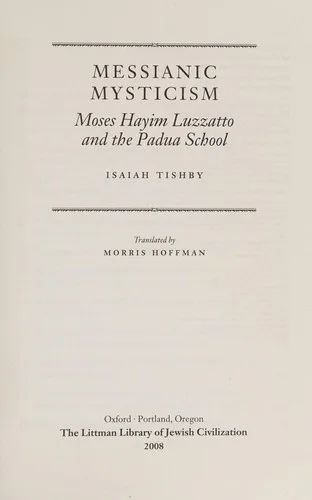
Ḥiḳre ḳabalah u-sheluḥoteha

 79
79

Ḥiḳre ḳabalah u-sheluḥoteha
Isaiah Tishby's Ḥiḳre ḳabalah u-sheluḥoteha functions less as a guided tour and more as an analytical dissection of Kabbalistic architecture. Its strength lies in its rigorous, scholarly approach, meticulously examining the conceptual frameworks that underpin Jewish mystical thought. The work is particularly adept at mapping the intricate relationships between various Sefirot and their emanatory processes, offering a clear, if dense, presentation. However, the book's academic focus can be a significant barrier for those not already steeped in the subject matter; its densely argued prose and reliance on specialized terminology demand considerable prior knowledge. A passage detailing the complexities of Keter's relationship with Chokhmah, for instance, while illuminating for specialists, might prove impenetrable for neophytes. Ultimately, Ḥiḳre ḳabalah u-sheluḥoteha is a valuable resource for dedicated researchers but less accessible for broader esoteric study.
📝 Description
79
Isaiah Tishby's 2008 work, Ḥiḳre ḳabalah u-sheluḥoteha, offers a rigorous academic analysis of Kabbalistic thought.
This book is not an introduction for newcomers to Jewish mysticism. Instead, it provides a scholarly examination of Kabbalistic philosophy and theology. Tishby dissects key concepts, tracing their historical development and the connections between them. The work assumes a reader already familiar with the basics of Kabbalah, Hebrew, and Jewish theological ideas. It is aimed at those who have already engaged with this literature and seek a deeper, more analytical perspective. The book addresses the foundational doctrines and their complex interrelations within the mystical tradition. It requires careful attention and a solid background in the subject matter.
Published in 2008, Tishby's study engages with ongoing academic discussions about Kabbalah. It builds upon the foundational research of earlier scholars and contributes to the scholarly understanding of Kabbalistic systems. The analysis considers the evolution and internal consistency of these mystical doctrines. It stands as a significant academic contribution for specialists in the field.
Ḥiḳre ḳabalah u-sheluḥoteha situates itself within the scholarly tradition of studying Kabbalah, a Jewish mystical system that emerged in medieval Europe. This tradition of scholarship, significantly shaped by figures like Gershom Scholem, seeks to understand the complex theological, philosophical, and cosmological ideas within Kabbalistic texts. Tishby's work engages with this academic discourse, analyzing specific doctrines and their historical trajectory, thereby contributing to a more precise understanding of this esoteric tradition.
💡 Why Read This Book?
• Gain a precise understanding of the Sefirot, the ten divine emanations central to Kabbalah, as detailed in Tishby's analytical framework, which differentiates this text from more general esoteric introductions. • Grasp the theological implications of Tzimtzum, the concept of divine contraction, and its role in creation, a concept explored with scholarly depth not commonly found in introductory works. • Appreciate the scholarly debate surrounding the historical development of Kabbalistic ideas, informed by Tishby's analysis which contextualizes the tradition beyond its 2008 publication date.
⭐ Reader Reviews
Honest opinions from readers who have explored this book.
❓ Frequently Asked Questions
What is the primary focus of Ḥiḳre ḳabalah u-sheluḥoteha?
The book primarily focuses on a scholarly examination of Kabbalistic philosophy and theology, dissecting its core concepts and their historical development within Jewish mysticism.
Is this book suitable for beginners interested in Kabbalah?
No, this is an advanced academic text. It assumes prior knowledge of Kabbalah, Hebrew, and Jewish theological concepts, making it unsuitable for beginners.
When was Ḥiḳre ḳabalah u-sheluḥoteha first published?
The work by Isaiah Tishby was first published in 2008, placing it within contemporary academic discourse on mysticism.
What specific Kabbalistic concepts does the book explore?
It delves into concepts such as the Sefirot, Tzimtzum, Adam Kadmon, and the divine realms, analyzing their interrelationships and doctrinal significance.
Does the book offer practical Kabbalistic exercises?
No, Ḥiḳre ḳabalah u-sheluḥoteha is a theoretical and analytical study. It does not provide practical guidance or meditative techniques.
What is the significance of the author, Isaiah Tishby, in Kabbalistic studies?
Isaiah Tishby is recognized for his scholarly contributions to understanding Kabbalah, building upon the foundations laid by earlier researchers in the field.
🔮 Key Themes & Symbolism
The Sefirot
The ten divine emanations, known as the Sefirot, form the structural backbone of Kabbalistic cosmology. Tishby's work meticulously details their hierarchical arrangement and interconnections, moving beyond simple enumeration to explore their philosophical implications. The book examines how these emanations function as divine attributes and channels through which the infinite Ein Sof manifests in the finite world, a crucial aspect of understanding Kabbalistic ontology.
Tzimtzum and Creation
Central to Kabbalistic cosmology is the concept of Tzimtzum, or divine contraction. Tishby's analysis explores this radical idea, wherein God withdraws to create a conceptual 'space' for the universe. This process is not merely a physical act but a theological necessity, allowing for the existence of a created reality distinct from the Creator, a concept profoundly explored in the book.
Adam Kadmon
The figure of Adam Kadmon, the primordial or archetypal human, is examined as a key mediator between the divine and the created realms. The book discusses how this cosmic being embodies the Sefirot and serves as a blueprint for the physical universe. Tishby's scholarship illuminates the symbolic and theological weight of Adam Kadmon within the broader Kabbalistic framework.
Divine Realms
The structure of the divine realms, often conceptualized through the Sefirot, is a significant focus. Ḥiḳre ḳabalah u-sheluḥoteha investigates the intricate pathways and dynamics within these realms, explaining how they influence the material world. The book provides a scholarly lens through which to understand the complex Kabbalistic map of divine existence.
💬 Memorable Quotes
“The Sefirot represent the divine attributes through which God interacts with creation.”
— This paraphrased concept highlights the functional role of the Sefirot as the interface between the infinite Creator and the finite manifested world, a core tenet of Kabbalistic theology.
“Kabbalah posits a divine 'contraction' (Tzimtzum) to allow for the possibility of existence.”
— This interpretation emphasizes the paradoxical nature of creation in Kabbalah, where the very act of bringing forth the universe necessitates a withdrawal or self-limitation of the divine.
“Adam Kadmon serves as the archetypal form embodying the divine emanations.”
— This statement captures the essence of Adam Kadmon's role as a cosmic blueprint, a primordial manifestation that bridges the gap between the abstract Sefirot and the physical universe.
“Understanding the sequence of emanation is crucial to grasping Kabbalistic cosmology.”
— This paraphrased concept stresses the importance of the hierarchical and sequential nature of divine outflow in Kabbalah, as analyzed in depth within Tishby's work.
“The relationship between Keter and Chokhmah is one of primary emanation.”
— This interpretation points to the foundational connection between the highest Sefirot, Keter (Crown) and Chokhmah (Wisdom), as a critical starting point for understanding the entire structure of divine manifestation.
🌙 Esoteric Significance
Tradition
This work is firmly rooted in the Kabbalistic tradition, specifically examining its philosophical and theological dimensions. It does not represent a departure from Kabbalah but rather a deep analytical exploration of its core doctrines. Tishby's scholarship positions the book within the academic study of Jewish mysticism, focusing on the internal logic and historical development of Kabbalistic thought as a distinct spiritual lineage.
Symbolism
Key symbols explored include the Sefirot, often depicted as a luminous tree or vessels, representing divine attributes and the structure of reality. Another vital symbol is Tzimtzum, the divine 'contraction,' which is not merely a static image but a dynamic concept explaining the possibility of creation. Adam Kadmon, the primordial man, also functions symbolically as the archetypal form that contains and mediates the divine emanations.
Modern Relevance
Contemporary scholars and practitioners of Jewish mysticism continue to engage with Tishby's rigorous analysis. His work serves as a critical reference point for understanding the philosophical underpinnings of Kabbalah, influencing modern interpretations of its cosmology and theology. Thinkers interested in comparative mysticism and the history of esoteric thought find value in his precise articulation of complex Kabbalistic ideas.
👥 Who Should Read This Book
• Advanced students of Kabbalah seeking a deep, scholarly exploration of its core doctrines, moving beyond introductory material. • Comparative religion scholars interested in the philosophical and theological intricacies of Jewish mysticism and its place within global esoteric traditions. • Researchers of Western esotericism requiring precise textual analysis and historical context for Kabbalistic concepts like the Sefirot and Tzimtzum.
📜 Historical Context
Isaiah Tishby's Ḥiḳre ḳabalah u-sheluḥoteha, published in 2008, emerges within a robust academic tradition dedicated to the study of Jewish mysticism. This era built upon the foundational scholarship of figures like Gershom Scholem, who significantly revitalized and contextualized Kabbalah for a modern audience starting in the mid-20th century. Tishby's work engages with Scholem's interpretations and also with subsequent scholarly debates concerning the historical trajectories and philosophical coherence of Kabbalistic systems. The publication occurs at a time when comparative mysticism and religious studies are well-established disciplines, allowing Tishby's analysis to be situated within broader intellectual currents. While not directly referencing a specific contemporary author in this blurb, the book implicitly dialogues with the extensive body of scholarship that followed Scholem's groundbreaking work on Kabbalah and its relationship to other mystical traditions.
📔 Journal Prompts
The concept of Tzimtzum: How does divine contraction enable existence?
Reflect on the symbolic role of Adam Kadmon in Kabbalistic cosmology.
Analyze the interrelationship between two specific Sefirot discussed in the text.
Consider the historical lineage of Kabbalistic thought as presented by Tishby.
What are the theological implications of the Sefirot for understanding the divine?
🗂️ Glossary
Sefirot
The ten divine emanations or attributes through which the infinite God (Ein Sof) manifests and interacts with the created universe in Kabbalistic cosmology.
Tzimtzum
A central Kabbalistic concept referring to the divine 'contraction' or withdrawal that creates a conceptual space necessary for the existence of the universe.
Ein Sof
The Kabbalistic term for the 'Infinite' or 'Endless,' representing the unknowable, transcendent aspect of God before any divine emanation.
Adam Kadmon
The primordial or archetypal human, a cosmic figure that embodies the Sefirot and serves as a divine blueprint for creation in Kabbalah.
Emanation
The process by which divine attributes or substance issue forth from a divine source, forming the structure of the created cosmos in Kabbalistic thought.
Kabbalah
A system of Jewish mysticism that explores the nature of God and the universe through esoteric interpretations of religious texts and symbolic imagery.
Divine Realms
The distinct levels or spheres of divine manifestation, often understood as being structured by the Sefirot, through which God's presence extends into reality.



















![The Amulet of Samarkand [graphic novel]](/img/thumb/the-amulet-of-samarkand-graphic-novel-jonathan-stroud-620896.webp)