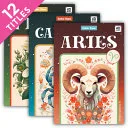
Zodiac Signs (Set)
 72
72

Zodiac Signs (Set)
The 'Zodiac Signs (Set)' offers a visually-driven introduction to astrological archetypes, a commendable effort given the often dense nature of such material. Its strength lies in the integration of infographics and QR codes, which genuinely make the abstract zodiacal wheel feel more tangible, especially for younger or less experienced readers. The series effectively breaks down complex correspondences like elemental and modal qualities into digestible pieces. However, the reliance on bright, modern design occasionally overshadows the deeper symbolic resonance of the signs. For instance, the depiction of Scorpio, while visually striking, could benefit from more nuanced exploration of its transformative rather than purely intense associations. The series presents a solid foundation, but those seeking profound astrological interpretation might find it somewhat superficial. It serves as an excellent primer, but not a definitive guide to natal interpretation.
📝 Description
72
### What It Is This set, titled 'Zodiac Signs', presents a comprehensive overview of the twelve astrological archetypes that form the foundation of Western astrology. Published in 2025, it aims to demystify the zodiac for a contemporary audience. The series employs visual aids, including infographics and colorful imagery, to illustrate astrological concepts. QR codes are integrated throughout, providing access to supplementary digital content, thereby bridging traditional astrological study with modern interactive technology. The primary objective is to make the intricate system of the zodiac accessible and engaging.
### Who It's For 'Zodiac Signs (Set)' is designed for a broad readership interested in self-discovery and understanding personality dynamics. It caters to individuals curious about how celestial positions at birth might influence character traits, relationships, and potential life paths. The accessible format makes it suitable for beginners with no prior astrological knowledge, as well as those seeking to deepen their existing understanding. Students of comparative mythology and ancient belief systems will also find value in its exploration of archetypal symbolism.
### Historical Context The zodiac, originating from Babylonian astronomy around the 2nd millennium BCE, has been a constant in human attempts to map the cosmos and its influence on terrestrial affairs. Its integration into philosophical and mystical thought, particularly through Hellenistic astrology, established the twelve signs as we know them today. The current work, published in 2025, arrives in an era where astrology has experienced a significant resurgence, often termed the 'New Age' astrological revival, blending ancient symbolism with modern psychological frameworks. This series positions itself within this contemporary astrological discourse, which often contrasts with the more deterministic astrological systems prevalent in earlier centuries.
### Key Concepts The core of this set revolves around the twelve zodiac signs: Aries, Taurus, Gemini, Cancer, Leo, Virgo, Libra, Scorpio, Sagittarius, Capricorn, Aquarius, and Pisces. Each sign is presented with its associated ruling planet, element (Fire, Earth, Air, Water), modality (Cardinal, Fixed, Mutable), and unique symbol. The work explores the archetypal energies each sign embodies, how these energies manifest in personality, and their interactions within the larger zodiacal wheel. It also touches upon the concept of the Ascendant and Sun sign as primary indicators of individual disposition and life direction.
💡 Why Read This Book?
• Gain a foundational understanding of the twelve zodiac signs, including their elemental and modal classifications, enabling you to identify core archetypal energies in yourself and others. • Discover the astrological significance of the year 2025 as a point of contemporary interest in zodiacal studies, understanding how modern interpretations build upon ancient frameworks. • Utilize the integrated QR codes to access supplementary digital content, offering interactive visualizations of the zodiac wheel that enhance comprehension beyond static text.
⭐ Reader Reviews
Honest opinions from readers who have explored this book.
❓ Frequently Asked Questions
When was the 'Zodiac Signs (Set)' first published?
The 'Zodiac Signs (Set)' was first published in 2025, marking it as a contemporary entry into the field of popular astrological literature.
What are the main visual features of the 'Zodiac Signs (Set)'?
The set prominently features amazing infographics, bright, colorful imagery, and integrated QR codes designed to bring the zodiac wheel to life for the reader.
Who is the intended audience for the 'Zodiac Signs (Set)'?
The intended audience includes readers interested in learning about their own zodiac sign or all twelve, and understanding how the zodiac shapes personalities and futures.
What is the primary goal of the 'Zodiac Signs (Set)'?
The primary goal is to explore the secrets of the Zodiac, making the information accessible and engaging through modern design and interactive elements.
Which imprint publishes the 'Zodiac Signs (Set)'?
The 'Zodiac Signs (Set)' is an imprint of DiscoverRoo, which is a division of ABDO.
Does the 'Zodiac Signs (Set)' align with educational standards?
Yes, the content is aligned to Common Core standards and correlated to state standards, indicating its suitability for educational contexts.
🔮 Key Themes & Symbolism
Archetypal Personalities
This set examines the twelve zodiac signs as distinct archetypes, each embodying unique sets of characteristics, motivations, and life approaches. It details how the position of the Sun at birth, the 'Sun sign,' is traditionally understood to influence core personality traits, temperaments, and innate potentials. The work explores the symbolic language of each sign, linking them to elements like Fire, Earth, Air, and Water, and modalities such as Cardinal, Fixed, and Mutable, providing a framework for understanding individual differences and common human experiences.
The Zodiacal Wheel
Central to the set is the concept of the zodiacal wheel, a circular diagram representing the twelve signs in their celestial order. The work illustrates how these signs are not isolated entities but exist in a dynamic relationship with each other. It explains the progression through the signs from Aries to Pisces, symbolizing a cycle of growth and experience. Infographics are used to map these relationships, showing potential harmonies and dissonances between signs based on their elemental and modal affiliations.
Astrology and Future
The set addresses the common interest in how astrology can offer insights into future possibilities and life paths. It presents the zodiac as a tool for self-awareness, suggesting that understanding one's sign can illuminate potential strengths, challenges, and tendencies. While not presented as deterministic prophecy, the work implies that astrological archetypes provide a symbolic map that can guide individuals in navigating their personal journeys and understanding the unfolding of events.
Visual Learning Tools
A distinguishing feature of this set is its emphasis on visual learning. The inclusion of vibrant imagery, detailed infographics, and interactive QR codes aims to demystify complex astrological concepts. These elements are designed to make the abstract principles of the zodiac more concrete and engaging, particularly for readers new to the subject. This approach facilitates a more intuitive grasp of astrological symbolism and its application.
💬 Memorable Quotes
“The zodiac wheel is a map of human experience.”
— This paraphrased concept highlights the symbolic nature of astrology, viewing the twelve signs not just as celestial divisions but as representations of distinct psychological states and life stages.
“Each sign has a unique energy and purpose.”
— This idea underscores the distinct archetypal qualities associated with each of the twelve zodiac signs, suggesting that they offer different potentials and challenges within the human journey.
“Understanding your sign can illuminate your path.”
— This statement points to the practical application of astrology for self-discovery, implying that knowledge of one's astrological blueprint can provide guidance and clarity on personal development.
“Infographics bring the zodiac to life.”
— This highlights the visual methodology employed by the set, emphasizing how diagrams and charts serve to make complex astrological relationships more accessible and understandable.
“QR codes offer deeper exploration.”
— This refers to the integration of digital technology, suggesting that the set provides gateways to further interactive learning and expanded content beyond the printed pages.
🌙 Esoteric Significance
Tradition
This work fits within the broad tradition of Western Esotericism, specifically drawing from the lineage of Hellenistic astrology which synthesized Babylonian, Egyptian, and Greek elements. While not explicitly Hermetic or Kabbalistic, its foundational concepts of celestial influence and symbolic correspondences align with the Hermetic principle of 'As Above, So Below'. It departs from highly technical astrological treatises by prioritizing accessibility and visual engagement, making its core tenets available to a wider audience than traditional, dense astrological texts.
Symbolism
The set prominently features the twelve zodiacal signs, each a potent symbol. Aries, the Ram, symbolizes new beginnings and assertive action. Taurus, the Bull, represents earthly stability, sensuality, and perseverance. Gemini, the Twins, embodies duality, communication, and intellectual curiosity. These symbols are not mere representations but are considered archetypal energies that influence human psychology and destiny within the astrological framework.
Modern Relevance
Contemporary practitioners of evolutionary astrology, psychological astrology, and even those exploring archetypal psychology often reference the core zodiacal symbolism presented in works like this. Thinkers and authors who synthesize astrology with mythology, such as Stephen Arroyo or Liz Greene, build upon these foundational archetypes. The set's modern relevance lies in its ability to introduce these ancient symbols to a generation accustomed to digital interaction, bridging the gap between historical esoteric knowledge and current spiritual seeking.
👥 Who Should Read This Book
• Beginners interested in self-understanding through astrology: This set provides a clear, visually supported introduction to the twelve zodiac signs, helping new students grasp fundamental astrological concepts. • Students of comparative mythology and symbolism: Readers exploring archetypal patterns across cultures will find the zodiacal signs a rich subject for analysis and comparison. • Individuals seeking accessible esoteric knowledge: Those curious about metaphysical systems but intimidated by complex texts will appreciate the simplified explanations and engaging format.
📜 Historical Context
The zodiac, as a system of twelve constellations through which the Sun, Moon, and planets appear to move, has roots in Babylonian astronomy from the 2nd millennium BCE. By the Hellenistic period in Egypt, around the 1st century BCE, these celestial divisions were integrated with Greek philosophy and Egyptian traditions, forming the basis of horoscopic astrology. Key figures like Claudius Ptolemy, in his 2nd-century CE work the *Tetrabiblos*, codified much of this system, which then heavily influenced Western esoteric thought for centuries. The 'Zodiac Signs (Set)', published in 2025, enters a landscape where astrology, after periods of decline and skepticism, particularly during the Enlightenment and the rise of scientific rationalism, has experienced a significant resurgence. This modern revival, often linked to the 'New Age' movement starting in the mid-20th century, tends to emphasize psychological interpretation and personal growth over the more deterministic or predictive approaches of earlier eras, such as those found in medieval or Renaissance astrological texts.
📔 Journal Prompts
The archetypal energy of your Sun sign: How does its description align with your lived experience?
Symbolism of the ruling planet for your Ascendant sign.
Reflect on the elemental qualities (Fire, Earth, Air, Water) and how they manifest in your daily life.
The concept of the zodiacal wheel as a map of human experience.
How the modalities (Cardinal, Fixed, Mutable) influence your approach to projects.
🗂️ Glossary
Zodiac
A belt of the heavens, extending about 8 degrees on either side of the ecliptic, divided into twelve equal parts or signs, each 30 degrees in extent. It is the path the Sun appears to trace annually.
Ascendant
The sign that was rising on the eastern horizon at the moment of birth. It is considered to represent the outward personality and the way one presents to the world.
Ruling Planet
In astrology, each zodiac sign is associated with a specific planet that governs its characteristics and themes. For example, Mars rules Aries.
Element
The four classical elements—Fire, Earth, Air, and Water—are assigned to the zodiac signs, categorizing them based on fundamental qualities and energies.
Modality
The three modalities—Cardinal, Fixed, and Mutable—further classify the signs into groups based on their approach to action and change (initiating, sustaining, adapting).
Infographic
A visual representation of information, data, or knowledge intended to present information quickly and clearly.
Archetype
A typical example of a certain person or thing; in psychology and mythology, a universal, inherited pattern of thought or imagery.












![Tales of Mystery and Imagination [22 stories]](/img/thumb/tales-of-mystery-and-imagination-22-stories-edgar-allan-poe-520084.webp)