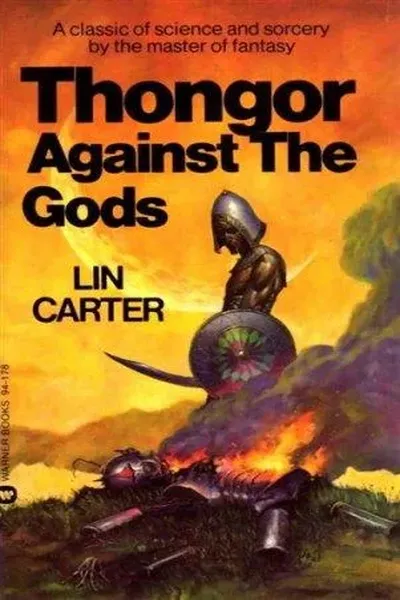
Thongor at the end of time

 72
72

Thongor at the end of time
Lin Carter's "Thongor at the End of Time" plunges the reader into a remarkably bleak, yet compelling, vision of humanity's twilight. The novel's strength lies in its unflinching portrayal of a universe succumbing to entropy, a far cry from the usual heroic fantasies. Carter excels at creating an atmosphere of profound desolation, where survival itself is a victory. However, the narrative occasionally falters due to the protagonist's rather static characterization; Thongor, while a capable warrior, often serves more as a vehicle for experiencing this dying world than as a deeply developed individual. A particularly striking passage involves Thongor's encounter with the degenerate inhabitants of a ruined metropolis, showcasing the novel's power to depict the grotesque and the tragic. Ultimately, "Thongor at the End of Time" offers a somber, atmospheric, and memorable exploration of cosmic decline.
📝 Description
72
### What It Is Thongor at the End of Time presents a vision of a far-future Earth, a world reduced to a desolate wasteland after untold millennia. This is not a tale of heroic quests in a vibrant fantasy realm, but a stark exploration of entropy and the remnants of civilization. The narrative follows Thongor, a warrior from a less advanced, yet more vital, past who finds himself thrust into this decaying epoch. His struggle is against the crushing weight of cosmic decay and the monstrous entities that have arisen in humanity's long decline.
### Who It's For This work appeals to readers who appreciate speculative fiction with a philosophical bent, particularly those interested in themes of decline, survival, and the ultimate fate of intelligent life. It's for those who find merit in exploring the melancholic beauty of a world on its last legs, rather than seeking conventional adventure. Readers who enjoy post-apocalyptic settings, dying earth scenarios, and character-driven narratives focused on enduring hardship will find resonance here.
### Historical Context Published in 1968, Thongor at the End of Time emerges from a period of intense science fiction and fantasy output. The 1960s saw a growing interest in more mature and complex themes within genre fiction, moving beyond simpler adventure narratives. Lin Carter, a prolific writer and editor, was part of a generation that sought to expand the conceptual boundaries of these genres. This book reflects a particular strain of dying earth fiction, a subgenre that gained traction in the mid-20th century, often exploring the melancholic beauty of worlds nearing their inevitable end.
### Key Concepts The novel grapples with the concept of the "Dying Earth," a trope popularized by Jack Vance, where the sun is a dim ember and civilization has regressed to primitive states amidst vast ruins. Entropy, both physical and societal, is a pervasive theme, presenting a universe succumbing to its own exhaustion. Survival against overwhelming odds is central, with Thongor embodying a primal will to persist in a world actively hostile to life. The narrative also touches upon the cyclical nature of existence, with remnants of advanced technology and forgotten magic hinting at past glories and future possibilities, however faint.
💡 Why Read This Book?
• You will experience a unique "dying earth" scenario, a specific science fantasy subgenre, exploring the ultimate decline of civilization under the shadow of cosmic entropy, a concept central to the book's setting. • You will gain insight into Lin Carter's contribution to speculative fiction from the 1960s, a period marked by genre expansion, by examining how "Thongor at the End of Time" diverges from typical adventure narratives of its era. • You will feel the weight of existence in a decaying universe, focusing on raw survival against overwhelming odds, embodied by Thongor's struggle in the desolate world presented in the novel.
⭐ Reader Reviews
Honest opinions from readers who have explored this book.
❓ Frequently Asked Questions
What is the "dying earth" concept in "Thongor at the End of Time"?
The "dying earth" concept refers to a far-future setting where the sun is a dim ember and civilization has collapsed, leaving behind vast ruins and degenerate life forms. This is a key element of the novel's atmosphere and plot, first popularized by Jack Vance.
Who is Thongor and why is he in this future world?
Thongor is a warrior from a more primitive, vital past who finds himself transported to the far-future, dying earth. His presence creates a contrast between primal vigor and cosmic decay, driving the narrative.
When was "Thongor at the End of Time" first published?
The book was first published in 1968, placing it within the prolific science fiction and fantasy output of the late 1960s.
What are the main themes explored in the book?
Major themes include entropy, cosmic decay, survival against overwhelming odds, and the melancholic beauty of a world nearing its end. The novel presents a stark view of civilization's ultimate fate.
Is "Thongor at the End of Time" part of a series?
Yes, "Thongor at the End of Time" is part of a series of novels featuring the character Thongor, all written by Lin Carter, exploring similar themes of adventure in dying worlds.
What kind of atmosphere does the book create?
The book creates a distinct atmosphere of desolation, decay, and existential dread, balanced by moments of primal action and a focus on enduring the inevitable collapse of all things.
🔮 Key Themes & Symbolism
Cosmic Entropy and Decline
The novel vividly portrays a universe teetering on the brink of absolute exhaustion. The sun is a dying ember, landscapes are barren wastelands, and civilization has long since crumbled into dust. This pervasive sense of decay isn't just environmental; it's also societal and spiritual, reflecting a profound commentary on the eventual fate of all things. Thongor's journey through this world underscores the relentless march of entropy, where even the remnants of past glories are merely echoes in the void.
Primal Survival
In the face of overwhelming cosmic forces and degenerate life, the core of the narrative lies in raw survival. Thongor, a warrior from a more robust era, embodies a primal will to endure. His struggles against monstrous creatures and environmental hazards highlight humanity's basic instinct to persist, even when all hope seems lost. This theme offers a counterpoint to the pervasive decay, suggesting that life, in its most fundamental form, can still fight against the inevitable end.
The Dying Earth Trope
Carter's work is a significant example of the "dying earth" subgenre, a concept famously explored by Jack Vance. This setting depicts a far-future Earth where the planet is ancient, its sun dimming, and humanity reduced to scattered, often degenerate, remnants. The trope allows for imaginative exploration of the ultimate consequences of time and cosmic evolution, blending elements of science fiction and fantasy into a unique, melancholic tapestry of worlds at their end.
Echoes of Lost Civilizations
The desolate landscape of Thongor's future is littered with the ruins of unimaginably advanced civilizations. These remnants—crumbling megastructures, forgotten technologies, and cryptic artifacts—serve as constant reminders of what once was. They hint at cycles of rise and fall, creation and destruction, adding a layer of poignant mystery to the narrative. The juxtaposition of primitive survival against the backdrop of cosmic ruins is a central element of the book's evocative power.
💬 Memorable Quotes
“The world was old. Older than memory, older than the stars themselves, or so it seemed.”
— This paraphrased sentiment captures the overwhelming sense of geological and cosmic time that permeates the novel. It emphasizes the sheer antiquity of the setting, suggesting a universe far beyond human comprehension or lifespan, where decay is the dominant force.
“He was a man of action, in a world that had forgotten what action meant.”
— This interpretation highlights Thongor's unique position. His warrior's spirit and drive to fight stand in stark contrast to the lethargic, degenerate, or monstrous inhabitants of the far-future. It underscores his role as an anachronism, a spark of primal energy in a dying world.
“Monsters born of the dust and the dying light.”
— This phrase evokes the grotesque and alien creatures that populate the novel's desolate landscapes. They are not merely beasts but manifestations of the world's decay, born from the very entropy that consumes everything else, representing the corrupted forms of life in the final age.
“Civilization was a forgotten dream, a whisper on the dying wind.”
— This captures the novel's bleak outlook on societal progress. The advanced civilizations of the past are gone, leaving behind only ruins and degenerate descendants. The concept of 'civilization' itself has become a lost ideal, a mere myth in the face of overwhelming decay.
“He fought not for glory, but for the simple, brutal fact of existence.”
— This interpretation defines Thongor's motivation. In this end-of-time world, traditional aspirations like glory are meaningless. The struggle is reduced to its most basic form: the will to simply continue living against impossible odds, a fundamental drive against oblivion.
🌙 Esoteric Significance
Tradition
While not explicitly Gnostic or Hermetic, "Thongor at the End of Time" resonates with themes found in these traditions, particularly the concept of a fallen or corrupted world and the struggle of a remnant consciousness. The pervasive sense of cosmic decay and the existence of degenerate beings can be seen as mirroring Gnostic ideas of a flawed creation. The ancient, forgotten technologies and the hint of lost knowledge touch upon a Hermetic fascination with primordial wisdom obscured by time and ignorance.
Symbolism
The dying sun serves as a potent symbol of exhausted creative energy, the fading of divine light, and the ultimate thermodynamic death of the universe. The crumbling ruins of past civilizations symbolize the transience of all material constructs and the inevitable decay that overtakes even the grandest achievements. Monstrous, degenerate beings represent the corruption of primal forms and the devolution of life under the influence of entropy and a decaying cosmic order.
Modern Relevance
Contemporary "dying earth" fiction, a subgenre that continues to thrive, owes a significant debt to works like Carter's. Modern authors exploring themes of post-apocalyptic decline, cosmic horror, and the melancholic beauty of entropy in speculative fiction often draw upon the atmospheric foundations laid by Carter and his contemporaries. The novel's stark vision of entropy remains relevant in discussions of ecological collapse and the long-term future of humanity.
👥 Who Should Read This Book
• Readers interested in the "dying earth" subgenre of science fantasy, seeking atmospheric explorations of worlds in their final epochs. • Speculative fiction enthusiasts who appreciate narratives focused on survival against overwhelming cosmic forces and societal collapse, rather than traditional heroic quests. • Students of 1960s genre fiction, examining how authors like Lin Carter expanded the thematic scope of science fiction and fantasy during a pivotal era.
📜 Historical Context
Emerging in 1968, "Thongor at the End of Time" arrived during a vibrant period for science fiction and fantasy. The decade had seen established authors like Jack Vance perfecting the "dying earth" subgenre, which "Thongor" directly engages with. Lin Carter, an influential editor and writer for publications like *Fantastic Stories of Imagination*, was instrumental in shaping genre perceptions. This era also saw a burgeoning interest in more complex, adult themes within speculative fiction, moving beyond simpler adventure narratives. While not facing overt censorship, the genre was nonetheless pushing boundaries, exploring darker, more philosophical concepts. Contemporaries like Poul Anderson were also writing epic fantasy and science fiction that touched on grand scales of time and civilization's fate, though Carter’s focus remained distinctly on the melancholic end-state of a world.
📔 Journal Prompts
Thongor's struggle for existence against the backdrop of cosmic entropy.
The symbolism of the dying sun in a far-future setting.
Reflecting on the remnants of lost civilizations within the narrative.
The nature of primal survival in a world devoid of hope.
Contrasting Thongor's era with the end-of-time setting.
🗂️ Glossary
Dying Earth
A science fantasy subgenre depicting a far-future Earth where the sun is dimming, civilization has collapsed, and humanity exists in degenerate states amidst ancient ruins.
Entropy
In this context, the pervasive force of decay and disorder that characterizes the universe in the novel, leading to the eventual exhaustion of all energy and structure.
Primal Survival
The most basic instinct to endure and persist in the face of overwhelming adversity, stripped of societal niceties or grand ambitions.
Cosmic Decay
The concept of the universe itself succumbing to age and exhaustion, leading to the decline of stars, planets, and life.
Degenerate Life
Species or beings that have devolved from more advanced or complex forms, often exhibiting primitive or monstrous characteristics due to long-term decline.
Ruins
The physical remnants of past, advanced civilizations that litter the landscape, serving as constant reminders of lost glories and the passage of immense time.
Thongor
The protagonist, a warrior from a more vital past who is transported to the far-future dying earth, embodying a spirit of action and survival.