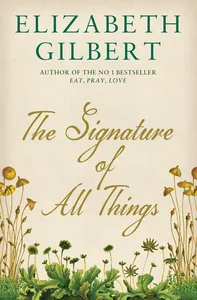
The signature of all things

 80
80

The signature of all things
Elizabeth Gilbert's "The Signature of All Things" offers a compelling, albeit uneven, exploration of scientific inquiry and spiritual yearning. The novel's greatest strength lies in its meticulously researched portrayal of 19th-century botany and the intellectual ferment of the era. Alma Whittaker is a vividly realized protagonist, her dedication to scientific observation rendered with palpable passion. However, the narrative occasionally falters in its pacing, particularly in the latter half, where the philosophical digressions, while interesting, can feel somewhat detached from the compelling character arc established earlier. The concept of "signatures" itself, while intriguing, is not always fully integrated into the plot's momentum. Despite these minor reservations, the novel provides a rich intellectual feast. It is a book that encourages contemplation on the interconnectedness of all living things and the enduring human quest for meaning within the vastness of the natural world.
📝 Description
80
### What It Is "The Signature of All Things" is a speculative historical novel that posits an alternative trajectory for the history of botany and scientific discovery. Set primarily in the 19th century, it follows the life of Alma Whittaker, a brilliant botanist born in 1800. The narrative traces her intellectual development, her passionate pursuit of botanical knowledge, and her eventual engagement with radical ideas about life and consciousness.
### Who It's For This work will appeal to readers interested in the intersection of science, spirituality, and speculative fiction. It is for those who appreciate detailed historical settings and character-driven narratives that explore philosophical questions. Readers seeking a novel that challenges conventional understandings of natural history and the human mind will find particular resonance here.
### Historical Context The novel is deeply embedded in the scientific and intellectual milieu of the 19th century. It engages with the burgeoning field of botany, the theories of evolution that were beginning to take shape, and the era's growing interest in spiritualism and alternative philosophies. The book implicitly contrasts Alma's scientific rigor with the more esoteric explorations of her contemporaries and the broader societal shifts occurring around the turn of the 20th century.
### Key Concepts Central to the narrative is the idea of "signatures" – the belief that natural objects contain symbolic clues to their divine origin and purpose. The book also explores themes of determinism versus free will, the nature of consciousness, and humanity's relationship with the natural world. It questions the rigid boundaries between the material and the spiritual, suggesting a more interconnected reality.
💡 Why Read This Book?
• You will learn about the 19th-century scientific method through Alma Whittaker's detailed botanical observations, gaining insight into how empirical study was conducted before modern technology. • You will explore the concept of "signatures" in nature, a historical belief that objects in the natural world hold symbolic clues to their divine purpose, enriching your understanding of early natural philosophy. • You will feel the intellectual tension between scientific rationalism and spiritual inquiry, as exemplified by Alma's personal journey and her engagement with the radical ideas circulating in the 1800s.
⭐ Reader Reviews
Honest opinions from readers who have explored this book.
❓ Frequently Asked Questions
What is the central premise of "The Signature of All Things"?
The novel centers on Alma Whittaker, a brilliant 19th-century botanist, whose life and work explore the interconnectedness of life, the nature of consciousness, and the historical belief that natural objects contain symbolic "signatures" revealing their divine origin.
When was "The Signature of All Things" first published?
The novel "The Signature of All Things" by Elizabeth Gilbert was first published in 2020.
What historical period does the book cover?
The book primarily covers the 19th century, following Alma Whittaker from her birth in 1800 through significant periods of scientific and intellectual change.
Does the book contain actual scientific theories or fictional ones?
While grounded in the real scientific context of the 19th century, particularly botany, the novel also incorporates speculative and philosophical concepts, like the "signatures" of plants, which are more allegorical than strictly scientific.
Is "The Signature of All Things" a sequel to another book?
No, "The Signature of All Things" is a standalone novel and not a sequel to any of Elizabeth Gilbert's previous works.
What are the main philosophical ideas explored in the novel?
The book delves into themes of determinism versus free will, the mystery of consciousness, the relationship between humanity and the natural world, and the historical interplay between scientific discovery and spiritual belief.
🔮 Key Themes & Symbolism
The Concept of Signatures
The novel deeply engages with the historical notion of "signatures," the idea that plants and other natural phenomena possess visible characteristics that symbolically indicate their uses or divine purpose. Alma Whittaker's scientific endeavors are framed by this concept, challenging her to reconcile empirical observation with a more mystical understanding of the natural world. This theme underscores the book's exploration of how humans have historically sought meaning and order in nature, bridging the gap between scientific classification and spiritual interpretation.
Botanical Discovery and Scientific Rigor
At its core, the book is a celebration of botanical science in the 19th century. It meticulously details the process of scientific discovery, from meticulous observation and classification to the challenges of fieldwork and theoretical debate. Alma's life is a testament to the intellectual rigor required in this field, highlighting the era's burgeoning scientific institutions and the often-solitary pursuit of knowledge. The narrative emphasizes the beauty and complexity of the plant kingdom as a subject of intense study.
Consciousness and the Material World
Gilbert probes the nature of consciousness and its relationship to the physical body and the wider universe. Alma's intellectual journey leads her to question the boundaries of sentience, exploring whether consciousness is unique to humans or a pervasive force within all life. This theme encourages readers to consider a more expansive view of existence, moving beyond purely materialistic explanations to contemplate the potential for a deeper, interconnected awareness within the cosmos.
Determinism vs. Free Will
The narrative grapples with questions of fate and agency. Alma's life, influenced by her father's philosophical leanings and her own experiences, prompts reflection on whether our paths are predetermined by genetics, environment, or a grander design. The book explores the tension between accepting one's circumstances and the active pursuit of self-determination, particularly within the context of scientific inquiry and personal relationships. This philosophical undercurrent adds depth to Alma's personal quest for understanding.
💬 Memorable Quotes
“The world is not made of atoms, it is made of stories.”
— This paraphrased concept suggests that our perception and understanding of reality are fundamentally shaped by narratives, both personal and collective, rather than by purely objective, material components.
“Nature is not a place to visit. It is your home.”
— This idea emphasizes a profound interconnectedness and belonging between humanity and the natural world, challenging the notion of nature as something separate or external to our existence.
“The greatest minds of the 19th century were grappling with the very nature of life itself.”
— This statement highlights the intellectual ferment of the era, where thinkers were not just classifying species but fundamentally questioning what it meant to be alive and conscious.
“Alma believed that the plant kingdom held secrets that could unlock the mysteries of the human mind.”
— This interpretation points to Alma's unique approach, suggesting she saw botany not just as a science of classification but as a pathway to understanding deeper philosophical questions about consciousness and existence.
“Every living thing carries a signature, a unique essence that speaks of its origin and purpose.”
— This concept encapsulates the novel's central philosophical idea, proposing that there is an inherent, discernible meaning or divine imprint within all of creation, waiting to be understood.
🌙 Esoteric Significance
Tradition
The novel taps into a Hermetic and Neoplatonic vein, exploring the idea of correspondence between the macrocosm and microcosm. The concept of "signatures" itself echoes Renaissance natural philosophy, particularly the belief that God imprinted clues to the divine order and purpose within creation. While not strictly aligned with any single esoteric school, it draws upon a broad Western tradition that seeks hidden meaning and interconnectedness in the natural world, often moving beyond purely materialistic scientific frameworks.
Symbolism
The primary symbol is the "signature" itself, representing the idea that all of creation bears divine markings or clues to its origin and function. Plants, as the focus of Alma's study, become potent symbols of life's complexity and interconnectedness. The act of botanical classification and the detailed observation of plant structures can be seen as symbolic of humanity's quest to understand the divine order through empirical study, bridging the material and the spiritual.
Modern Relevance
Contemporary thinkers in fields like ecopsychology, deep ecology, and certain branches of spirituality draw parallels to the novel's themes. The emphasis on the inherent meaning in nature and the interconnectedness of all life resonates with modern concerns about environmentalism and humanity's relationship with the planet. It speaks to a contemporary yearning for meaning beyond secular materialism, echoing the spiritual quests of earlier eras.
👥 Who Should Read This Book
• Aspiring botanists and natural historians: Gain an appreciation for the historical context of their field and the philosophical questions that have long accompanied scientific inquiry. • Readers interested in the history of ideas: Explore the intellectual landscape of the 19th century, where science, spirituality, and philosophy intersected in fascinating ways. • Those seeking a novel that contemplates consciousness and the natural world: Engage with a narrative that probes the profound connections between life, mind, and the universe.
📜 Historical Context
Published in 2020, Elizabeth Gilbert's "The Signature of All Things" is a work of historical fiction deeply rooted in the intellectual currents of the 19th century. The era was characterized by rapid scientific advancement, particularly in fields like botany, geology, and biology, with figures like Charles Darwin revolutionizing understandings of life. Simultaneously, the period saw a rise in spiritualism and alternative philosophies, as people grappled with the implications of scientific materialism. Gilbert positions her protagonist, Alma Whittaker, within this dynamic landscape, a brilliant botanist whose empirical work is paralleled by her engagement with more esoteric ideas. The novel implicitly contrasts Alma's scientific rigor with the burgeoning spiritualist movement and the philosophical questions raised by evolutionary theory. While not a direct engagement, the work exists in a cultural space occupied by thinkers like Darwin, whose theories were challenging established religious and scientific paradigms, and authors exploring the human psyche and its place in the universe.
📔 Journal Prompts
Alma Whittaker's engagement with the concept of "signatures" in nature.
The tension between determinism and free will as depicted in the novel.
The role of botanical observation in understanding consciousness.
Your personal interpretation of nature as a "home" rather than a "place to visit."
The historical context of 19th-century scientific discovery and spiritual inquiry.
🗂️ Glossary
Signatures
In the context of the novel, "signatures" refers to the historical belief that objects in the natural world possess visible characteristics (like shape, color, or habitat) that symbolically indicate their divine origin, purpose, or medicinal properties.
Botanical Classification
The scientific process of identifying, naming, and organizing plants into a hierarchical system based on shared characteristics. This was a major area of scientific endeavor in the 19th century.
Determinism
The philosophical belief that all events, including human actions, are ultimately determined by causes external to the will. This contrasts with the idea of free will.
Consciousness
The state of being aware of and responsive to one's surroundings; the mind's awareness of itself and its existence. The novel explores its nature and potential presence in non-human life.
Natural Philosophy
An ancient and medieval scholarly approach to questions that we today would associate with natural science. It was the precursor to modern science, often incorporating metaphysical and theological considerations.
Epistemology
The theory of knowledge, especially with regard to its methods, validity, and scope. Epistemology is the investigation of what distinguishes justified belief from opinion.
Spiritualism
A religious movement that held the belief that the spirits of the dead could be communicated with through mediums. It was popular in the 19th century.