The messianic secret

 74
74

The messianic secret
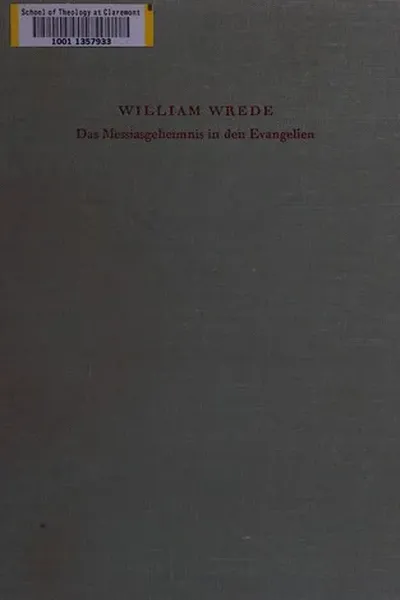
William Wrede’s The Messianic Secret presents a starkly analytical, almost surgical, dissection of the Gospels. Rather than accepting the narratives at face value, Wrede, writing in 1901, proposes that the pervasive injunctions for secrecy regarding Jesus's identity were not historical directives but literary inventions of the Gospel writers. This perspective, articulated with relentless logic, is the work’s undeniable strength. It forces a re-evaluation of how we understand the early Christian message. However, the text can feel relentlessly academic, occasionally sacrificing narrative flow for exhaustive argumentation. A particularly striking passage is Wrede's sustained argument against the idea that Jesus himself imposed secrecy, demonstrating instead how this interpretation arose from later theological needs. The verdict? A challenging but essential work for anyone serious about the historical Jesus.
📝 Description
74
### What It Is The Messianic Secret, first published in 2018, is a foundational text in critical biblical studies, though its implications resonate far beyond academic theology. William Wrede, writing with incisive scholarship, deconstructs the conventional understanding of Jesus's public ministry. He posits that the 'messianic secret' – the phenomenon of Jesus instructing disciples and those he healed to keep his identity concealed – was not a historical event but a literary device developed by early Gospel writers. This work challenges readers to reconsider the narrative construction of the Gospels themselves.
### Who It's For This book is essential for scholars of early Christianity, New Testament critics, and anyone interested in the historical Jesus. It is also valuable for students of religious history, comparative mythology, and the sociology of religion. Readers seeking to understand the development of early Christian doctrine and the formation of the New Testament canon will find it particularly illuminating. It appeals to those who appreciate rigorous textual analysis and are unafraid to question established narratives.
### Historical Context William Wrede’s original work, published in German as 'Das Messiasgeheimnis in den Evangelien' in 1901, emerged during a period of intense historical-critical examination of the Bible in Germany. This era saw scholars like Julius Wellhausen challenging traditional authorship and dating of biblical texts. Wrede’s thesis directly confronted the prevailing view that the Gospels were straightforward historical accounts, proposing instead a complex literary and theological development. His work was controversial, met with resistance from many theologians who defended the traditional understanding of the Gospels, but it profoundly influenced subsequent generations of biblical scholars, including those in the Bultmann school.
### Key Concepts The central concept is the "messianic secret" itself, interpreted not as a historical command by Jesus but as a theological construction by the Gospel authors. Wrede argues this secret was introduced to explain why Jesus was not recognized as the Messiah during his lifetime, reconciling the historical Jesus with the later Christology that proclaimed him as such. Another key idea is the distinction Wrede makes between the 'historical Jesus' and the 'Christ of faith,' suggesting the Gospels present a Christology that evolved over time, with the 'secret' serving as a narrative mechanism for this evolution.
💡 Why Read This Book?
• Gain a critical understanding of the 'messianic secret' concept, a central argument in understanding the Gospel narratives, enabling a deeper analysis of their theological development. • Grasp the historical-critical method as applied to biblical studies, learning how scholars like Wrede analyzed texts in the early 20th century, providing tools for evaluating religious literature. • Appreciate the distinction between the 'historical Jesus' and the 'Christ of faith,' a concept crucial for contemporary theological and philosophical discussions, offering a framework for interpreting religious figures.
⭐ Reader Reviews
Honest opinions from readers who have explored this book.
❓ Frequently Asked Questions
What is the core argument of William Wrede's The Messianic Secret?
Wrede's central thesis is that the 'messianic secret,' the idea that Jesus instructed people to conceal his identity, was not a historical reality but a literary and theological construction developed by the Gospel writers to reconcile the historical Jesus with later Christological beliefs.
When was The Messianic Secret first published and why is this significant?
The original German edition, 'Das Messiasgeheimnis in den Evangelien,' was published in 1901. This date is significant as it places Wrede's work within a period of intense historical-critical scholarship in Germany, challenging traditional biblical interpretations.
How did scholars receive Wrede's thesis upon its initial publication?
Wrede's thesis was highly controversial and met with considerable resistance from many theologians of his time who adhered to more traditional interpretations of the Gospels. Despite this, it profoundly influenced subsequent biblical scholarship.
What is the distinction Wrede makes between the 'historical Jesus' and the 'Christ of faith'?
Wrede suggests that the Gospels present a 'Christ of faith' shaped by later theological developments. He distinguishes this from the 'historical Jesus,' arguing that the messianic secret was a device to bridge the gap between the Jesus of history and the later proclamation of him as Messiah.
Does The Messianic Secret offer a view on the divinity of Jesus?
While Wrede's work focuses on the historical and literary construction of the Gospels, it implicitly challenges traditional doctrines by suggesting that the concept of Jesus as the Messiah was a post-resurrectional development, not necessarily a self-proclaimed identity during his earthly ministry.
Is William Wrede's The Messianic Secret available for free online?
As an older work, the original German text and early translations of 'Das Messiasgeheimnis in den Evangelien' may be available in public domain archives or academic libraries. However, the 2018 English edition is a published work and typically requires purchase.
🔮 Key Themes & Symbolism
The Literary Construction of the Messiah
Wrede argues that the concept of Jesus as the Messiah, particularly the perceived secrecy surrounding this identity, was not a direct historical fact but a narrative strategy employed by early Christian writers. The 'messianic secret' served as a literary tool to reconcile the earthly Jesus with the post-resurrectional proclamation of Christ. This theme examines how theological needs and interpretive frameworks shaped the Gospel accounts, moving beyond a purely historical reading.
Historical-Critical Method in Biblical Studies
This work is a prime example of the historical-critical method applied to New Testament texts. Wrede meticulously analyzes the Gospel narratives, questioning traditional assumptions about authorship, dating, and authorial intent. The theme explores how scholars in the late 19th and early 20th centuries began to dissect the Bible as historical documents, seeking to understand their origins and development through rigorous textual analysis and historical reasoning.
The Evolution of Christology
The book traces the development of Christology, the study of the nature and identity of Jesus Christ. Wrede suggests that the title 'Messiah' and its implications were not fully understood or proclaimed during Jesus's lifetime in the way later Gospels portray. Instead, the understanding of Jesus as the Messiah evolved over time, with the 'messianic secret' functioning as a device to explain this gradual recognition and proclamation.
Gospel Source Criticism
A significant aspect of Wrede's analysis involves understanding the sources and editorial processes behind the Gospels. He implies that different traditions and editorial layers contributed to the final texts. The theme focuses on how Wrede's work encouraged scholars to look for underlying sources and to analyze how editors might have shaped narratives to fit particular theological agendas, thereby influencing later source criticism.
💬 Memorable Quotes
“The messianic secret is a literary construction.”
— This concise statement encapsulates Wrede's central thesis: the perceived need to hide Jesus's messianic identity was not a historical command but an invention by the Gospel authors to explain a theological understanding that developed later.
“Jesus did not proclaim himself Messiah.”
— This interpretation highlights Wrede's challenge to traditional views. He suggests that evidence for Jesus actively claiming the title 'Messiah' during his ministry is weak, and that the title was applied to him retrospectively by his followers.
“The Gospels present a theology of the Christ, not a biography of Jesus.”
— This paraphrase points to Wrede's view that the Gospel writers were more concerned with presenting a theological interpretation of Jesus's significance (the 'Christ') than with providing a strictly historical record of his life and actions.
“The secrecy was a device to explain the lack of recognition.”
— This quote-like interpretation explains the function Wrede attributes to the messianic secret. It was a narrative mechanism created to address the apparent contradiction between Jesus being the Messiah and not being recognized as such during his lifetime.
“The 'Messiasgeheimnis' arose from later Christological needs.”
— This paraphrase emphasizes the temporal aspect of Wrede's argument. The concept of the messianic secret, according to him, emerged not from Jesus's own actions but from the theological and apologetic requirements of the early Christian community after Jesus's death and resurrection.
🌙 Esoteric Significance
Tradition
While Wrede’s work is primarily academic biblical criticism, its focus on uncovering hidden meanings and authorial intent aligns with certain esoteric traditions. It can be seen as a form of 'higher criticism' that seeks to reveal deeper, perhaps concealed, layers of meaning within sacred texts, akin to Gnostic or Kabbalistic approaches to scripture, albeit through historical-critical rather than mystical methods. It departs from traditional faith-based interpretations by employing purely rational and historical analysis.
Symbolism
The central 'symbol' explored is the 'messianic secret' itself. Wrede interprets this not as a divine mystery to be revealed, but as a literary device. In an esoteric reading, the 'secret' can symbolize the hidden nature of true spiritual realization, which is often misunderstood or rejected by the mundane world, requiring a process of inner unveiling rather than external proclamation. The concept of the 'historical Jesus' versus the 'Christ of faith' also acts symbolically, representing the distinction between the external, observable phenomenon and the internal, realized truth.
Modern Relevance
Wrede's ideas continue to inform contemporary discussions on the historical Jesus and the interpretation of the Gospels. Scholars in fields ranging from New Testament studies to comparative religion and even literary theory engage with his foundational arguments. His work remains relevant for those exploring the construction of religious narratives, the relationship between historical figures and their later interpretations, and the critical examination of sacred texts, influencing thinkers interested in textual deconstruction and the sociology of belief.
👥 Who Should Read This Book
• Students of comparative religion and early Christian history: To understand the development of Christology and the critical methodologies applied to sacred texts. • Scholars of literary criticism and narrative theory: To analyze how authorial intent, theological agendas, and historical context shape narrative construction in foundational religious works. • Skeptics and critical thinkers: To engage with a rigorous, text-based argument that questions traditional interpretations of one of history's most influential figures.
📜 Historical Context
Published in 1901 as 'Das Messiasgeheimnis in den Evangelien,' William Wrede's work emerged during the height of German liberal Protestant theology and the burgeoning historical-critical movement. Scholars like Julius Wellhausen had already shaken foundational biblical views. Wrede’s thesis directly challenged the prevailing consensus that the Gospels were straightforward historical accounts. He argued that the 'messianic secret' was not an actual historical phenomenon but a literary motif developed by the Gospel writers. This controversial stance positioned Wrede against many contemporaries who defended traditional interpretations. While initially met with resistance, his work profoundly influenced later generations of biblical scholars, including Rudolf Bultmann and the form-critical school, and became a cornerstone of New Testament scholarship, despite ongoing debates about its conclusions.
📔 Journal Prompts
The narrative function of the 'messianic secret' in Mark's Gospel.
Wrede's distinction between the historical Jesus and the Christ of faith.
Applying historical-critical methods to contemporary religious claims.
The role of authorial intent in shaping biblical narratives.
Reconciling historical analysis with personal faith regarding Jesus's identity.
🗂️ Glossary
Messianic Secret
The hypothesis, proposed by William Wrede, that Jesus's instructions for secrecy about his identity as the Messiah were not historical commands but a literary device created by the Gospel writers.
Historical-Critical Method
An academic approach to studying religious texts, particularly the Bible, that uses historical and critical analysis to understand their origins, development, and meaning, often questioning traditional authorship and divine inspiration.
Christology
The branch of Christian theology concerned with the nature and identity of Jesus Christ, particularly his divinity and his role as the Messiah.
Gospel
One of the first four books of the New Testament (Matthew, Mark, Luke, John), presenting accounts of the life, teachings, death, and resurrection of Jesus Christ.
Literary Device
A technique used by writers to create a specific effect or convey a particular meaning in their writing, such as metaphor, irony, or, in Wrede's thesis, the 'messianic secret'.
Christ of Faith
The theological understanding of Jesus as the divine Son of God and savior, as proclaimed by the Christian Church, often contrasted with the 'historical Jesus' sought by critical scholarship.
Source Criticism
A method of biblical analysis that seeks to identify and evaluate the sources (written or oral) that may have been used by the authors of the Gospels.