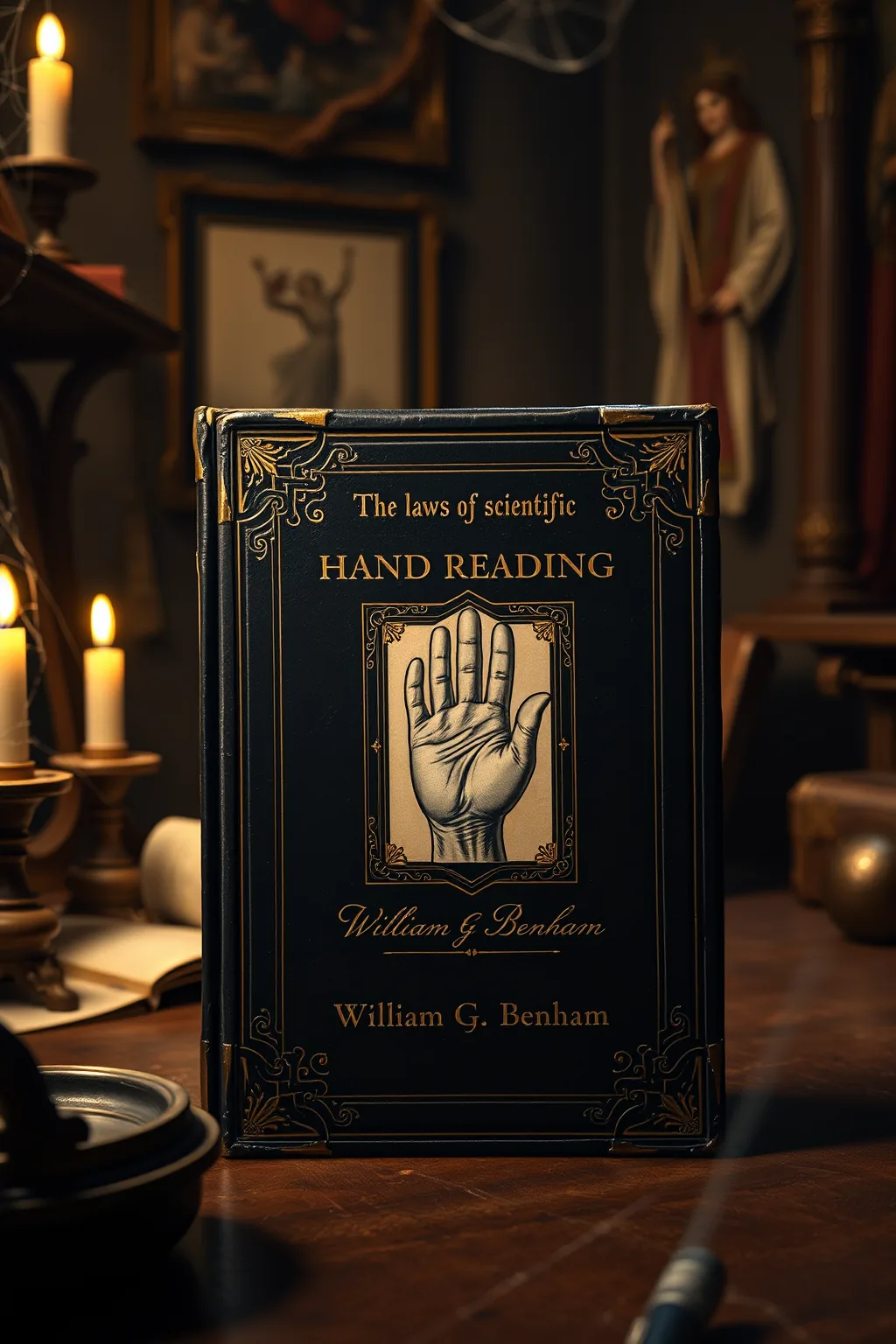
The laws of scientific hand reading
 82
82

The laws of scientific hand reading
William G. Benham’s "The Laws of Scientific Hand Reading" is an ambitious attempt to codify chiromancy into a rigorous system. Benham’s meticulousness in detailing hand anatomy—from the specific meaning of each phalange to the subtle variations in palm texture—is commendable, offering a depth rarely found in popular palmistry guides. The structured approach, particularly in classifying hand types and correlating them with personality traits, provides a solid foundation for analysis. However, the sheer volume of detail can become overwhelming, and the assertion of 'scientific' validity sometimes feels more like an assertion than a demonstrated fact, given the inherent subjectivity of interpretation. The chapter on the Mounts, while exhaustive, requires careful cross-referencing to avoid confusion. Ultimately, it serves as a valuable, albeit dense, reference for those dedicated to the serious study of hand analysis.
📝 Description
82
### What It Is William G. Benham's "The Laws of Scientific Hand Reading" presents a comprehensive system for interpreting the human palm. Far from mere fortune-telling, Benham approaches chiromancy as a scientific discipline, meticulously detailing the anatomy of the hand and correlating its features—lines, mounts, shape, and texture—to character, disposition, and potential life paths. First published in 1993, the work seeks to establish a logical framework for understanding palmistry, moving beyond anecdotal evidence to a structured methodology.
### Who It's For This volume is intended for serious students of esoteric sciences and those interested in the deeper psychological dimensions of chiromancy. It appeals to individuals seeking a systematic, analytical approach to hand analysis rather than superficial predictive techniques. Readers who appreciate detailed anatomical descriptions and a methodical, almost clinical, presentation of esoteric knowledge will find significant value here.
### Historical Context Benham's work emerged in a period when esoteric studies were gaining renewed academic and popular interest, following the broader occult revival of the late 19th and early 20th centuries. While figures like Arthur Conan Doyle championed spiritualism, Benham carved a niche by focusing on the perceived scientific underpinnings of palmistry. His approach positioned chiromancy within a lineage of Western esoteric thought that sought to codify hidden knowledge into observable laws, contrasting with purely mystical or religious interpretations of the hand.
### Key Concepts The book systematically explores the significance of various hand elements. It details the seven types of hands (e.g., the Elementary, the Philosophical, the Artistic), the meaning of the major lines (Life, Head, Heart, Fate), and the role of the mounts (Venus, Jupiter, Saturn, Apollo, Mercury, Mars, Luna). Benham also dedicates significant attention to finger shapes, phalanges, and the texture and color of the palm, all presented as indicators of specific psychological traits and life patterns.
💡 Why Read This Book?
• Gain a structured understanding of chiromancy, learning how Benham correlates specific hand features like the Elementary Hand type to personality traits, moving beyond generic interpretations. • Explore the detailed anatomy of the palm, including the specific meanings assigned to each phalange and the seven distinct hand types, as presented in the book's systematic classifications. • Understand the historical context of 'scientific' esoteric practices, recognizing how Benham's work in 1993 aimed to legitimize palmistry through a methodical approach, distinct from earlier spiritualist movements.
⭐ Reader Reviews
Honest opinions from readers who have explored this book.
❓ Frequently Asked Questions
What is the primary goal of William G. Benham's 'The Laws of Scientific Hand Reading'?
Benham's primary goal is to present chiromancy not as mystical guesswork but as a scientific discipline. He aims to establish a systematic, logical framework for interpreting the hand based on detailed observation of its anatomical features.
When was 'The Laws of Scientific Hand Reading' first published?
The book 'The Laws of Scientific Hand Reading' by William G. Benham was first published in 1993, positioning it within a later wave of esoteric literature seeking structured analysis.
What are the seven hand types discussed in the book?
Benham categorizes hands into seven types: Elementary, Spatulate, Square, Philosophical, Conic, Psychic, and Artistic. Each type is described with associated personality characteristics and life tendencies.
Does the book focus on predicting the future?
While the book discusses life paths and potential tendencies, its emphasis is on character analysis and psychological interpretation rather than deterministic future prediction. Benham treats palmistry as a science of disposition.
What is the significance of the mounts on the palm according to Benham?
According to Benham, the mounts (e.g., Mount of Venus, Mount of Jupiter) represent specific psychological energies and potentials. Their development, flatness, or prominence on the palm is interpreted as indicative of these traits.
Is this book suitable for beginners in palmistry?
While comprehensive, the book's detailed and systematic approach might be best suited for intermediate or advanced students of chiromancy who appreciate a rigorous, analytical method rather than introductory overviews.
🔮 Key Themes & Symbolism
Chiromancy as Science
Benham champions chiromancy as a scientific discipline, moving beyond speculative fortune-telling. He meticulously details the anatomical features of the hand—lines, mounts, fingers, and palm shape—and seeks to establish observable correlations between these physical attributes and psychological characteristics. This approach positions hand reading within a framework of empirical observation, aiming for a logical, systematic interpretation that can be studied and applied consistently, distinguishing it from purely intuitive or mystical practices.
Hand Typology
A central theme is the classification of hands into distinct types, such as the Elementary, Spatulate, Square, Philosophical, Conic, Psychic, and Artistic. Benham elaborates on the unique characteristics associated with each type, linking them to fundamental personality structures, innate talents, and life approaches. This typological system provides a foundational lens through which to interpret the myriad combinations of lines and mounts, offering a structured method for understanding an individual's core disposition.
The Language of the Palm
The book dissects the complex 'language' of the palm, assigning specific meanings to major and minor lines (Life Line, Head Line, Heart Line, Fate Line), the seven mounts (Venus, Jupiter, Saturn, Apollo, Mercury, Mars, Luna), and even the shape and segmentation of fingers. Benham provides a detailed lexicon for interpreting these elements, emphasizing how their appearance, depth, and position offer insights into an individual's character, mental faculties, emotional tendencies, and potential life experiences.
Characterological Interpretation
Rather than focusing solely on prediction, Benham's work emphasizes characterological interpretation. The hand is presented as a map of the psyche, revealing inherent strengths, weaknesses, psychological patterns, and behavioral tendencies. By analyzing the confluence of various hand features, readers are guided to understand the underlying psychological architecture of individuals, offering a tool for self-awareness and interpersonal understanding grounded in the physical form.
💬 Memorable Quotes
“The lines upon the palm are not arbitrary markings, but are formed by the muscles and tissues beneath, and are, therefore, an indication of the physical and mental condition of the individual.”
— This statement underscores Benham's scientific premise: palm lines are not random but are physical manifestations influenced by underlying physiology and psychology. It suggests a direct, observable link between the hand's markings and a person's state of being.
“The mounts... are the fleshy elevations on the palm, and their development indicates the strength of the qualities associated with the planet from which they derive their names.”
— This interpretation highlights the astrological connections Benham makes within his system. The mounts act as indicators of planetary influences, suggesting specific personality traits and potentials based on their prominence.
“The shape of the hand is the most general indication of character.”
— This paraphrased concept emphasizes the foundational importance of hand shape in Benham's typology. It suggests that the overall form of the hand provides the broadest strokes for understanding an individual's fundamental nature.
“The fingers, like the hand itself, are also subject to classification.”
— This quote implies that the analysis extends to the individual digits. Benham likely assigns specific meanings to finger shapes and lengths, further refining the characterological profile derived from the hand's overall structure.
“The Life Line, while not an index of longevity, speaks of vitality and the manner in which life is lived.”
— This interpretation clarifies a common misconception about the Life Line. Benham reframes it not as a predictor of lifespan but as an indicator of vital energy, health, and the quality of one's life experience.
🌙 Esoteric Significance
Tradition
Benham's work draws from the Western esoteric tradition, particularly within the branch that seeks to rationalize and systematize occult knowledge. While not explicitly Hermetic or Kabbalistic, his methodical approach to interpreting symbols (hand features) and establishing correspondences (hand to character) aligns with the broader Hermetic principle of 'As Above, So Below.' His attempt to create 'laws' for hand reading reflects a desire to bring order and predictability to what is often perceived as intuitive or mystical knowledge.
Symbolism
Key symbols in Benham's work include the seven planetary mounts on the palm (Venus, Jupiter, Saturn, Apollo, Mercury, Mars, Luna), each representing archetypal energies and qualities. The major lines (Life, Head, Heart, Fate) are also symbolic, interpreted as pathways of vital energy, mental processes, emotional expression, and destiny. The overall shape and features of the hand itself function as a symbolic representation of the individual's core nature and potential.
Modern Relevance
Contemporary practitioners of psychological astrology and somatic psychology often find Benham's detailed correlations between physical form (the hand) and psychological disposition to be insightful. His systematic approach to chiromancy continues to inform modern hand analysis, particularly for those seeking a structured methodology. Thinkers exploring embodied cognition and the psycho-physical connection may also find value in his detailed mapping of character onto the physical hand.
👥 Who Should Read This Book
• Aspiring chiromancers seeking a structured, comprehensive system for hand analysis, moving beyond basic guides to understand the detailed correlations Benham proposes. • Students of esoteric psychology interested in how physical form is interpreted as a map of character and disposition, as explored in Benham's typologies. • Researchers of Western esoteric traditions who wish to examine attempts to 'scientifically' codify occult knowledge, as exemplified by Benham's methodical approach to palmistry.
📜 Historical Context
William G. Benham's "The Laws of Scientific Hand Reading," first published in 1993, emerged during a period of renewed interest in esoteric studies, building upon the foundations laid by earlier occult revivals. While the late 19th and early 20th centuries saw figures like Helena Blavatsky and the Theosophical Society popularizing complex metaphysical systems, Benham focused on codifying chiromancy into a seemingly empirical science. His approach stood in contrast to the more mystical or spiritualist interpretations prevalent in earlier eras. The work implicitly engaged with the ongoing debate about the legitimacy of esoteric practices, seeking to lend them an air of scientific credibility. Unlike contemporaries who might have focused on divination or mediumship, Benham's meticulous, almost clinical, presentation of hand analysis offered a distinct path, aiming for a systematic understanding that could appeal to a more analytical mind, positioning palmistry within a lineage of Western esoteric thought that valued structured knowledge.
📔 Journal Prompts
The designation of the seven hand types (Elementary, Spatulate, etc.) and their associated characteristics.
The interpretation of the Mounts (Venus, Jupiter, etc.) and their influence on personality.
The significance of the Life Line's relationship to vitality and life experience.
The detailed analysis of finger shapes and phalanges as indicators of character.
The concept of chiromancy as a 'scientific' discipline, as presented by Benham.
🗂️ Glossary
Chiromancy
The practice of interpreting the lines, mounts, and other features of the human palm to understand character, disposition, and potential life paths. Benham endeavors to present it as a scientific study.
Mounts
Fleshy elevations on the palm, typically located at the base of the fingers or the palm's edge. Benham associates each mount with a planetary influence and specific psychological traits.
Phalanges
The individual segments or bones of the fingers and thumb. Benham assigns specific meanings to the relative lengths and development of these segments.
Hand Types
Benham's classification system categorizing palms into distinct types (e.g., Elementary, Square, Conic) based on their general shape and features, each linked to core personality traits.
Life Line
The curved line on the palm, generally starting between the thumb and index finger and extending towards the wrist. Benham interprets it as an indicator of vitality and the quality of life lived, not longevity.
Head Line
The line that typically traverses the palm horizontally from near the Life Line towards the other side. It is interpreted as representing mental faculties, thought processes, and intellectual approach.
Fate Line
A vertical line, often found in the center of the palm, extending upwards. Benham associates it with career, life direction, and external influences impacting one's path.