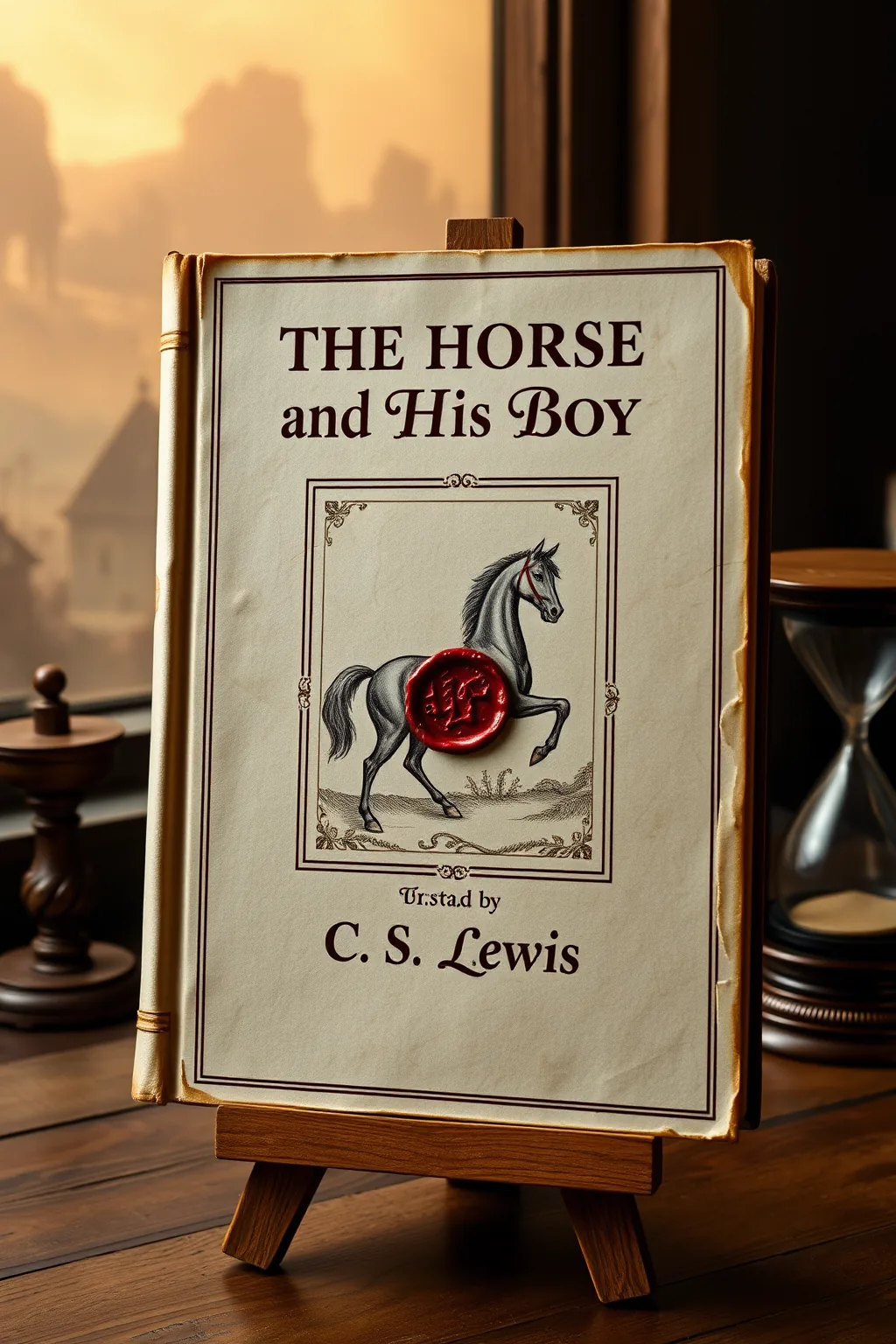
The Horse and His Boy
 84
84

The Horse and His Boy
Lewis crafts a compelling narrative of escape and self-discovery in *The Horse and His Boy*. The novel excels in its depiction of Shasta’s burgeoning awareness of his own agency, moving from a passive recipient of circumstance to an active participant in his fate. The dynamic between Shasta and Bree, the talking Narnian horse, provides much of the story's charm and philosophical undercurrent, exploring the complexities of master-servant relationships and mutual respect. However, the portrayal of Calormen, while serving the allegorical purpose of representing a decadent, oppressive society, can feel somewhat monolithic. The depiction of its inhabitants, particularly the Tisroc and his court, leans towards caricature, lacking the nuanced development seen in the protagonists. A passage that stands out is Shasta's encounter with the hermit, where the boy grapples with the idea of a benevolent God allowing suffering, a core tenet of Lewis's theological explorations. Ultimately, *The Horse and His Boy* is a powerful, if occasionally simplistic, exploration of freedom and true lineage.
📝 Description
84
C.S. Lewis published The Horse and His Boy in 1954, set during the Golden Age of Narnia.
This novel follows Shasta, a boy raised in Calormen, who learns he is not the son of the fisherman Arsheesh. He escapes a life of servitude when he encounters Bree, a talking Narnian horse. Together, they embark on a journey north towards Narnia and freedom, a path that leads Shasta to discover his true identity and heritage.
The story is set during the same period as The Lion, the Witch and the Wardrobe, during Narnia's Golden Age. Shasta's flight from Calormen is a dangerous undertaking, involving encounters with various characters and challenges as he travels toward the land of his birth. The narrative explores themes of self-discovery, courage, and the contrast between different cultures and belief systems.
Lewis, a scholar of medieval literature, crafts a tale that functions as an adventure while also carrying allegorical weight. The book engages with ideas of freedom, loyalty, and the nature of true nobility through its characters' experiences and choices.
Published in 1954, The Horse and His Boy emerges from C.S. Lewis's engagement with Christian apologetics and his academic study of medieval literature. As a member of the Inklings, Lewis was part of a group that explored myth, fantasy, and theological ideas through imaginative writing. The novel, set within the fictional land of Calormen, contrasts its societal structures and beliefs with those of Narnia, reflecting Lewis's interest in cultural critique and the exploration of differing worldviews. This work continues his tradition of embedding spiritual and moral frameworks within accessible adventure narratives.
💡 Why Read This Book?
• Gain insight into the concept of 'True Nobility' as explored through Shasta’s journey from a humble background to discovering his Narnian lineage, a theme distinct from mere social standing. • Understand the allegorical representation of societal structures, particularly the contrast between the oppressive Calormen and the free North, as presented in the perilous journey north undertaken in 1954. • Experience the unique character dynamic between a human boy and a sentient, talking horse, exemplified by Shasta and Bree, offering a model for interspecies understanding and partnership.
⭐ Reader Reviews
Honest opinions from readers who have explored this book.
❓ Frequently Asked Questions
When was C.S. Lewis's 'The Horse and His Boy' first published?
C.S. Lewis's 'The Horse and His Boy' was first published in 1954, as part of the Chronicles of Narnia series.
What is the primary theme of 'The Horse and His Boy'?
The primary theme is the search for identity and freedom, exploring how one's true nature and destiny are not determined by their upbringing but by their choices and heritage.
Where does 'The Horse and His Boy' take place in relation to other Narnia books?
Chronologically, the events of 'The Horse and His Boy' occur during the Golden Age of Narnia, specifically during the reign of the Pevensie siblings as Kings and Queens, which is detailed in 'The Lion, the Witch and the Wardrobe'.
Who are the main characters in 'The Horse and His Boy'?
The main characters are Shasta, a young runaway boy from Calormen, and Bree, a talking Narnian horse. They are joined by Aravis Tarkaan, another runaway, and her talking Narnian horse, Hwin.
What is the significance of the talking horses in the book?
The talking horses, like Bree and Hwin, represent a connection to the magical world of Narnia and serve as guides and companions, embodying wisdom and a longing for freedom from their Calormen oppressors.
Does 'The Horse and His Boy' contain Christian allegory?
Yes, like much of Lewis's work, 'The Horse and His Boy' contains Christian allegory. Shasta's journey and eventual discovery of his true identity can be interpreted as a metaphor for spiritual awakening and salvation.
🔮 Key Themes & Symbolism
Identity and True Nobility
The narrative deeply explores the concept that true nobility stems not from lineage or social standing, but from character and inner strength. Shasta, believing himself to be the son of a poor fisherman in Calormen, starts a journey that reveals his Narnian heritage. This quest for his origins forces him to confront who he truly is, independent of his upbringing. The book posits that inherent worth and courageous action are the markers of nobility, a concept Lewis subtly contrasts with the superficial status-seeking prevalent in Calormen society.
Freedom vs. Oppression
A central tension in *The Horse and His Boy* is the stark contrast between the oppressive, hierarchical society of Calormen and the freedom associated with Narnia and its allies. Shasta and Aravis flee Calormen to escape lives of servitude and potential cruelty. Their perilous journey north is a flight toward liberty, both political and personal. Lewis uses the distinct cultural landscapes to allegorize spiritual freedom, suggesting that true liberation comes from aligning oneself with righteousness and escaping the spiritual and societal bonds of tyranny.
The Nature of Destiny and Providence
The novel engages with the idea of a guiding providence, particularly through Shasta's experiences. Despite facing immense danger and despair, he consistently finds himself in situations where he is unexpectedly aided or guided, often by a mysterious figure he initially perceives as a lone traveler. This unfolding of events suggests a divine plan or destiny at work. The book explores how individuals navigate their perceived fate, with characters like Shasta learning to trust in a higher purpose, even when its workings are not immediately apparent.
Courage in the Face of Fear
Shasta’s journey is a profound test of courage. He begins as a fearful boy, easily intimidated by his adoptive father and the prospect of servitude. However, through his escape and the challenges he faces—from wild beasts to confronting his pursuers—he develops resilience and bravery. The narrative emphasizes that courage is not the absence of fear, but the willingness to act despite it. This theme is crucial to Shasta’s maturation and his eventual embrace of his true identity and responsibilities.
💬 Memorable Quotes
Direct passages from the work, attributed to the author.
“It is very hard to be brave when you are frightened.”
— This simple statement expresses the core of developing courage. It acknowledges the natural human response to fear while subtly suggesting that bravery is an active choice made in spite of that fear, a central theme for Shasta's development.
“When a lion is roaring, you must not pay attention to the lion.”
— This metaphorical advice, likely related to Aslan's presence, suggests focusing on the benevolent or guiding force rather than the terrifying aspects of a situation. It’s a lesson in spiritual discernment and maintaining faith amidst peril.
“I have come a long way. I have seen many things. I have learned much.”
— Spoken by Bree, this reflects the transformative power of the journey itself. The characters learn and grow through their experiences, accumulating wisdom and self-knowledge that reshapes their understanding of themselves and the world.
“The further up you go, the higher you climb, the more you see.”
— This proverb, encountered by Shasta, speaks to the rewards of perseverance and ascent, both literal and metaphorical. It suggests that greater understanding and perspective are gained through effort and by moving towards a higher goal.
“All the time, the beasts are a warning to us, and the good dreams a promise.”
— This highlights the dual nature of challenges and hopes. Dangers serve as cautionary signals, while positive aspirations offer encouragement and point towards a desired future, guiding characters on their path.
🌙 Esoteric Significance
Tradition
While Lewis was not a practicing occultist, his work engages with archetypal narratives and mythopoeic traditions that resonate with esoteric thought. The Narnian chronicles, including *The Horse and His Boy*, can be viewed through a lens of Hermeticism or Neoplatonism, emphasizing the correspondence between the spiritual and material realms, the concept of the divine spark within individuals, and the journey of the soul towards its true home. Lewis’s Christian framework provides the specific theological interpretation, but the underlying structure of a hidden reality and a quest for spiritual liberation aligns with broader esoteric preoccupations.
Symbolism
The talking animals, particularly horses like Bree and Hwin, symbolize instinct, freedom, and a connection to the divine or primal forces. Their ability to speak signifies a higher consciousness or spiritual awareness distinct from ordinary creatures. The desert and the perilous journey north symbolize the arduous path of spiritual seeking, a passage through trials and temptations away from the material or corrupt. The recurring motif of Shasta’s unknown parentage represents the soul’s search for its divine origin or true spiritual identity, obscured by earthly circumstances.
Modern Relevance
Contemporary readers and thinkers interested in mythic archetypes, Jungian psychology (particularly concepts of the shadow and the self), and comparative mythology often find resonance in Lewis's work. His allegorical method and exploration of universal themes—identity, freedom, courage, and the struggle against oppression—continue to be relevant. Modern spiritual writers and educators sometimes reference the Narnian series as accessible examples of allegorical storytelling that can convey complex philosophical and theological ideas to a wide audience, bridging the gap between faith and imagination.
👥 Who Should Read This Book
• Individuals interested in allegorical literature and mythopoeia will find a rich narrative exploring spiritual themes through adventure. • Readers drawn to stories of self-discovery and quests for identity will connect with Shasta's journey from obscurity to his true heritage. • Students of C.S. Lewis's work and Christian apologetics will appreciate the theological underpinnings and moral lessons woven into the plot.
📜 Historical Context
Published in 1954, *The Horse and His Boy* arrived during a period of significant cultural and literary output following World War II. C.S. Lewis, a respected Oxford scholar of medieval and Renaissance literature and a key figure in the Inklings group, was already well-regarded for his academic work and his burgeoning Narnian series. The novel’s publication occurred when fantasy literature, influenced by figures like J.R.R. Tolkien (whose *The Fellowship of the Ring* also appeared in 1954), was gaining wider recognition. Lewis, a devout Christian, consistently embedded theological and philosophical ideas within his imaginative works, a practice that drew both praise and criticism. The reception of *The Horse and His Boy* was generally positive, fitting within the broader context of post-war literature that often explored themes of good versus evil, heroism, and the search for meaning. While not a subject of major controversy itself, the Narnian series, including this book, was part of a larger intellectual current exploring myth, allegory, and Christian apologetics in fiction.
📔 Journal Prompts
Shasta's initial fear of Arsheesh and his later courage.
The significance of Bree's initial arrogance and subsequent humility.
The contrast between Calormene society and the northern lands.
The mysterious guidance Shasta receives on his journey north.
Aravis's motivations for fleeing her arranged marriage.
🗂️ Glossary
Calormen
A fictional, powerful, and often depicted as decadent and oppressive empire south of Narnia, characterized by a rigid social hierarchy and a different religious system.
Narnia
The magical land where much of Lewis's fantasy series is set, known for its talking animals, mythical creatures, and benevolent rule, often under the guidance of Aslan.
Tisroc
The title of the emperor of Calormen, depicted as an ancient, immobile figurehead ruling from a throne, symbolizing a distant and perhaps decaying authority.
Talking Beasts
Animals in Narnia and related lands who possess human-like intelligence, speech, and sentience, representing a higher order of creation in Lewis's cosmology.
Hermit
A spiritual figure Shasta encounters, who offers wisdom and guidance, representing a path of asceticism and contemplation detached from worldly power.
Bree
A Narnian war-horse who was captured and forced into servitude in Calormen. He is proud, knowledgeable about Narnian ways, and instrumental in Shasta's escape.
Aravis Tarkaan
A noble Calormene girl who flees her homeland with her talking horse, Hwin, seeking freedom from a forced marriage and a life she despises.
🔮 Readers Also Liked
Browse all →








More by C. S. Lewis
All books →




More Free Occult Philosophy Books
View all →