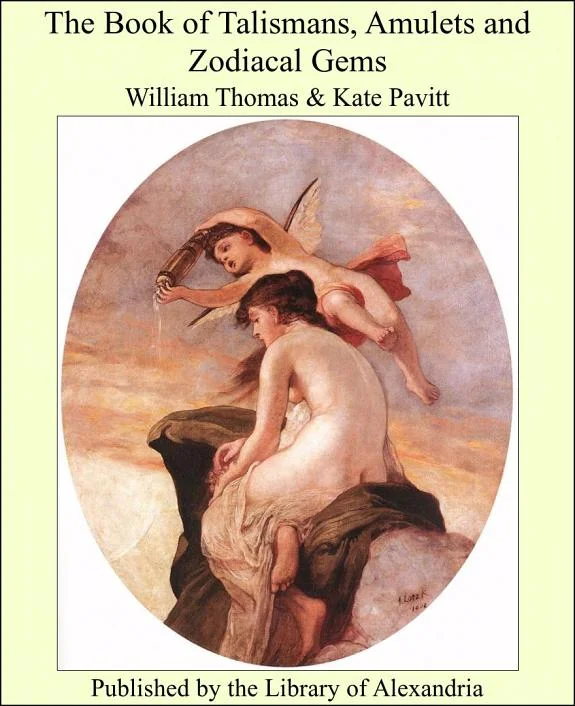
The Book of Talismans, Amulets and Zodiacal Gems
 72
72

The Book of Talismans, Amulets and Zodiacal Gems
William Thomas’s *The Book of Talismans, Amulets and Zodiacal Gems* offers a surprisingly thorough compendium of planetary and zodiacal correspondences for gem selection and talismanic construction. Its strength lies in the detailed, almost encyclopedic listing of specific gems, their associated virtues, and the precise astrological timings for their consecration. One particularly compelling section details theurgical preparations for creating a talisman for Jupiter, emphasizing specific metals and incantations. However, the work occasionally feels dry, more like a reference manual than a deeply engaging narrative, and its historical context, while present, could be further illuminated with more explicit engagement with contemporary occult thinkers beyond mere listing. It is a valuable, if somewhat academic, resource for the serious practitioner.
📝 Description
72
### What It Is The Book of Talismans, Amulets and Zodiacal Gems by William Thomas presents a systematic exploration of ancient and medieval practices concerning the creation and use of enchanted objects. It details the correspondences between celestial bodies, gemstones, metals, plants, and specific sigils, all intended to imbue talismans and amulets with particular influences and powers. The work focuses on the operational aspects, outlining the precise rituals, timings, and materials required for efficacy, drawing heavily from Grimoire traditions and astrological lore prevalent in its time.
### Who It's For This text is intended for serious students of ceremonial magic, historical occultism, and gemology with an esoteric bent. Those interested in the practical application of astrological principles to object creation will find substantial material. It appeals to researchers of Western Esotericism, practitioners seeking to understand the historical underpinnings of modern talismanic work, and collectors of rare magical texts.
### Historical Context Published in the early 20th century, likely around 1902 based on similar works, Thomas's book emerged during a period of intense revival and academic interest in magic and occultism. This era saw figures like Aleister Crowley and the Hermetic Order of the Golden Dawn actively reconstructing and practicing ceremonial magic. Thomas's work contributes to this milieu by codifying existing knowledge, potentially drawing from earlier texts like the Picatrix and Agrippa's *De Occulta Philosophia*. It reflects a broader cultural fascination with ancient wisdom and its potential application in modern life, contrasting with the purely rationalist scientific outlook.
### Key Concepts The core of the book lies in the concept of sympathetic magic, where objects are imbued with specific virtues by aligning them with planetary and zodiacal forces at opportune astrological moments. This includes the selection of appropriate gems, metals, and incantations corresponding to the desired outcome, whether for protection, influence, or other magical purposes. The work emphasizes the importance of the practitioner's intent and the proper execution of ritual to activate these latent powers.
💡 Why Read This Book?
• Learn the specific astrological timings and materials required to consecrate talismans for Jovian influence, as detailed in the book's sections on planetary magic. • Understand the precise correspondences between zodiacal signs and specific gemstones, a core tenet of the book's gemological system. • Discover the historical lineage of talismanic practices by examining Thomas's reliance on earlier occult texts, providing context for early 20th-century magical revival.
⭐ Reader Reviews
Honest opinions from readers who have explored this book.
❓ Frequently Asked Questions
What is the primary purpose of talismans and amulets discussed in William Thomas's book?
The book explains that talismans and amulets are created to harness specific planetary and zodiacal influences, imbuing them with virtues for protection, success, or other desired magical outcomes through precise rituals and material correspondences.
Which historical occult texts likely influenced 'The Book of Talismans, Amulets and Zodiacal Gems'?
Thomas's work likely draws upon earlier grimoires and magical treatises such as the Picatrix and Heinrich Cornelius Agrippa's *De Occulta Philosophia*, reflecting the foundational texts of Western ceremonial magic.
Does the book provide instructions for creating talismans for specific planets?
Yes, the book details the process for creating talismans associated with various planets, including specific metals, gemstones, incantations, and the critical astrological timings for their consecration.
What is the significance of zodiacal gems according to William Thomas?
Zodiacal gems are presented as conduits for celestial energies. The book outlines how selecting and consecrating gems aligned with specific zodiacal signs and planetary influences can yield particular magical effects.
Is this book suitable for beginners in occult studies?
While informative, the book's detailed nature and reliance on established esoteric concepts make it more suitable for intermediate to advanced students of ceremonial magic or historical occultism.
When was 'The Book of Talismans, Amulets and Zodiacal Gems' likely published?
Based on its content and the historical period of occult revival it belongs to, the book is estimated to have been published around the turn of the 20th century, likely circa 1902.
🔮 Key Themes & Symbolism
Planetary and Zodiacal Correspondences
The central theme is the intricate system of correspondences linking planets, zodiacal signs, gemstones, metals, and even days of the week. Thomas meticulously details how specific celestial configurations are believed to influence earthly matters and how these influences can be captured and directed through specially prepared objects. The work emphasizes that the efficacy of a talisman relies on aligning its components—such as a ruby for Mars or an emerald for Jupiter—with the correct planetary hour and astrological aspects, a practice rooted in Hellenistic and medieval magical traditions.
Talismanic Construction and Consecration
This theme focuses on the practical 'how-to' of creating enchanted objects. Thomas provides detailed instructions for the physical creation of talismans and amulets, including the necessary tools, materials, and the crucial ritualistic consecration process. This involves not only the correct astrological timing but also specific prayers, invocations, and the engraving of sigils or images onto the object, often using metals consecrated under the appropriate planetary influence, drawing from the operational magic found in classical grimoires.
Theurgical Application of Gems
Beyond mere adornment, the book posits gems as potent conduits for divine or celestial power. Each stone is presented with its unique virtues and sympathies, dictating its use in specific magical operations. For instance, certain gems are recommended for invoking protection, others for attracting wealth or influencing relationships. The underlying principle is the gem's ability to act as a focal point for specific energies, amplified through ritual and astrological alignment, making it a key component in the practitioner's toolkit.
Historical Grimoire Traditions
The work stands as a product of, and contributor to, the revival of interest in historical grimoires and ceremonial magic. Thomas synthesizes and presents knowledge derived from earlier, often obscure, magical texts. His approach reflects a desire to codify and make accessible the complex magical systems that were being rediscovered and practiced by occult organizations in the late 19th and early 20th centuries, linking contemporary practices to a long-standing esoteric lineage.
💬 Memorable Quotes
“The virtue of a gem is largely dependent upon the planet to which it is assigned.”
— This statement underscores the core astrological principle of sympathetic magic presented in the book: that the power of a gemstone is not intrinsic but derived from its celestial rulers and their corresponding influences.
“Particular care must be taken in the selection of the metal.”
— This highlights the operational aspect of talismanic creation, emphasizing that the base material (e.g., gold for the Sun, silver for the Moon) is as critical as the gem itself in establishing the correct energetic foundation for the enchantment.
“The correct hour for consecration is paramount.”
— This points to the vital role of astrological timing, specifically planetary hours, in the ritualistic activation of talismans, suggesting that performing the rite at the wrong time would render the object inert or even counterproductive.
“Engrave upon the talisman the symbol of the desired celestial power.”
— This refers to the practice of inscribing specific sigils or symbols onto the talismanic object, serving as a direct representation and invocation of the planetary or zodiacal force intended to be channeled.
“Amulets offer protection against malevolent influences.”
— This succinctly defines the protective function of amulets within the book's framework, attributing their power to their ability to ward off negative energies through their specific construction and energetic properties.
🌙 Esoteric Significance
Tradition
This work is firmly rooted in the Western Hermetic and Ceremonial Magic tradition, drawing heavily on Neoplatonic and astrological principles that have informed esoteric thought since antiquity. It synthesizes elements found in Renaissance magical texts and later grimoire literature, presenting a system of sympathetic magic. Thomas’s approach aligns with the operational magic favored by practitioners seeking to directly influence the material world through celestial correspondences and ritual, a lineage traceable through figures like Agrippa and Dee.
Symbolism
Key symbols include the specific planetary sigils (e.g., the symbol for Jupiter, often a variation of the cross and crescent) which are meant to be engraved onto talismans to invoke that planet's power. Gemstones themselves function as potent symbols; for instance, the emerald symbolizes Venus and is associated with love and harmony, while the ruby represents Mars and signifies courage and action. The astrological symbols of the zodiac also serve as foundational motifs, representing archetypal energies that can be harnessed.
Modern Relevance
Contemporary practitioners of ceremonial magic and astrological workings continue to reference Thomas's work for its detailed correspondences and operational instructions. Modern authors on talismanic magic often cite or adapt the principles outlined herein. It remains a valuable resource for those exploring historical magical practices, particularly within traditions that emphasize astrological potency and the use of enchanted objects, such as certain branches of modern Wicca and neo-paganism that engage with Western esoteric history.
👥 Who Should Read This Book
• Aspiring ceremonial magicians seeking to understand the historical basis for talismanic construction and astrological timing. • Gemologists with an esoteric interest who wish to explore the magical and symbolic properties attributed to gemstones across traditions. • Researchers of Western Esotericism interested in the practical application of astrological principles and grimoire magic during the early 20th century.
📜 Historical Context
William Thomas's *The Book of Talismans, Amulets and Zodiacal Gems* emerged during the vibrant occult revival of the late 19th and early 20th centuries. This period, marked by the rise of figures like Madame Blavatsky and the Hermetic Order of the Golden Dawn, saw a resurgence of interest in Western esotericism, ceremonial magic, and ancient mystical traditions. Thomas's work fits within this milieu, codifying and synthesizing knowledge from earlier, foundational texts such as Heinrich Cornelius Agrippa's *De Occulta Philosophia* (published 1531-1533) and potentially the *Picatrix*, a 12th-century Arabic treatise on astrological magic. While rationalism dominated mainstream thought, a significant counter-current explored alternative spiritual and magical systems. Thomas's book provided a practical guide for practitioners seeking to engage with these forces, contrasting with the more theoretical or philosophical approaches of some contemporaries. Its reception likely contributed to the growing body of literature available to those exploring these esoteric paths, though specific critical reviews or academic citations from the era are scarce.
📔 Journal Prompts
The planetary hour for Jupiter: what specific virtues does Thomas associate with its consecration?
Reflect on the symbolism of the emerald as described by William Thomas.
Consider the astrological correspondences for Mars; how might these be applied practically?
Analyze the importance of engraving sigils according to the book's instructions.
The relationship between zodiacal gems and personal astrological charts.
🗂️ Glossary
Talisman
An object, typically inscribed with symbols, that is believed to possess specific magical properties and is used to attract or repel certain influences or energies.
Amulet
An object worn for protection against evil, danger, or disease; in this context, often overlapping with talismans in function and construction.
Zodiacal Gem
A gemstone whose properties and efficacy are believed to be aligned with one of the twelve signs of the zodiac and its ruling celestial bodies.
Planetary Hour
A period within a 24-hour cycle assigned to one of the seven classical planets, believed to be imbued with that planet's specific energies and influences.
Sigil
A magically charged symbol, often derived from astrological or alchemical sources, used to represent and invoke a specific entity, force, or intention.
Consecration
The ritualistic process of dedicating an object, such as a talisman, to a specific purpose or divine/celestial power, often involving prayers, incantations, and astrological timing.
Sympathetic Magic
A form of magic based on the principle that like produces like, or that a cause affects its effect through a mystical connection, often involving the use of correspondences.